Health Equity Action Lab, Department of Infectious Disease Epidemiology, London School of Hygiene & Tropical Medicine, London, UK.
Department of Disease Control, London School of Hygiene & Tropical Medicine, London, UK.
BMJ Glob Health. 2021 Dec;6(12). doi: 10.1136/bmjgh-2021-006811.
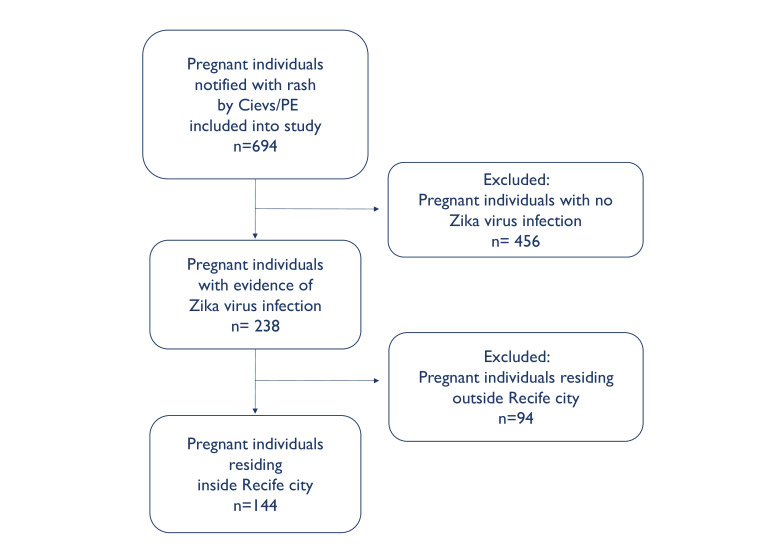
Zika virus (ZIKV) infections during pregnancy can lead to adverse neurodevelopmental and clinical outcomes in congenitally infected offspring. As the city of Recife in Pernambuco State, Brazil-the epicentre of the Brazilian microcephaly epidemic-has considerable disparities in living conditions, this study used an ecological approach to investigate the association between income at the neighbourhood level and the risk of ZIKV infections in pregnant individuals between December 2015 and April 2017. The spatial distribution of pregnant individuals with ZIKV infection was plotted on a map of Recife stratified into four categories based on mean monthly income of household heads. Additionally, a Poisson regression model with robust variance was fitted to compare proportions of ZIKV infections among pregnant individuals in relation to the mean monthly income of household heads, based on the 2010 census data, across 94 neighbourhoods in Recife. The results provide evidence that the risk of ZIKV infection to pregnant individuals was higher among those residing in lower-income neighbourhoods: relative to neighbourhoods that had a mean monthly income of ≥5 times minimum wage, neighbourhoods with <1 and 1 to <2 times minimum wage had more than four times the risk (incidence rate ratio, 95% CI 4.08, 1.88 to 8.85 and 4.30, 2.00 to 9.20, respectively). This study provides evidence of a strong association between neighbourhood-level income and ZIKV infection risks in the pregnant population of Recife. In settings prone to arboviral outbreaks, locally targeted interventions to improve living conditions, sanitation, and mosquito control should be a key focus of governmental interventions to reduce risks associated with ZIKV infections during pregnancy.
寨卡病毒(ZIKV)感染孕妇可导致先天感染胎儿出现不良神经发育和临床结局。巴西伯南布哥州累西腓市是巴西小头症疫情的中心,该城市各社区的生活条件存在显著差异。因此,本研究采用生态方法,于 2015 年 12 月至 2017 年 4 月期间,调查了社区层面的收入与 ZIKV 感染孕妇风险之间的关系。将感染寨卡病毒的孕妇的空间分布绘制在累西腓地图上,该地图根据家庭户主的月平均收入分为四个类别。此外,根据 2010 年人口普查数据,在累西腓的 94 个社区中,使用泊松回归模型(稳健方差)比较了不同家庭户主月平均收入与 ZIKV 感染孕妇比例之间的关系。结果表明,低收入社区孕妇感染寨卡病毒的风险更高:与月平均收入≥5 倍最低工资的社区相比,月平均收入<1 倍最低工资和 1-2 倍最低工资的社区感染风险分别高出四倍以上(发病率比,95%置信区间 4.08,1.88 至 8.85 和 4.30,2.00 至 9.20)。本研究为社区层面的收入与累西腓孕妇寨卡病毒感染风险之间存在较强关联提供了证据。在容易发生虫媒病毒爆发的地区,改善生活条件、卫生和蚊虫控制的地方针对性干预措施应成为政府减少孕妇感染寨卡病毒风险相关干预措施的重点。