Power Grace M, Vaughan Aisling M, Qiao Luxi, Sanchez Clemente Nuria, Pescarini Julia M, Paixão Enny S, Lobkowicz Ludmila, Raja Amber I, Portela Souza André, Barreto Mauricio Lima, Brickley Elizabeth B
Health Equity Action Lab, Department of Infectious Disease Epidemiology, London School of Hygiene & Tropical Medicine, London, UK.
Department of Disease Control, London School of Hygiene & Tropical Medicine, London, UK.
BMJ Glob Health. 2022 Apr;7(4). doi: 10.1136/bmjgh-2021-007735.
Arthropod-borne viruses (arboviruses) are of notable public health importance worldwide, owing to their potential to cause explosive outbreaks and induce debilitating and potentially life-threatening disease manifestations. This systematic review and meta-analysis aims to assess the relationship between markers of socioeconomic position (SEP) and infection due to arboviruses with mosquito vectors.
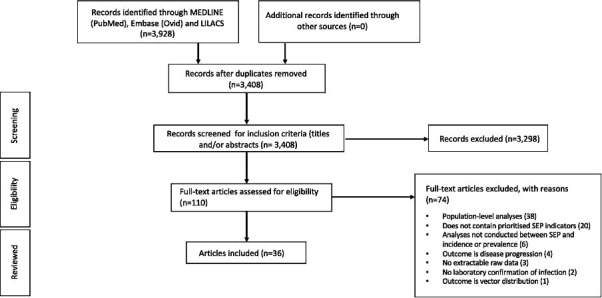
We conducted a systematic search on PubMed, Embase, and LILACS databases to identify studies published between 1980 and 2020 that measured the association of SEP markers with arbovirus infection. We included observational studies without geographic location or age restrictions. We excluded studies from grey literature, reviews and ecological studies. Study findings were extracted and summarised, and pooled estimates were obtained using random-effects meta-analyses.
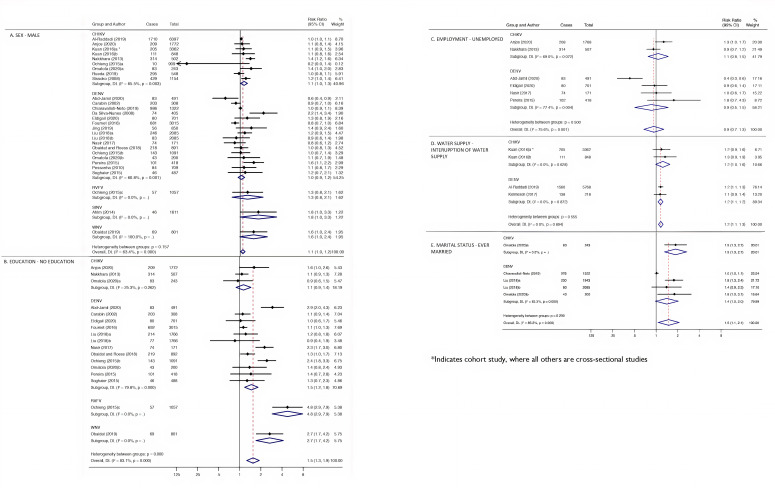
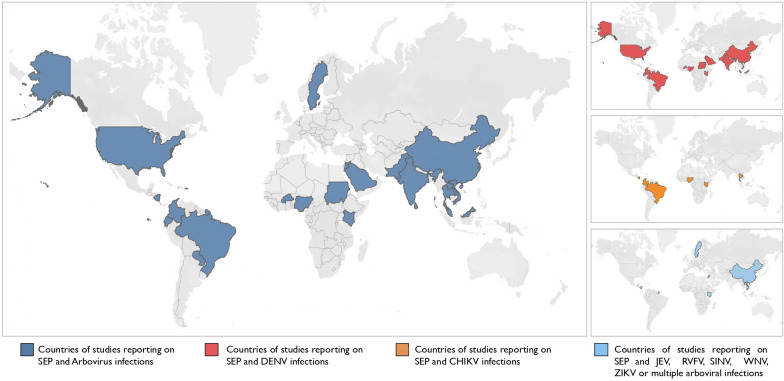
We identified 36 observational studies using data pertaining to 106 524 study participants in 23 geographic locations that empirically examined the relationship between socioeconomic factors and infections caused by seven arboviruses (dengue, chikungunya, Japanese encephalitis, Rift Valley fever, Sindbis, West Nile and Zika viruses). While results were varied, descriptive synthesis pointed to a higher risk of arbovirus infection associated with markers of lower SEP, including lower education, income poverty, low healthcare coverage, poor housing materials, interrupted water supply, marital status (married, divorced or widowed), non-white ethnicities and migration status. Pooled crude estimates indicated an increased risk of arboviral infection associated with lower education (risk ratio, RR 1.5 95% CI 1.3 to 1.9); I=83.1%), interruption of water supply (RR 1.2; 95% CI 1.1 to 1.3; I=0.0%) and having been married (RR 1.5 95% CI 1.1 to 2.1; I=85.2%).
Evidence from this systematic review suggests that lower SEP increases the risk of acquiring arboviral infection; however, there was large heterogeneity across studies. Further studies are required to delineate the relationship between specific individual, household and community-level SEP indicators and arbovirus infection risks to help inform targeted public health interventions.
CRD42019158572.
节肢动物传播病毒(虫媒病毒)在全球范围内对公众健康具有重大意义,因为它们有可能引发爆发性疫情,并导致使人衰弱甚至危及生命的疾病表现。本系统评价和荟萃分析旨在评估社会经济地位(SEP)指标与蚊媒传播的虫媒病毒感染之间的关系。
我们在PubMed、Embase和LILACS数据库中进行了系统检索,以识别1980年至2020年间发表的测量SEP指标与虫媒病毒感染关联的研究。我们纳入了无地理位置或年龄限制的观察性研究。我们排除了灰色文献、综述和生态学研究。提取并总结研究结果,使用随机效应荟萃分析获得合并估计值。
我们识别出36项观察性研究,这些研究使用了来自23个地理位置的106524名研究参与者的数据,实证检验了社会经济因素与七种虫媒病毒(登革热、基孔肯雅热、日本脑炎、裂谷热、辛德毕斯病毒、西尼罗河病毒和寨卡病毒)感染之间的关系。虽然结果各不相同,但描述性综合分析表明,SEP较低的指标与虫媒病毒感染风险较高相关,包括教育程度较低、收入贫困、医疗保健覆盖率低、住房材料差、供水中断、婚姻状况(已婚、离婚或丧偶)、非白人种族和移民身份。合并的粗略估计值表明,教育程度较低(风险比,RR 1.5;95%置信区间1.3至1.9;I=83.1%)、供水中断(RR 1.2;95%置信区间1.1至1.3;I=0.0%)和已婚(RR 1.5;95%置信区间1.1至2.1;I=85.2%)与虫媒病毒感染风险增加相关。
本系统评价的证据表明,SEP较低会增加感染虫媒病毒的风险;然而,各研究之间存在很大异质性。需要进一步研究来阐明特定的个人、家庭和社区层面SEP指标与虫媒病毒感染风险之间的关系,以帮助为有针对性的公共卫生干预措施提供信息。
PROSPERO注册号:CRD42019158572。