
产前多普勒超声对中低收入国家不良围产结局的预测准确性:系统评价。
Prognostic accuracy of antenatal Doppler ultrasound for adverse perinatal outcomes in low-income and middle-income countries: a systematic review.
机构信息
Ernest Cook Ultrasound Research and Education Institute (ECUREI), Kampala, Uganda
Julius Global Health, Julius Center for Health Sciences and Primary Care, University Medical Center Utrecht, Utrecht University, Utrecht, The Netherlands.
出版信息
BMJ Open. 2021 Dec 2;11(12):e049799. doi: 10.1136/bmjopen-2021-049799.
OBJECTIVES
This systematic review examined available literature on the prognostic accuracy of Doppler ultrasound for adverse perinatal outcomes in low/middle-income countries (LMIC).
DESIGN
We searched PubMed, Embase, Cochrane Library and Scopus from inception to April 2020.
SETTING
Observational or interventional studies from LMICs.
PARTICIPANTS
Singleton pregnancies of any risk profile.
INTERVENTIONS
Umbilical artery (UA), middle cerebral artery (MCA), cerebroplacental ratio (CPR), uterine artery (UtA), fetal descending aorta (FDA), ductus venosus, umbilical vein and inferior vena cava.
PRIMARY AND SECONDARY OUTCOME MEASURES
Perinatal death, stillbirth, neonatal death, expedited delivery for fetal distress, meconium-stained amniotic fluid, low birth weight, fetal growth restriction, admission to neonatal intensive care unit, neonatal acidosis, Apgar scores, preterm birth, fetal anaemia, respiratory distress syndrome, length of hospital stay, birth asphyxia and composite adverse perinatal outcomes (CAPO).
RESULTS
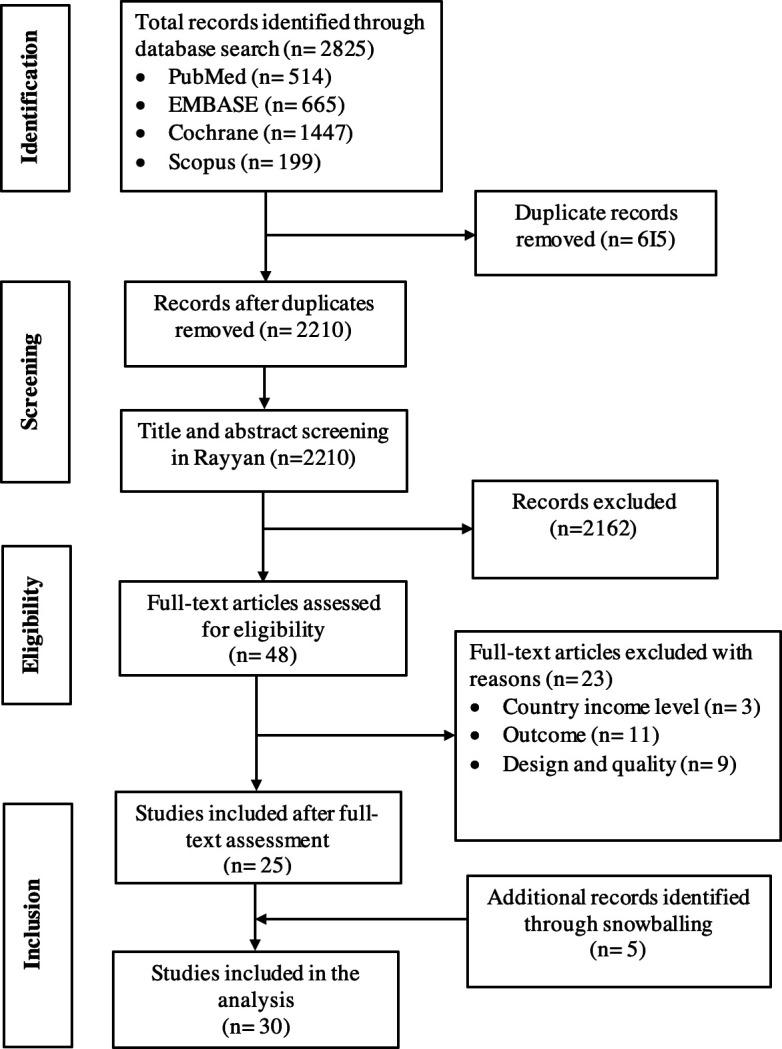
We identified 2825 records, and 30 (including 4977 women) from Africa (40.0%, n=12), Asia (56.7%, n=17) and South America (3.3%, n=01) were included. Many individual studies reported associations and promising predictive values of UA Doppler for various adverse perinatal outcomes mostly in high-risk pregnancies, and moderate to high predictive values of MCA, CPR and UtA Dopplers for CAPO. A few studies suggested that the MCA and FDA may be potent predictors of fetal anaemia. No randomised clinical trial (RCT) was found. Most studies were of suboptimal quality, poorly powered and characterised by wide variations in outcome classifications, the timing for the Doppler tests and study populations.
CONCLUSION
Local evidence to guide how antenatal Doppler ultrasound should be used in LMIC is lacking. Well-designed studies, preferably RCTs, are required. Standardisation of practice and classification of perinatal outcomes across countries, following the international standards, is imperative.
PROSPERO REGISTRATION NUMBER
CRD42019128546.
目的
本系统评价旨在探讨中低收入国家(LMIC)多普勒超声对不良围产结局的预测准确性的现有文献。
设计
我们检索了 PubMed、Embase、Cochrane 图书馆和 Scopus,检索时间截至 2020 年 4 月。
设置
来自 LMIC 的观察性或干预性研究。
参与者
任何风险特征的单胎妊娠。
干预措施
脐动脉(UA)、大脑中动脉(MCA)、胎盘血流比(CPR)、子宫动脉(UtA)、胎儿降主动脉(FDA)、静脉导管、脐静脉和下腔静脉。
主要和次要结局测量
围产儿死亡、死产、新生儿死亡、因胎儿窘迫加速分娩、羊水胎粪污染、低出生体重、胎儿生长受限、新生儿重症监护病房入院、新生儿酸中毒、阿普加评分、早产、胎儿贫血、呼吸窘迫综合征、住院时间、出生窒息和复合不良围产结局(CAPO)。
结果
我们共确定了 2825 条记录,其中来自非洲(40.0%,n=12)、亚洲(56.7%,n=17)和南美洲(3.3%,n=01)的 30 项研究(包括 4977 名女性)被纳入。许多单独的研究报告了 UA 多普勒对各种不良围产结局的关联和有希望的预测值,主要是在高危妊娠中,MCA、CPR 和 UtA 多普勒对 CAPO 有中等到高的预测值。一些研究表明,MCA 和 FDA 可能是胎儿贫血的有力预测指标。未发现随机临床试验(RCT)。大多数研究的质量较差,效力不足,且结局分类、多普勒检测时机和研究人群差异较大。
结论
缺乏指导中低收入国家如何使用产前多普勒超声的本地证据。需要进行精心设计的研究,最好是 RCT。至关重要的是,需要在各国遵循国际标准,对实践进行标准化,并对围产结局进行分类。
PROSPERO 注册号:CRD42019128546。

 Zotero 插件