Li Yunhao, Zheng Ningning, Ding Xudong
The First Clinical College, China Medical University, Shenyang, Liaoning, People's Republic of China.
Department of Pathophysiology, College of Basic Medical Science, China Medical University, Shenyang, Liaoning, People's Republic of China.
Diabetes Metab Syndr Obes. 2021 Nov 25;14:4631-4640. doi: 10.2147/DMSO.S336882. eCollection 2021.
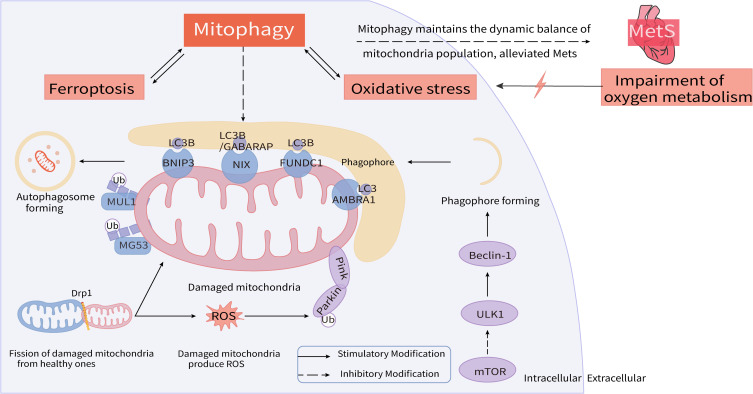
With overall food intake among the general population as high as ever, metabolic syndrome (MetS) has become a global epidemic and is responsible for many serious life-threatening diseases, especially heart failure. In multiple metabolic disorders, maintaining a dynamic balance of mitochondrial number and function is necessary to prevent the overproduction of reactive oxygen species (ROS), which has been proved to be one of the important mechanisms of cardiomyocyte injury due to the mismatching of oxygen consumption and mitochondrial population and finally to heart failure. Mitophagy is a process that eliminates damaged or redundant mitochondria. It is mediated by a series of signaling molecules, including PINK, parkin, BINP3, FUNDC1, CTSD, Drp1, Rab9 and mTOR. Meanwhile, increasing evidence also showed that the interaction between ferroptosis and mitophagy interfered with mitochondrial homeostasis. This review will focus on these essential molecules and pathways of mitophagy and cell homeostasis affected by hypoxia and other stimuli in metabolic heart diseases.
随着普通人群的总体食物摄入量达到前所未有的高度,代谢综合征(MetS)已成为一种全球流行病,并引发了许多严重的危及生命的疾病,尤其是心力衰竭。在多种代谢紊乱中,维持线粒体数量和功能的动态平衡对于防止活性氧(ROS)的过度产生是必要的,由于氧消耗与线粒体数量不匹配,ROS已被证明是心肌细胞损伤并最终导致心力衰竭的重要机制之一。线粒体自噬是一个消除受损或多余线粒体的过程。它由一系列信号分子介导,包括PINK、帕金、BINP3、FUNDC1、CTSD、Drp1、Rab9和mTOR。与此同时,越来越多的证据还表明,铁死亡与线粒体自噬之间的相互作用会干扰线粒体稳态。本综述将聚焦于代谢性心脏病中受缺氧和其他刺激影响的线粒体自噬及细胞稳态的这些关键分子和途径。