Glitscher Mirco, Hildt Eberhard
Department of Virology, Paul-Ehrlich-Institute, Langen, Germany.
Front Physiol. 2021 Nov 11;12:750544. doi: 10.3389/fphys.2021.750544. eCollection 2021.
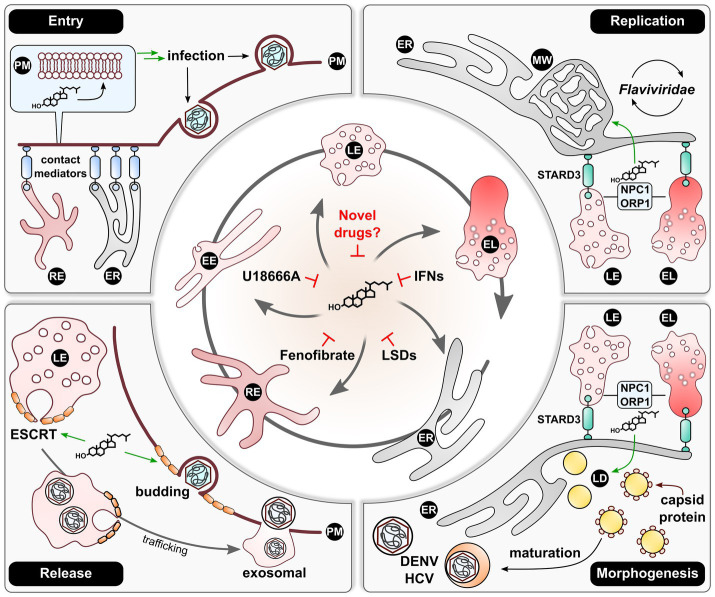
Cholesterol has gained tremendous attention as an essential lipid in the life cycle of virtually all viruses. These seem to have developed manifold strategies to modulate the cholesterol metabolism to the side of lipid uptake and synthesis. In turn, affecting the cholesterol homeostasis has emerged as novel broad-spectrum antiviral strategy. On the other hand, the innate immune system is similarly regulated by the lipid and stimulated by its derivatives. This certainly requires attention in the design of antiviral strategies aiming to decrease cellular cholesterol, as evidence accumulates that withdrawal of cholesterol hampers innate immunity. Secondly, there are exceptions to the rule of the abovementioned virus-induced metabolic shift toward cholesterol anabolism. It therefore is of interest to dissect underlying regulatory mechanisms, which we aimed for in this minireview. We further collected evidence for intracellular cholesterol concentrations being less important in viral life cycles as compared to the spatial distribution of the lipid. Various routes of cholesterol trafficking were found to be hijacked in viral infections with respect to organelle-endosome contact sites mediating cholesterol shuttling. Thus, re-distribution of cellular cholesterol in the context of viral infections requires more attention in ongoing research. As a final aim, a pan-antiviral treatment could be found just within the transport and re-adjustment of local cholesterol concentrations. Thus, we aimed to emphasize the importance of the regulatory roles the endosomal system fulfils herein and hope to stimulate research in this field.
胆固醇作为几乎所有病毒生命周期中一种必需的脂质,已受到极大关注。这些病毒似乎已开发出多种策略,将胆固醇代谢调节至脂质摄取和合成方面。反过来,影响胆固醇稳态已成为一种新型的广谱抗病毒策略。另一方面,先天免疫系统同样受脂质调节并由其衍生物刺激。鉴于越来越多的证据表明胆固醇的减少会阻碍先天免疫,在设计旨在降低细胞胆固醇的抗病毒策略时,这一点无疑需要关注。其次,上述病毒诱导的代谢向胆固醇合成转变的规律也有例外情况。因此,剖析潜在的调控机制很有意义,这也是本综述的目的所在。我们还收集了证据,表明与脂质的空间分布相比,细胞内胆固醇浓度在病毒生命周期中不太重要。在介导胆固醇穿梭的细胞器 - 内体接触位点方面,发现病毒感染会劫持各种胆固醇运输途径。因此,在正在进行的研究中,病毒感染情况下细胞胆固醇的重新分布需要更多关注。作为最终目标,也许可以在局部胆固醇浓度的运输和重新调节过程中找到一种泛抗病毒治疗方法。因此,我们旨在强调内体系统在此所发挥的调控作用的重要性,并希望能激发该领域的研究。