Zhang Chi, Zeng Ping, Tan Joshua, Sun Siwei, Zhao Minghao, Cui Ju, Zhang Guifang, Jia Jinzhong, Liu Deping
The Key Laboratory of Geriatrics, Beijing Institute of Geriatrics, Institute of Geriatric Medicine, Chinese Academy of Medical Sciences, Beijing Hospital, National Center of Gerontology of National Health Commission, Beijing, China.
School of Basic Medicine, Peking University Health Science Center, Beijing, China.
Front Psychiatry. 2021 Nov 10;12:755059. doi: 10.3389/fpsyt.2021.755059. eCollection 2021.
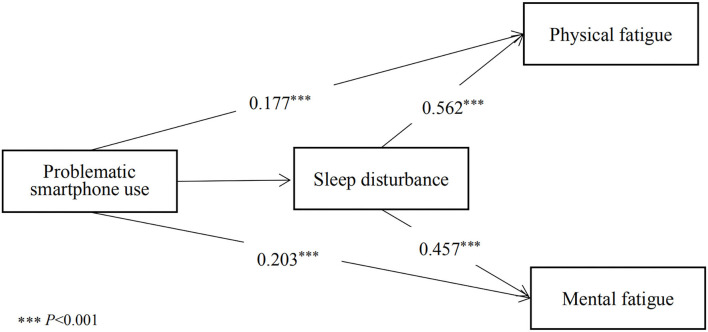
The COVID-19 pandemic brought about great transformation to medical education mode. Although mobile communication devices played a crucial role in online learning among quarantined university students, the potential smartphone addition problems, negative health behaviors, and psychological symptoms need considerable attention. This study examined the relationship of problematic smartphone use (PSU), sleep quality, and daytime fatigue among medical students. A web-based survey was conducted in six polyclinic hospitals in Beijing between February and May 2020. 1016 participants (26.01 ± 2.46 years, 65.16% female) completed self-report measurements including Short Version Smartphone Addiction Scale (SAS-SV), Athens Insomnia Scale (AIS), and Subjective Fatigue Scale (FS). Spearman correlation coefficients and multiple regression models were used to analyze the association among PSU, sleep quality, and daytime fatigue. We used structural equation modeling to test the mediating effect of sleep quality between PSU and daytime fatigue. 49.70% of the participants had PSU. Significant positive correlations were found among SAS-SV, AIS, and FS scores ( = 0.35-0.61, < 0.001). Subjects with PSU were more likely to report sleep disturbance (β = 1.07, < 0.001, OR = 2.91, 95%CI = 2.17-3.91), physical fatigue (β = 1.16, < 0.001, OR = 3.18, 95%CI = 2.45-4.15), and mental fatigue (β = 0.88, < 0.001, OR = 2.42, 95%CI = 1.86-3.14). The indirect effect of PSU on physical fatigue and mental fatigue mediated by sleep quality accounted for 50.03 and 45.43% of the total effect, respectively. PSU was significantly associated with sleep disturbance and fatigue among medical students during the COVID-19 pandemic. Sleep quality mediated the relationship between PSU and daytime fatigue. Our results provide valuable information for maintaining medical students' health status and constructing online education structures.
新型冠状病毒肺炎疫情给医学教育模式带来了巨大变革。尽管移动通信设备在隔离大学生的在线学习中发挥了关键作用,但潜在的智能手机成瘾问题、负面健康行为和心理症状需要引起相当的关注。本研究调查了医学生中问题性智能手机使用(PSU)、睡眠质量和日间疲劳之间的关系。2020年2月至5月间,在北京的6家综合医院开展了一项基于网络的调查。1016名参与者(年龄26.01±2.46岁,65.16%为女性)完成了自我报告测量,包括简版智能手机成瘾量表(SAS-SV)、雅典失眠量表(AIS)和主观疲劳量表(FS)。采用Spearman相关系数和多元回归模型分析PSU、睡眠质量和日间疲劳之间的关联。我们使用结构方程模型来检验睡眠质量在PSU和日间疲劳之间的中介作用。49.70%的参与者存在PSU。SAS-SV、AIS和FS得分之间存在显著正相关(=0.35-0.61,<0.001)。存在PSU的受试者更有可能报告睡眠障碍(β=1.07,<0.001,OR=2.91,95%CI=2.17-3.91)、身体疲劳(β=1.16,<0.001,OR=3.18,95%CI=2.45-4.15)和精神疲劳(β=0.88,<0.001,OR=2.42,95%CI=1.86-3.14)。由睡眠质量介导的PSU对身体疲劳和精神疲劳的间接效应分别占总效应的50.03%和45.43%。在新型冠状病毒肺炎疫情期间,PSU与医学生的睡眠障碍和疲劳显著相关。睡眠质量介导了PSU和日间疲劳之间的关系。我们的结果为维持医学生的健康状况和构建在线教育结构提供了有价值的信息。