Wagner Anne C
Remedy, Toronto, ON, Canada.
Front Psychol. 2021 Nov 11;12:733456. doi: 10.3389/fpsyg.2021.733456. eCollection 2021.
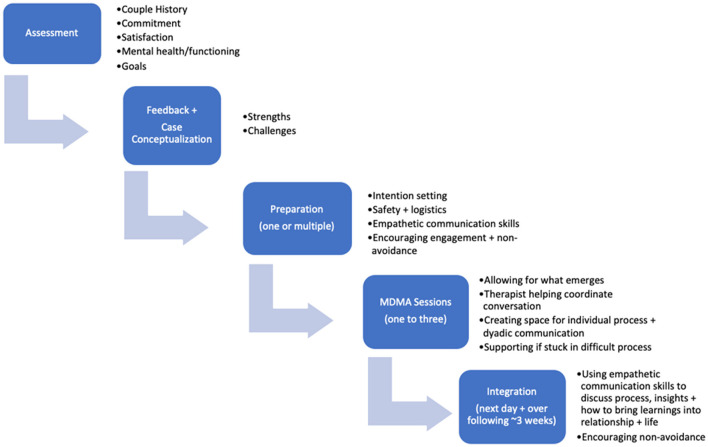
MDMA's first identified potential as a therapeutic catalyst was for couple therapy. Early work in the 1970s and 1980s explored its potential amongst seasoned psychotherapists and their clients. With the completion of the first pilot trial of MDMA-assisted psychotherapy with couples for PTSD, and as the possibility of conducting MDMA-assisted psychotherapy trials expands due to new regulatory frameworks, we have an opportunity to explore and investigate how and why MDMA-assisted couples therapy works. This theoretical paper will explore the neurobiological and neurochemical effects of MDMA in a relational context, the emotional, behavioral, cognitive and somatic effects within a dyadic frame, and how empathy, communication, perception of social connection/support, non-avoidance, openness, attachment/safety, bonding/social intimacy and relationship satisfaction, are all impacted by MDMA, and can be harnessed to facilitate systems-level and interpersonal healing and growth. A model to support MDMA-assisted couple therapy is introduced, and future directions, including implications for intervention development and delivery, will be elucidated.
摇头丸首次被确定具有作为治疗催化剂的潜力是在夫妻治疗方面。20世纪70年代和80年代的早期研究探索了其在经验丰富的心理治疗师及其客户中的潜力。随着针对创伤后应激障碍(PTSD)的夫妻摇头丸辅助心理治疗首次试点试验的完成,并且由于新的监管框架,进行摇头丸辅助心理治疗试验的可能性不断扩大,我们有机会探索和研究摇头丸辅助夫妻治疗的作用方式及原因。这篇理论性论文将探讨摇头丸在人际关系背景下的神经生物学和神经化学作用、二元框架内的情绪、行为、认知和躯体影响,以及共情、沟通、对社会联系/支持的感知、不回避、开放、依恋/安全感、联结/社会亲密感和关系满意度如何都受到摇头丸的影响,并可被利用来促进系统层面和人际层面的治愈与成长。本文介绍了一个支持摇头丸辅助夫妻治疗的模型,并阐明了未来的方向,包括对干预开发和实施的影响。