Department of Infectious Diseases, Xiangya Hospital, Central South University, Changsha, China.
Hunan Key Laboratory of Viral Hepatitis, Xiangya Hospital, Central South University, Changsha, China.
Front Immunol. 2021 Nov 11;12:751533. doi: 10.3389/fimmu.2021.751533. eCollection 2021.
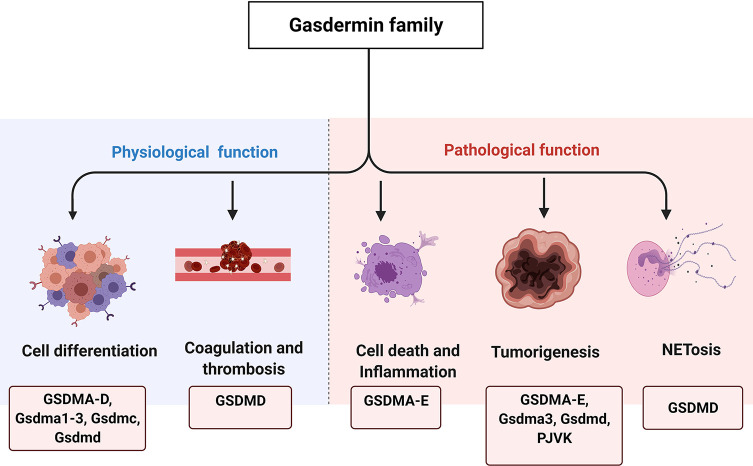
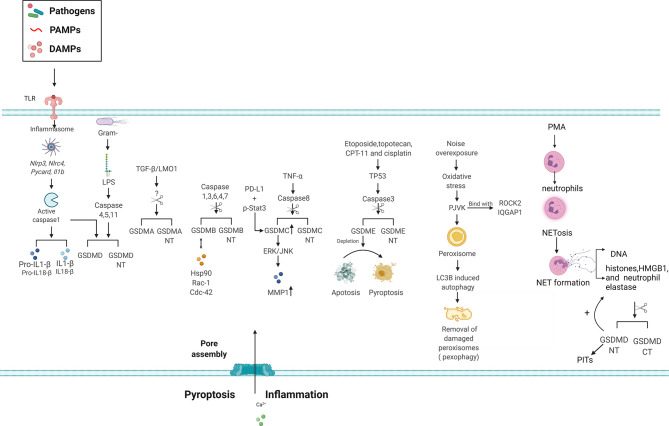
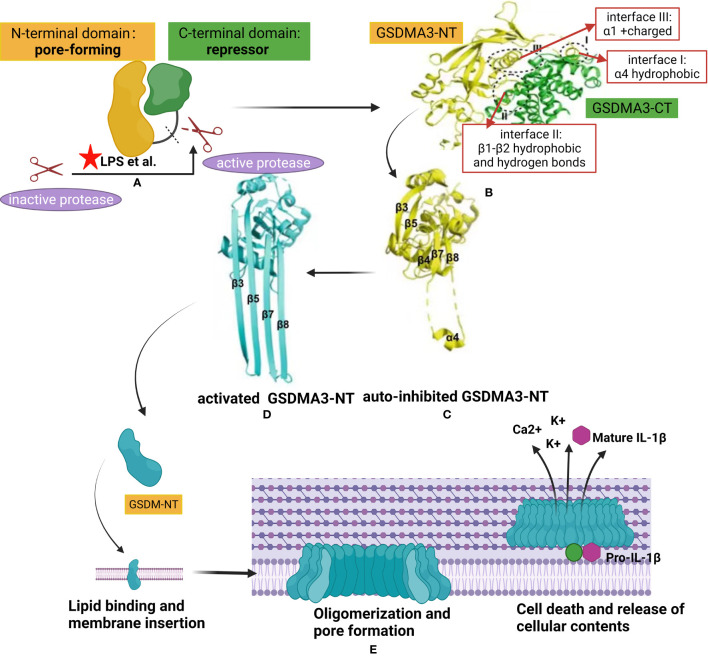
The gasdermin (GSDM) family, a novel group of structure-related proteins, consists of GSDMA, GSDMB, GSDMC, GSDMD, GSDME/DNFA5, and PVJK/GSDMF. GSDMs possess a C-terminal repressor domain, cytotoxic N-terminal domain, and flexible linker domain (except for GSDMF). The GSDM-NT domain can be cleaved and released to form large oligomeric pores in the membrane that facilitate pyroptosis. The emerging roles of GSDMs include the regulation of various physiological and pathological processes, such as cell differentiation, coagulation, inflammation, and tumorigenesis. Here, we introduce the basic structure, activation, and expression patterns of GSDMs, summarize their biological and pathological functions, and explore their regulatory mechanisms in health and disease. This review provides a reference for the development of GSDM-targeted drugs to treat various inflammatory and tissue damage-related conditions.
gasdermin (GSDM) 家族是一类新型结构相关蛋白,包含 GSDMA、GSDMB、GSDMC、GSDMD、GSDME/DNFA5 和 PVJK/GSDMF。GSDMs 具有 C 端抑制结构域、细胞毒性 N 端结构域和灵活的连接结构域(除 GSDMF 外)。GSDM-NT 结构域可被切割并释放,形成膜上的大寡聚体孔,从而促进细胞焦亡。GSDMs 的新兴作用包括调节多种生理和病理过程,如细胞分化、凝血、炎症和肿瘤发生。本文介绍了 GSDMs 的基本结构、激活和表达模式,总结了它们的生物学和病理学功能,并探讨了它们在健康和疾病中的调节机制。本文综述为开发针对 GSDM 的药物治疗各种炎症和组织损伤相关疾病提供了参考。