Fatkulina Natalja, Hendrixson Vaiva, Rauckiene-Michealsson Alona, Kievisiene Justina, Razbadauskas Arturas, Agostinis Sobrinho Cesar
Faculty of Medicine, Vilnius University, Vilnius, Lithuania.
Faculty of Health Sciences, Klaipeda University, Klaipeda, Lithuania.
Evid Based Complement Alternat Med. 2021 Nov 23;2021:4989282. doi: 10.1155/2021/4989282. eCollection 2021.
In this paper, we systematically review the evidence looking at the effect of dance/movement therapy (DMT) and mental health outcomes and quality of life in breast cancer patients.
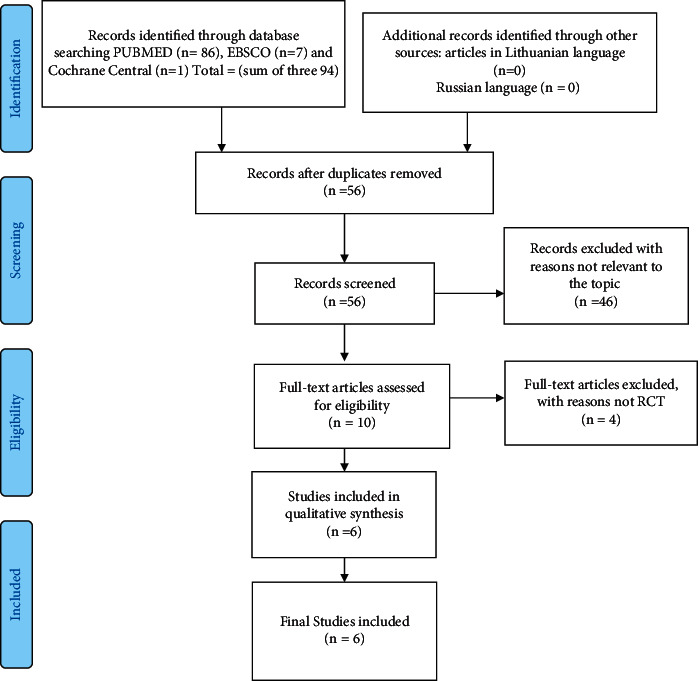
The literature search was done with the databases PubMed (MEDLINE), EBSCO, and Cochrane Central by using the following search words: "dancing/dance/movement therapy," "breast cancer/neoplasms/carcinoma/tumour" or "mammary cancer," "mental health," and "quality of life." Ninety-four articles were found. Only empirical interventional studies ( = 6) were selected for the review: randomised controlled trials (RCT) ( = 5) and non-RCT ( = 1). PRISMA guidelines were used.
Data from 6 studies including 385 participants who had been diagnosed with breast cancer, were of an average age of 55.7 years, and had participated in DMT programmes for 3-24 weeks were analysed. In each study, the main outcomes that were measured were quality of life, physical activity, stress, and emotional and social well-being. Different questionnaires were used for the evaluation of outcomes. The mental health of the participants who received DMT intervention improved: they reported a better quality of life and decreased stress, symptoms, and fatigue.
We found only six studies for review, and some had a small number of participants. However, our findings indicate that DMT could be successfully used as a complimentary therapy in addition to standard cancer treatment for improving the quality of life and mental health of women who have been diagnosed with breast cancer. More research is needed to evaluate the complexity of the impact of complimentary therapies. It is possible that DMT could be more effective if used with other therapies.
在本文中,我们系统地回顾了有关舞蹈/运动疗法(DMT)对乳腺癌患者心理健康结局和生活质量影响的证据。
通过使用以下检索词在PubMed(MEDLINE)、EBSCO和Cochrane Central数据库中进行文献检索:“舞蹈/舞蹈/运动疗法”、“乳腺癌/肿瘤/癌/瘤”或“乳癌”、“心理健康”以及“生活质量”。共找到94篇文章。仅选择实证性干预研究(=6项)进行综述:随机对照试验(RCT)(=5项)和非随机对照试验(=1项)。采用PRISMA指南。
分析了6项研究的数据,这些研究包括385名被诊断为乳腺癌的参与者,平均年龄为55.7岁,且参加了3至24周的DMT项目。在每项研究中,所测量的主要结局为生活质量、身体活动、压力以及情绪和社会幸福感。使用了不同的问卷来评估结局。接受DMT干预的参与者的心理健康状况有所改善:他们报告生活质量更好,压力、症状和疲劳有所减轻。
我们仅找到6项研究进行综述,且其中一些研究的参与者数量较少。然而,我们的研究结果表明,除了标准的癌症治疗外,DMT可成功用作辅助疗法,以改善被诊断为乳腺癌的女性的生活质量和心理健康。需要更多研究来评估辅助疗法影响的复杂性。如果与其他疗法联合使用,DMT可能会更有效。