Metabolomics and Cell Biology Platforms, Gustave Roussy Cancer Center, Université Paris Saclay, Villejuif, France.
Centre de Recherche des Cordeliers, Equipe Labellisée par la Ligue Contre le Cancer, Université de Paris, Sorbonne Université, Inserm U1138 and CNRS SNC 5096, Institut Universitaire de France, Paris, France.
Oncoimmunology. 2021 Nov 23;10(1):2005859. doi: 10.1080/2162402X.2021.2005859. eCollection 2021.
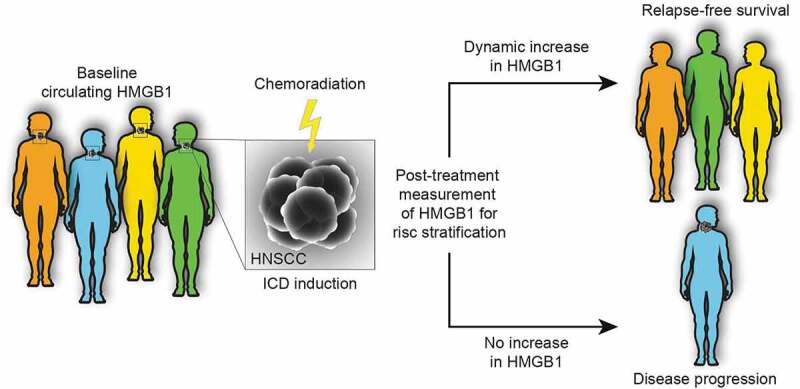
High mobility group B1 (HMGB1) is a protein that is released from dying cancer cells in the context of immunogenic cell death (ICD). A recent study performed on patients with head and neck squamous cell carcinomas (HNSCC) reports that a chemoradiotherapy-induced increase in circulating HMGB1 levels predicts favorable outcome, echoing prior studies on neoadjuvant treatment of breast and rectal cancer in which the dynamics of HMGB1 plasma levels also have prognostic value. Hence, a therapy-induced rise in HMGB1 may be interpreted as a clinical sign of ICD and therapeutic response.
高迁移率族蛋白 B1(HMGB1)是一种在免疫原性细胞死亡(ICD)情况下从死亡的癌细胞中释放出来的蛋白质。最近一项对头颈部鳞状细胞癌(HNSCC)患者进行的研究报告称,化疗诱导的循环 HMGB1 水平升高预示着良好的预后,这与之前关于新辅助治疗乳腺癌和直肠癌的研究结果相呼应,其中 HMGB1 血浆水平的动态变化也具有预后价值。因此,治疗诱导的 HMGB1 升高可被解释为 ICD 和治疗反应的临床标志。