Faculty of Medicine, University of Paris Sud, Kremlin-Bicetre, France.
Cell Biology and Metabolomics Platforms, Gustave Roussy Cancer Campus, Villejuif, France.
Sci Rep. 2017 Nov 2;7(1):14915. doi: 10.1038/s41598-017-14848-1.
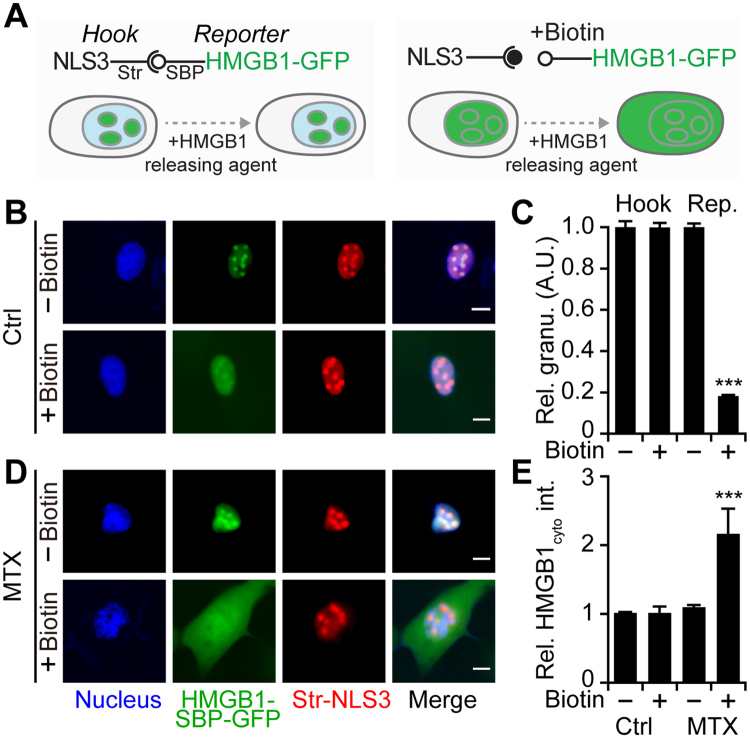
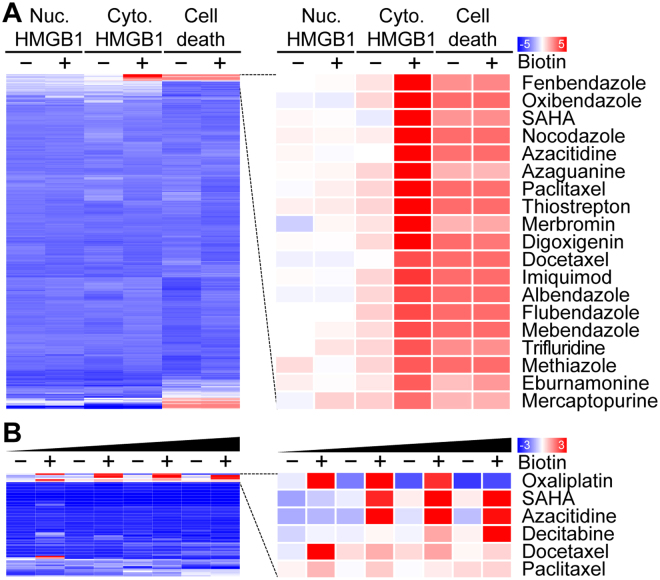
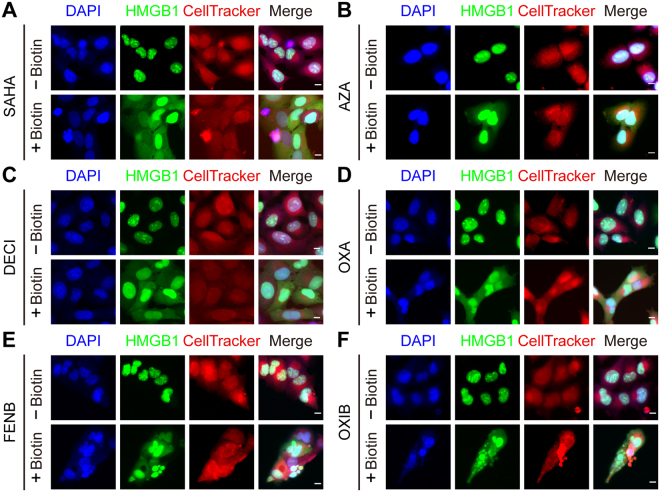
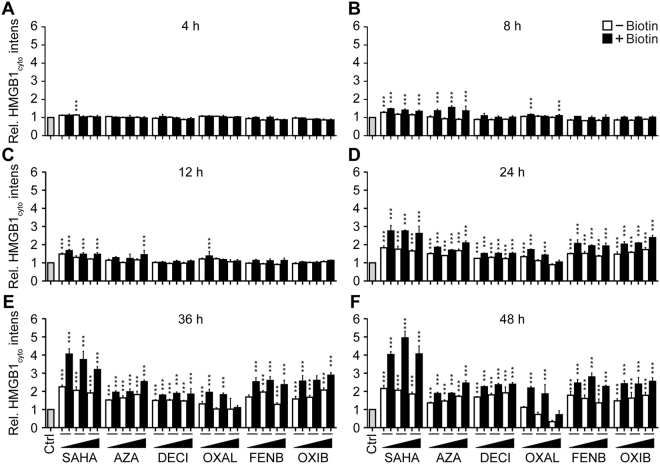
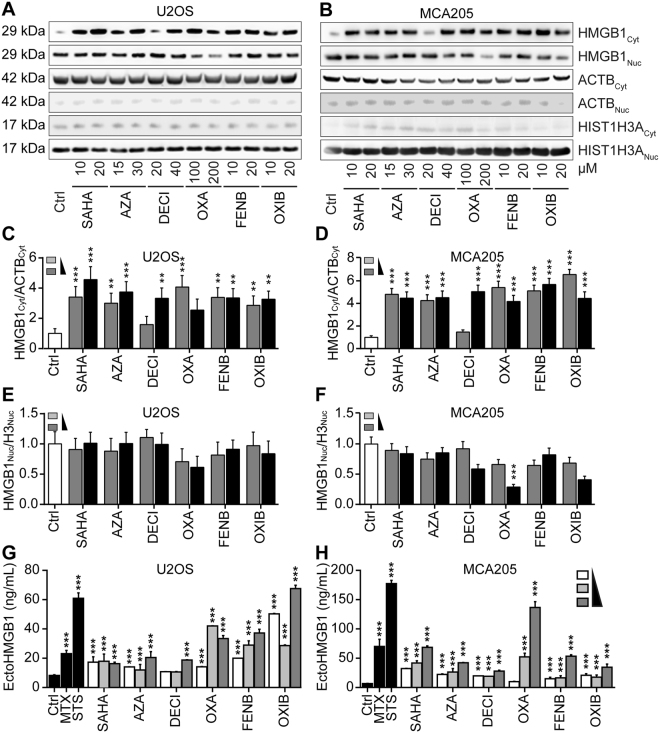
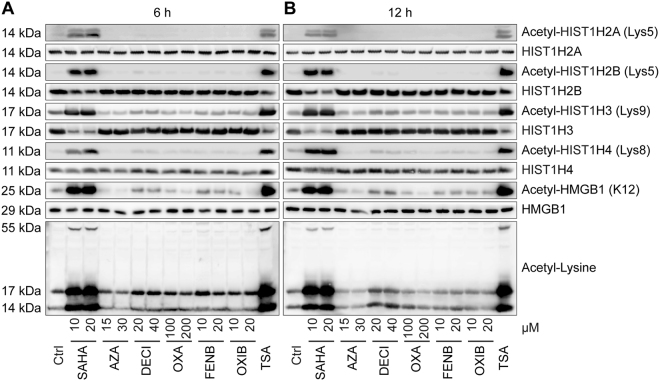
The translocation of the protein high mobility group box 1 (HMGB1) from the nucleus to the cytoplasm and its secretion or passive release through the permeabilized plasma membrane, constitutes a major cellular danger signal. Extracellular HMGB1 can interact with pattern recognition receptors to stimulate pro-inflammatory and immunostimulatory pathways. Here, we developed a screening assay to identify pharmacological agents endowed with HMGB1 releasing properties. For this, we took advantage of the "retention using selective hooks" (RUSH) system in which a streptavidin-NLS3 fusion protein was used as a nuclear hook to sequestrate streptavidin-binding peptide (SBP) fused with HMGB1 and green fluorescent protein (GFP). When combined with biotin, which competitively disrupts the interaction between streptavidin-NLS3 and HMGB1-SBP-GFP, immunogenic cell death (ICD) inducers such as anthracyclines were able to cause the nucleo-cytoplasmic translocation of HMGB1-SBP-GFP. This system, was used in a high-content screening (HCS) campaign for the identification of HMGB1 releasing agents. Hits fell into three functional categories: known ICD inducers, microtubule inhibitors and epigenetic modifiers. These agents induced ICD through a panoply of distinct mechanisms. Their effective action was confirmed by multiple methods monitoring nuclear, cytoplasmic and extracellular HMGB1 pools, both in cultured human or murine cells, as well as in mouse plasma.
蛋白质高迁移率族蛋白 B1(HMGB1)从细胞核到细胞质的易位,以及通过渗透的质膜的分泌或被动释放,构成了主要的细胞危险信号。细胞外 HMGB1 可以与模式识别受体相互作用,刺激促炎和免疫刺激途径。在这里,我们开发了一种筛选测定法来鉴定具有 HMGB1 释放特性的药理学制剂。为此,我们利用了“保留使用选择性钩子”(RUSH)系统,其中将链霉亲和素-NLS3 融合蛋白用作核钩子,以隔离与 HMGB1 和绿色荧光蛋白(GFP)融合的链霉亲和素结合肽(SBP)。当与竞争性破坏链霉亲和素-NLS3 与 HMGB1-SBP-GFP 之间相互作用的生物素结合时,细胞免疫原性死亡(ICD)诱导剂,如蒽环类药物,能够导致 HMGB1-SBP-GFP 的核质易位。该系统用于高内涵筛选(HCS)活动,以鉴定 HMGB1 释放剂。命中结果分为三个功能类别:已知的 ICD 诱导剂、微管抑制剂和表观遗传修饰剂。这些药物通过多种不同的机制诱导 ICD。通过监测核、细胞质和细胞外 HMGB1 池的多种方法,在培养的人类或鼠细胞以及小鼠血浆中,证实了它们的有效作用。