O'Brien Susan M, Brown Jennifer R, Byrd John C, Furman Richard R, Ghia Paolo, Sharman Jeff P, Wierda William G
Chao Family Comprehensive Cancer Center, University of California, Orange, CA, United States.
Chronic Lymphocytic Leukemia (CLL) Center, Dana-Farber Cancer Institute, Boston, MA, United States.
Front Oncol. 2021 Nov 8;11:720704. doi: 10.3389/fonc.2021.720704. eCollection 2021.
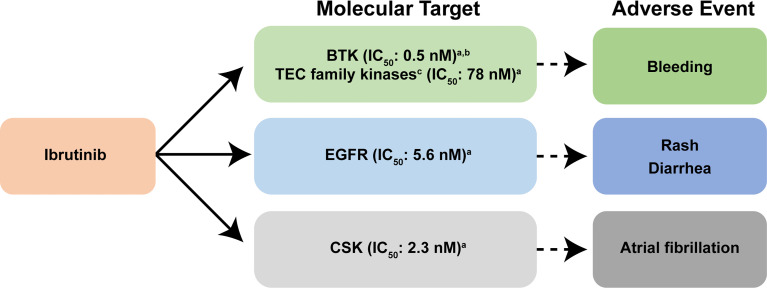
Bruton tyrosine kinase (BTK) inhibitors represent an important therapeutic advancement for B cell malignancies. Ibrutinib, the first-in-class BTK inhibitor, is approved by the US FDA to treat patients with chronic lymphocytic leukemia (CLL)/small lymphocytic lymphoma (SLL), and mantle cell lymphoma (MCL; after ≥1 prior therapy); and by the European Medicines Agency (EMA) for adult patients with relapsed/refractory (R/R) MCL and patients with CLL. Ibrutinib treatment can be limited by adverse events (AEs) including atrial fibrillation, arthralgias, rash, diarrhea, and bleeding events, leading to drug discontinuation in 4%-26% of patients. Acalabrutinib, a second-generation BTK inhibitor, is approved by the FDA to treat adult patients with CLL/SLL or MCL (relapsed after 1 prior therapy); and by the EMA to treat adult patients with CLL or R/R MCL. The most common AE associated with acalabrutinib is headache of limited duration, which occurs in 22%-51% of patients, and is mainly grade 1-2 in severity, with only 1% of patients experiencing grade ≥3 headache. Furthermore, acalabrutinib is associated with a low incidence of atrial fibrillation. Zanubrutinib, a selective next-generation covalent BTK inhibitor, is approved by the FDA to treat adult patients with MCL who have received ≥1 prior therapy, and is under investigation for the treatment of patients with CLL. In the phase 3 SEQUOIA trial in patients with CLL, the most common grade ≥3 AEs were neutropenia/neutrophil count decreased and infections. This review provides an overview of BTK inhibitor-related AEs in patients with CLL, and strategies for their management.
布鲁顿酪氨酸激酶(BTK)抑制剂是B细胞恶性肿瘤治疗领域的一项重要进展。第一代BTK抑制剂依鲁替尼已获美国食品药品监督管理局(FDA)批准,用于治疗慢性淋巴细胞白血病(CLL)/小淋巴细胞淋巴瘤(SLL)以及套细胞淋巴瘤(MCL;≥1次既往治疗后)患者;欧洲药品管理局(EMA)也批准其用于治疗复发/难治性(R/R)MCL成年患者和CLL患者。依鲁替尼治疗可能会受到不良事件(AE)的限制,这些不良事件包括心房颤动、关节痛、皮疹、腹泻和出血事件,导致4%-26%的患者停药。第二代BTK抑制剂阿卡替尼已获FDA批准,用于治疗CLL/SLL或MCL成年患者(1次既往治疗后复发);EMA也批准其用于治疗CLL或R/R MCL成年患者。与阿卡替尼相关的最常见AE是持续时间有限的头痛,发生率为22%-51%,严重程度主要为1-2级,只有1%的患者出现≥3级头痛。此外,阿卡替尼引发心房颤动的发生率较低。赞布替尼是一种选择性下一代共价BTK抑制剂,已获FDA批准用于治疗接受过≥1次既往治疗的MCL成年患者,目前正在进行治疗CLL患者的研究。在针对CLL患者的3期SEQUOIA试验中,最常见的≥3级AE是中性粒细胞减少/中性粒细胞计数降低和感染。本综述概述了CLL患者中与BTK抑制剂相关的AE及其管理策略。