Vuletić Ana, Mirjačić Martinović Katarina, Tišma Miletić Nevena, Zoidakis Jerome, Castellvi-Bel Sergi, Čavić Milena
Department of Experimental Oncology, Institute of Oncology and Radiology of Serbia, Belgrade, Serbia.
Department of Biotechnology, Biomedical Research Foundation, Academy of Athens, Athens, Greece.
Front Cell Dev Biol. 2021 Nov 10;9:750022. doi: 10.3389/fcell.2021.750022. eCollection 2021.
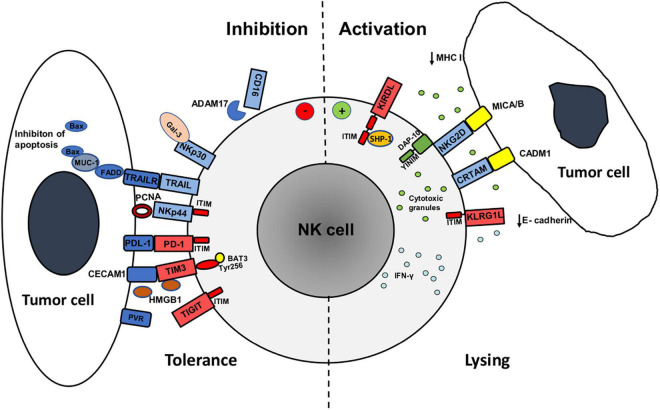
Tumor cells undergoing epithelial to mesenchymal transition (EMT) and immune cells in tumor microenvironment (TME) reciprocally influence each other. Immune cells, by supplying TME with bioactive molecules including cytokines, chemokines, enzymes, metabolites, and by physical interactions with tumor cells via their receptors, represent an important factor that affects EMT. Chronical inflammation in TME favorizes tumor growth and invasiveness and stimulates synthesis of EMT promoting transcription factors. Natural killer (NK) cells, owing to their unique ability to exert cytotoxic function independent of major histocompatibility (MHC)-mediated antigen presentation, play a significant role in the control of metastasis in colorectal cancer (CRC). Although, the cross-talk between immune cells and tumor cells in general favors the induction of EMT and inhibition of antitumor immune responses, there are some changes in the immunogenicity of tumor cells during EMT of CRC cells that increase their susceptibility to NK cell cytotoxic lysis. However, suppressive TME downmodulates the expression of activating NK cell receptors, decreases the expression of activating and increases the expression of inhibitory NK cell ligands on tumor cells, and impairs NK cell metabolism that altogether negatively affects the overall NK cell function. Furthermore, process of EMT is often associated with increased expression of programmed cell death ligand (PD-L) and expression of immune checkpoint molecules PD-1, TIGIT, and TIM3 on functionally exhausted NK cells in TME in CRC. In this review we discuss modalities of cross-talk between tumor cells and NK cells, with regard of EMT-driven changes.
经历上皮-间质转化(EMT)的肿瘤细胞与肿瘤微环境(TME)中的免疫细胞相互影响。免疫细胞通过向TME提供包括细胞因子、趋化因子、酶、代谢产物等生物活性分子,并通过其受体与肿瘤细胞进行物理相互作用,成为影响EMT的一个重要因素。TME中的慢性炎症有利于肿瘤生长和侵袭,并刺激EMT促进转录因子的合成。自然杀伤(NK)细胞由于具有独立于主要组织相容性(MHC)介导的抗原呈递发挥细胞毒性功能的独特能力,在控制结直肠癌(CRC)转移中起重要作用。虽然免疫细胞与肿瘤细胞之间的相互作用总体上有利于EMT的诱导和抗肿瘤免疫反应的抑制,但在CRC细胞EMT过程中肿瘤细胞的免疫原性存在一些变化,增加了它们对NK细胞细胞毒性裂解的敏感性。然而,抑制性TME下调活化NK细胞受体的表达,降低肿瘤细胞上活化性NK细胞配体的表达并增加抑制性NK细胞配体的表达,损害NK细胞代谢,这些都对NK细胞的整体功能产生负面影响。此外,EMT过程通常与程序性细胞死亡配体(PD-L)表达增加以及TME中CRC功能耗竭的NK细胞上免疫检查点分子PD-1、TIGIT和TIM3的表达有关。在本综述中,我们讨论了肿瘤细胞与NK细胞之间相互作用的方式,以及EMT驱动的变化。