Zhu Yungang, Li Baoguo, Xu Guoping, Han Changrui, Xing Gang
Radiology Department, Tianjin Teda Hospital, Tianjin 300457, P.R. China.
Department of Interventional Treatment, National Clinical Research Center for Cancer, Key Laboratory of Cancer Prevention and Therapy, Tianjin's Clinical Research Center for Cancer, Tianjin Medical University Cancer Institute and Hospital, Tianjin 300060, P.R. China.
Mol Med Rep. 2022 Jan;25(1). doi: 10.3892/mmr.2021.12554. Epub 2021 Dec 3.
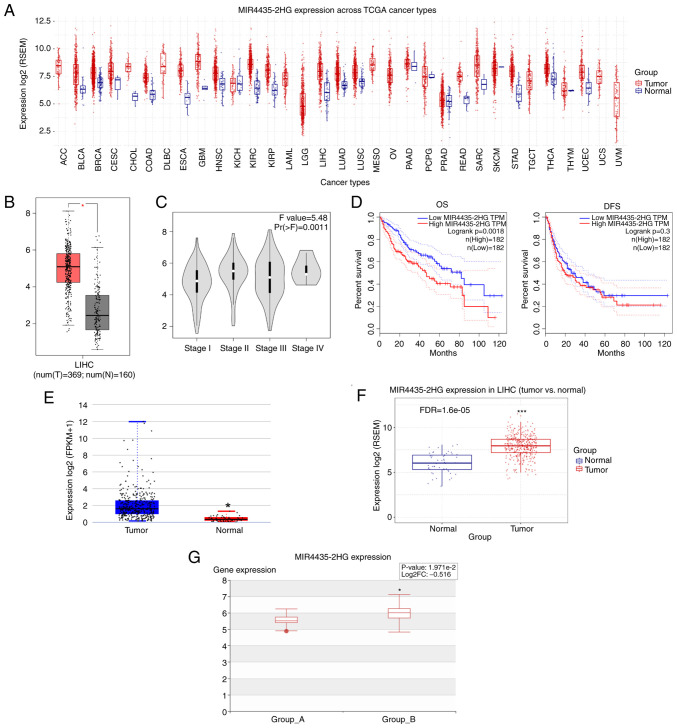
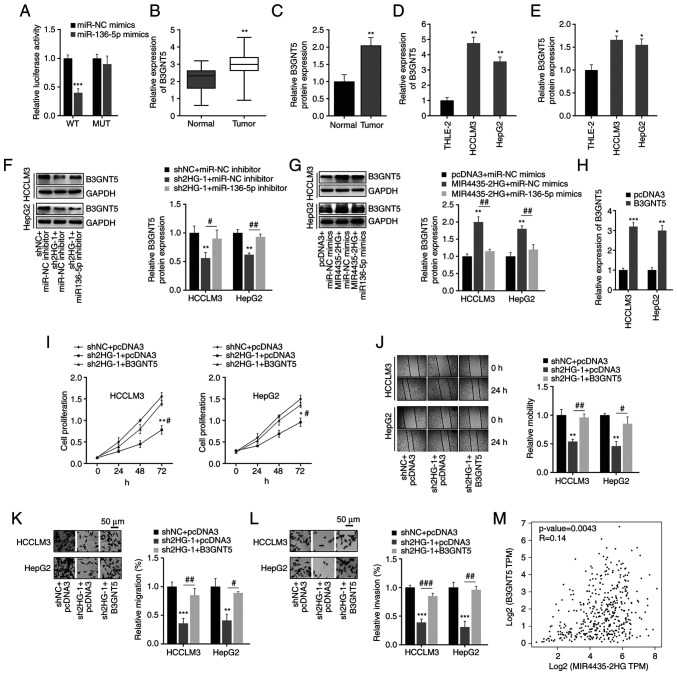
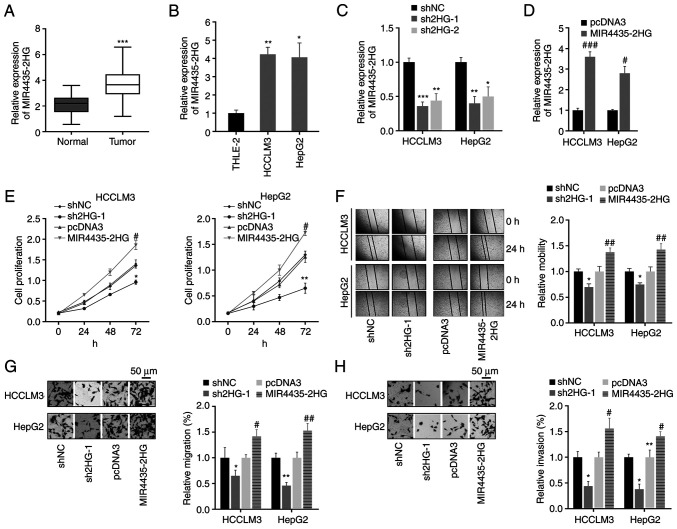
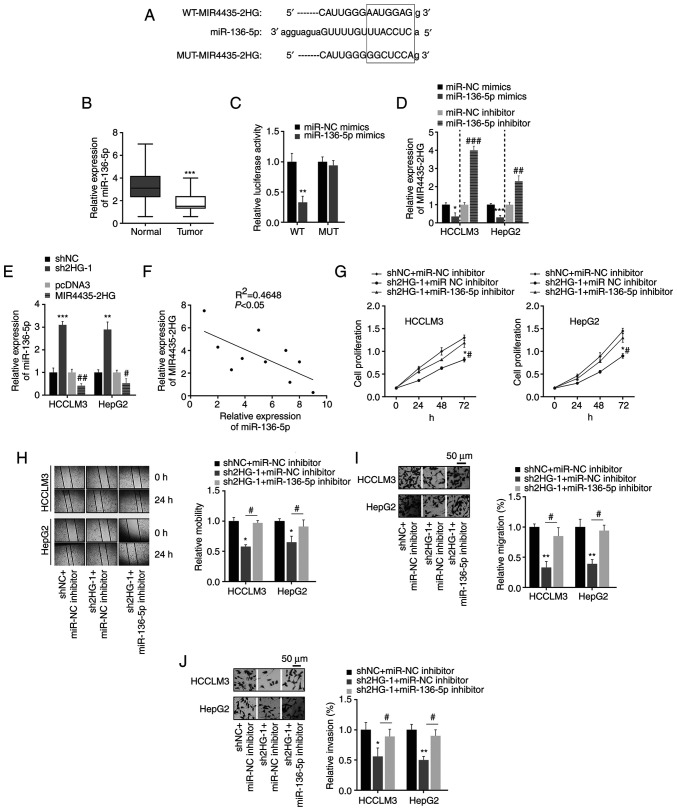
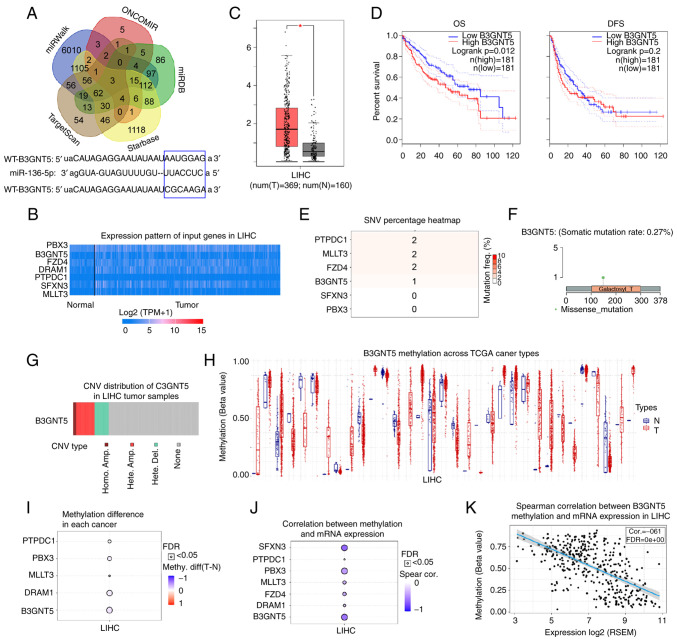
Several studies have indicated that dysregulation of long non‑coding RNAs (lncRNAs) participates in the initiation and progression of cancer. The lncRNA MIR4435‑2HG was previously reported to act as an oncogene in human cancer, including liver cancer. However, its role in the pathogenesis in liver cancer is largely unclear. The present study aimed to reveal the molecular mechanism by which MIR4435‑2HG regulates liver cancer. The expression levels of MIR4435‑2HG in liver cancer and adjacent normal tissues were analyzed using The Cancer Genome Atlas database. MIR4435‑2HG expression was validated by reverse transcription‑quantitative polymerase chain reaction (RT‑qPCR) in cancer cells in vitro. The target genes of MIR4435‑2HG were predicted using bioinformatics analysis. Interactions between miR‑136‑5p, MIR4435‑2HG and B3GNT5 were detected using luciferase reporter assays, and their effects on cell viability, migration and invasion were assessed using Cell Counting Kit‑8, wound healing and Transwell assays. The effects of miR‑136‑5p and MIR4435‑2HG on B3GNT5 expression were confirmed by western blot analysis. The results revealed that MIR4435‑2HG expression was upregulated in primary liver cancer and liver cancer cell lines, and was positively associated with advanced tumor stage, metastasis and poor prognosis in patients with liver cancer. Knockdown of MIR4435‑2HG significantly inhibited the proliferation, migration and invasion of liver cancer cells. Furthermore, miR‑136‑5p was determined to be a direct target of MIR4435‑2HG and suppressed MIR4435‑2HG expression by binding with the seed region of the 3'‑UTR of MIR4435‑2HG in liver cancer cells. Functional studies showed that the inhibitory effects of MIR4435‑2HG knockdown on cell proliferation, migration and invasion were significantly rescued by inhibiting miR‑136‑5p. Furthermore, the target gene, B3GNT5, of miR‑136‑5p was confirmed by bioinformatics analysis and RT‑qPCR. In addition, B3GNT5 expression was regulated by the MIR4435‑2HG/miR‑136‑5p axis. In conclusion, the present study indicated that MIR4435‑2HG facilitated the progression of liver cancer via the MIR4435‑2HG/miR‑136‑5p/B3GNT5 axis, which demonstrated that MIR4435‑2HG may be a potential biomarker for the prognosis and treatment of liver cancer.
多项研究表明,长链非编码RNA(lncRNA)失调参与癌症的发生和发展。lncRNA MIR4435-2HG此前被报道在包括肝癌在内的人类癌症中作为癌基因发挥作用。然而,其在肝癌发病机制中的作用在很大程度上尚不清楚。本研究旨在揭示MIR4435-2HG调控肝癌的分子机制。利用癌症基因组图谱数据库分析了MIR4435-2HG在肝癌组织和癌旁正常组织中的表达水平。通过逆转录定量聚合酶链反应(RT-qPCR)在体外癌细胞中验证了MIR4435-2HG的表达。利用生物信息学分析预测了MIR4435-2HG的靶基因。使用荧光素酶报告基因检测法检测miR-136-5p、MIR4435-2HG和B3GNT5之间的相互作用,并使用细胞计数试剂盒-8、伤口愈合实验和Transwell实验评估它们对细胞活力、迁移和侵袭的影响。通过蛋白质免疫印迹分析证实了miR-136-5p和MIR4435-2HG对B3GNT5表达的影响。结果显示,MIR4435-2HG在原发性肝癌和肝癌细胞系中表达上调,且与肝癌患者的肿瘤晚期、转移及不良预后呈正相关。敲低MIR4435-2HG可显著抑制肝癌细胞的增殖、迁移和侵袭。此外,确定miR-136-5p是MIR4435-2HG的直接靶标,并通过与肝癌细胞中MIR4435-2HG 3'-UTR的种子区域结合来抑制MIR4435-2HG的表达。功能研究表明,抑制miR-136-5p可显著挽救敲低MIR4435-2HG对细胞增殖、迁移和侵袭的抑制作用。此外,通过生物信息学分析和RT-qPCR证实了miR-136-5p的靶基因B3GNT5。此外,B3GNT5的表达受MIR4435-2HG/miR-136-5p轴调控。总之,本研究表明MIR4435-2HG通过MIR4435-2HG/miR-136-5p/B3GNT5轴促进肝癌进展,这表明MIR4435-2HG可能是肝癌预后和治疗的潜在生物标志物。