
布立尼坦通过激活 AMPK/GSK3β/Nrf2 信号通路上调 GPX4 来缓解铁死亡介导的心肌缺血/再灌注损伤。
Britanin relieves ferroptosis-mediated myocardial ischaemia/reperfusion damage by upregulating GPX4 through activation of AMPK/GSK3β/Nrf2 signalling.
机构信息
Department of Cardiovascular Medicine, the First Affiliated Hospital of Anhui Medical University, Hefei, China.
出版信息
Pharm Biol. 2022 Dec;60(1):38-45. doi: 10.1080/13880209.2021.2007269.
CONTEXT
Ferroptosis was described as an important contributor to the myocardial ischaemia/reperfusion (MIR) injury, and britanin (Bri) was reported to exert antitumor and anti-inflammatory activities.
OBJECTIVE
Our study explores the effect and mechanism of Bri on MIR damage.
MATERIALS AND METHODS
The rat model of MIR was established by ligation of the left anterior descending coronary artery. Male Sprague-Dawley (SD) rats were divided into three groups: sham group ( = 6), MIR group ( = 6) and MIR + Bri group ( = 6; 50 mg/kg). Rats were intragastrically pre-treated with Bri or normal saline once daily for 3 days. To further verify the role and mechanism of Bri, H9C2 cells were subjected to hypoxia plus reoxygenation (H/R) to induce the model of MIR.
RESULTS
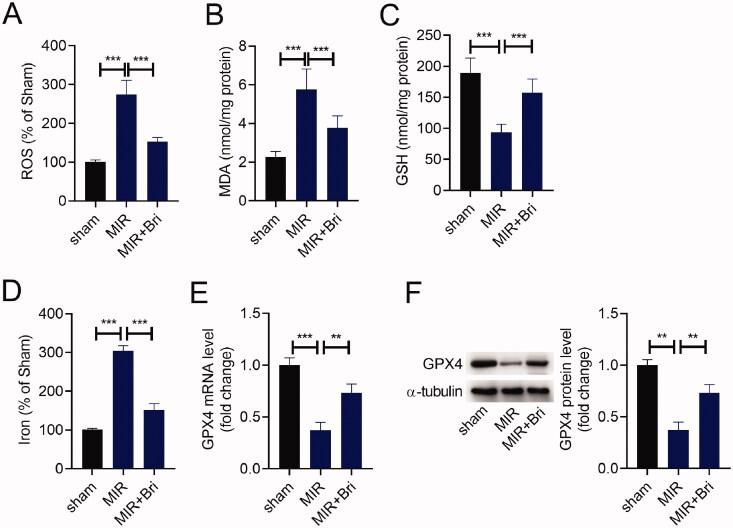
Compared with MIR rats, Bri significantly decreased infarct area (22.50% vs. 38.67%), myocardial apoptosis (23.00% vs. 41.5%), creatine phosphokinase (0.57 U/mL vs. 0.76 U/mL), and lactate dehydrogenase levels (3.18 U/mL vs. 5.17 U/mL), concomitant with alleviation of ferroptosis. Mechanistically, Bri treatment induced the activation of the adenosine monophosphate activated protein kinase (AMPK)/glycogen synthase kinase 3β (GSK3β)/nuclear factor erythroid 2-related factor 2 (Nrf2) pathway . In addition, the AMPK/GSK3β/Nrf2 pathway participated in the regulation of glutathione peroxidase 4 (GPX4) expression, and silencing of Nrf2 attenuated the effect of Bri on H/R-induced cell injury.
DISCUSSION AND CONCLUSIONS
Bri protected against ferroptosis-mediated MIR damage by upregulating GPX4 through activation of the AMPK/GSK3β/Nrf2 signalling, suggesting that Bri might become a novel therapeutic agent for MIR.
背景
铁死亡被描述为心肌缺血/再灌注(MIR)损伤的重要贡献者,而 britanin(Bri)被报道具有抗肿瘤和抗炎活性。
目的
本研究探讨 Bri 对 MIR 损伤的作用和机制。
材料和方法
通过结扎左前降支冠状动脉建立大鼠 MIR 模型。雄性 Sprague-Dawley(SD)大鼠分为三组:假手术组(n=6)、MIR 组(n=6)和 MIR+Bri 组(n=6;50mg/kg)。大鼠每日胃内预处理 Bri 或生理盐水 3 天。为了进一步验证 Bri 的作用和机制,将 H9C2 细胞进行缺氧再复氧(H/R)诱导 MIR 模型。
结果
与 MIR 大鼠相比,Bri 显著减少梗死面积(22.50%比 38.67%)、心肌细胞凋亡(23.00%比 41.5%)、肌酸磷酸激酶(0.57U/mL 比 0.76U/mL)和乳酸脱氢酶水平(3.18U/mL 比 5.17U/mL),同时减轻铁死亡。机制上,Bri 处理诱导了腺苷单磷酸激活蛋白激酶(AMPK)/糖原合成酶激酶 3β(GSK3β)/核因子红细胞 2 相关因子 2(Nrf2)通路的激活。此外,AMPK/GSK3β/Nrf2 通路参与调节谷胱甘肽过氧化物酶 4(GPX4)的表达,沉默 Nrf2 减弱了 Bri 对 H/R 诱导的细胞损伤的作用。
讨论和结论
Bri 通过激活 AMPK/GSK3β/Nrf2 信号通路上调 GPX4,从而防止铁死亡介导的 MIR 损伤,这表明 Bri 可能成为 MIR 的一种新型治疗药物。




 Zotero 插件