Dipartimento di Medicina Clinica e Chirurgia, Sezione di Endocrinologia, Università Federico II di Napoli, Naples, Italy.
Centro Italiano per la cura e il Benessere del paziente con Obesità (C.I.B.O), Dipartimento di Medicina Clinica e Chirurgia, Sezione di Endocrinologia, Università Federico II di Napoli, Naples, Italy.
Obes Rev. 2022 Mar;23(3):e13390. doi: 10.1111/obr.13390. Epub 2021 Dec 3.
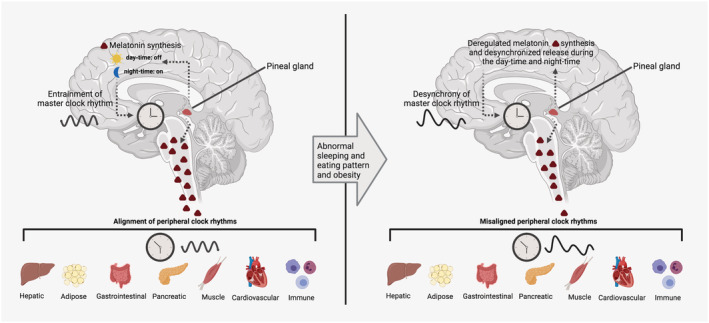
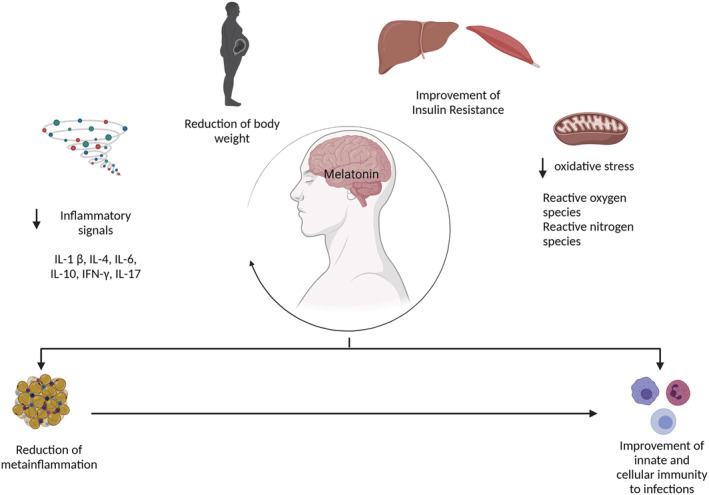
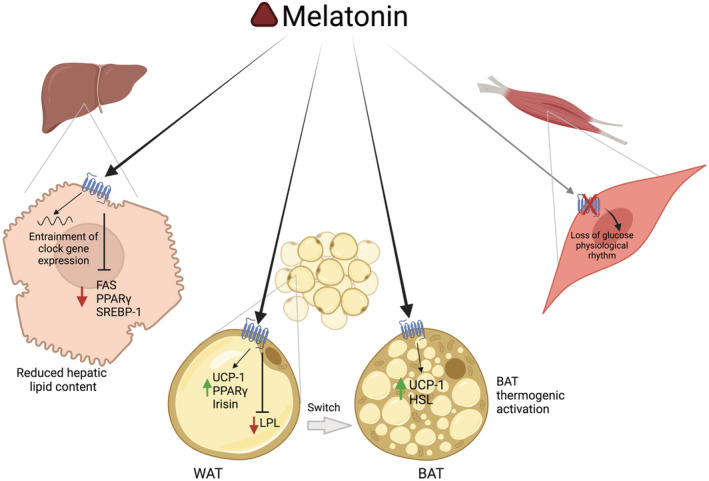
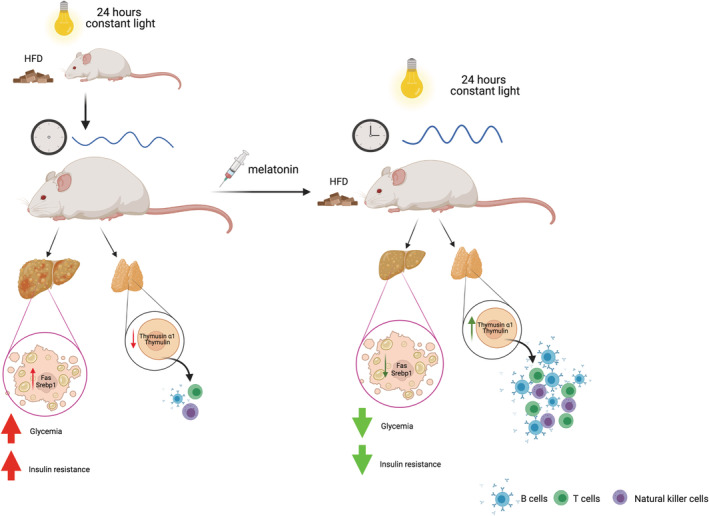
Obesity is a chronic condition whose management is a critical challenge for physicians. The scientific community has increased its focus on the molecular mechanisms involved in obesity etiopathogenesis to better manage patients with obesity and its associated complications. The tight connection between adipose tissue and the immune system has been demonstrated to play a crucial role in inflammation, and melatonin is important for circadian rhythm regulation and metabolic homeostasis, in which it orchestrates several molecular mechanisms involved in obesity and associated inflammation. Melatonin also regulates innate and adaptive immunity; its antioxidant properties are linked to reduced predisposition to infection and weight gain in patients with obesity through the modulation of the immune response, which has a significant beneficial effect on inflammation and, consequently, on the metabolic state. Low melatonin levels have been linked to obesity, and melatonin supplementation can reduce body weight, improve metabolic profile, and ameliorate immune responses and pro-inflammatory stimuli. The role of melatonin in obesity is mainly related to improved oxidative stress signaling, modulation of adipokine secretion, and a switching from white-to-brown adipose tissue phenotype and activity. Moreover, the role of melatonin in obesity modulation by controlling circadian rhythm has recently emerged as a pivotal mechanism for lipid and glucose metabolism dysfunction in adipose, muscle, and liver tissues. Melatonin may also regulate the immune system by acting directly on thymus morphology and activity as well as by modulating oxidative stress and inflammatory states during infections. The tight association between melatonin and immune response regulation is coordinated by Toll-like receptors, which are rhythmically expressed during the day. Their expression may be strongly modulated by melatonin as their signaling is highly inhibited by melatonin. The current review summarizes studies of melatonin-induced mechanisms involved in infection regulation, particularly the modulation of obesity-associated inflammation and systemic complications.
肥胖是一种慢性疾病,其管理是医生面临的重大挑战。科学界越来越关注肥胖发病机制中的分子机制,以更好地管理肥胖患者及其相关并发症。已经证明脂肪组织与免疫系统之间的紧密联系在炎症中起着至关重要的作用,而褪黑素对于昼夜节律调节和代谢稳态很重要,它协调了肥胖和相关炎症中涉及的几种分子机制。褪黑素还调节先天和适应性免疫;其抗氧化特性通过调节免疫反应与肥胖患者的感染易感性和体重增加降低有关,这对炎症有显著的有益影响,从而对代谢状态产生影响。褪黑素水平低与肥胖有关,褪黑素补充剂可以减轻体重,改善代谢状况,并改善免疫反应和促炎刺激。褪黑素在肥胖中的作用主要与改善氧化应激信号、调节脂肪因子分泌以及从白色脂肪组织向棕色脂肪组织表型和活性的转变有关。此外,褪黑素通过控制昼夜节律在肥胖调节中的作用最近被认为是脂肪、肌肉和肝脏组织中脂质和葡萄糖代谢功能障碍的关键机制。褪黑素还可以通过直接作用于胸腺形态和活性以及通过调节氧化应激和炎症状态来调节免疫系统。褪黑素与免疫反应调节之间的紧密关联是由 Toll 样受体协调的,这些受体在白天呈节律性表达。它们的表达可能被褪黑素强烈调节,因为褪黑素信号高度受到抑制。本综述总结了褪黑素诱导的感染调节机制的研究,特别是肥胖相关炎症和全身并发症的调节。