Department of Neurology, Laboratory of Neurodegenerative Disorders, Rare disease center, West China Hospital, Sichuan University, Chengdu, Sichuan, China.
Department of Neurology, Laboratory of Neurodegenerative Disorders, Rare disease center, West China Hospital, Sichuan University, Chengdu, Sichuan, China.
EBioMedicine. 2021 Dec;74:103732. doi: 10.1016/j.ebiom.2021.103732. Epub 2021 Dec 1.
The survival time of amyotrophic lateral sclerosis (ALS) is greatly variable and protective or risk effects of the potential survival predictors are controversial. Thus, we aim to undertake a comprehensive meta-analysis of studies investigating non-genetic prognostic and survival factors in patients with ALS.
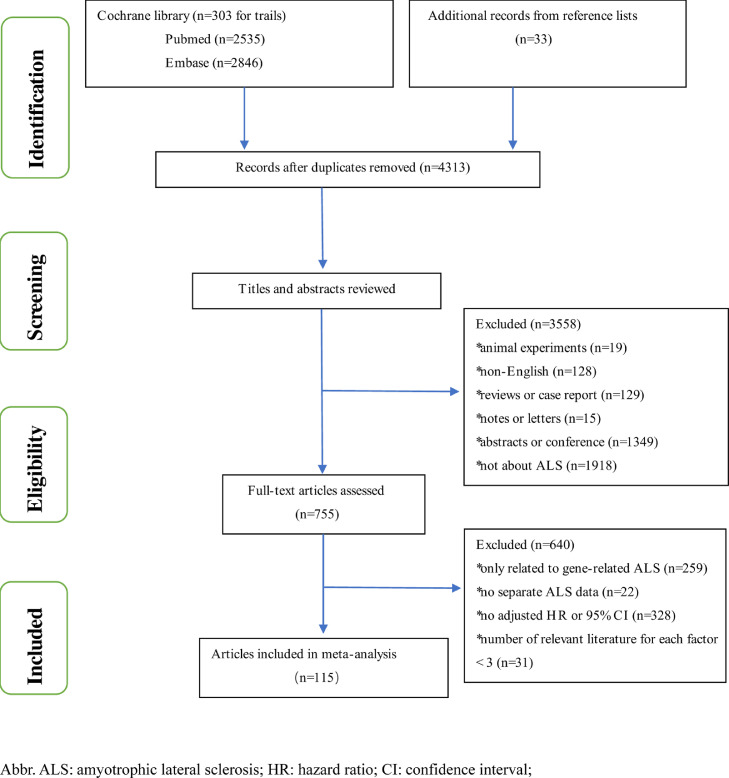
A search of relevant literature from PubMed, Embase, Cochrane library and other citations from 1 January 1966 to 1 December 020 was conducted. Random-effects models were conducted to pool the multivariable or adjusted hazard ratios (HR) by Stata MP 16.0. PROSPERO registration number: CRD42021256923.
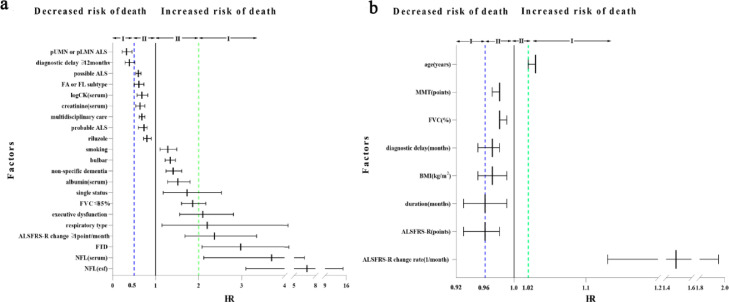
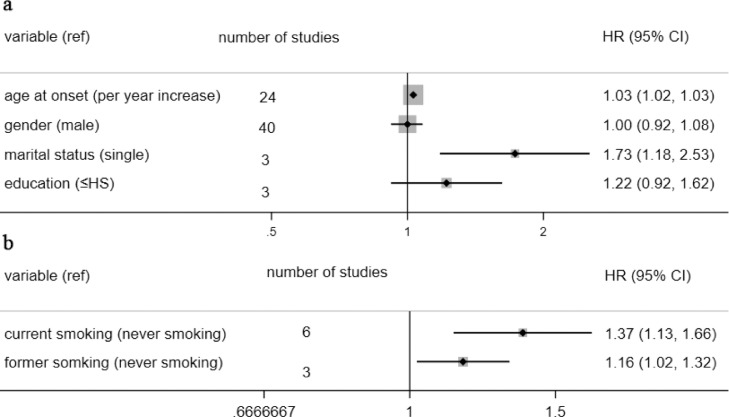
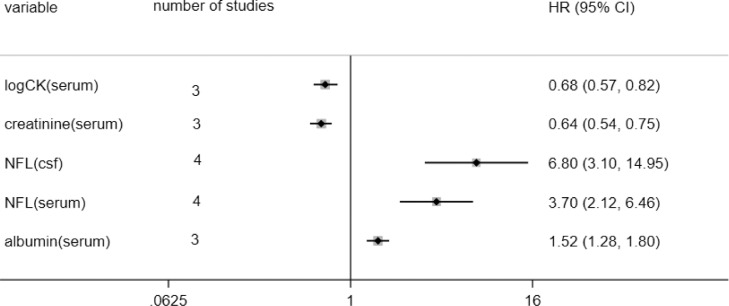
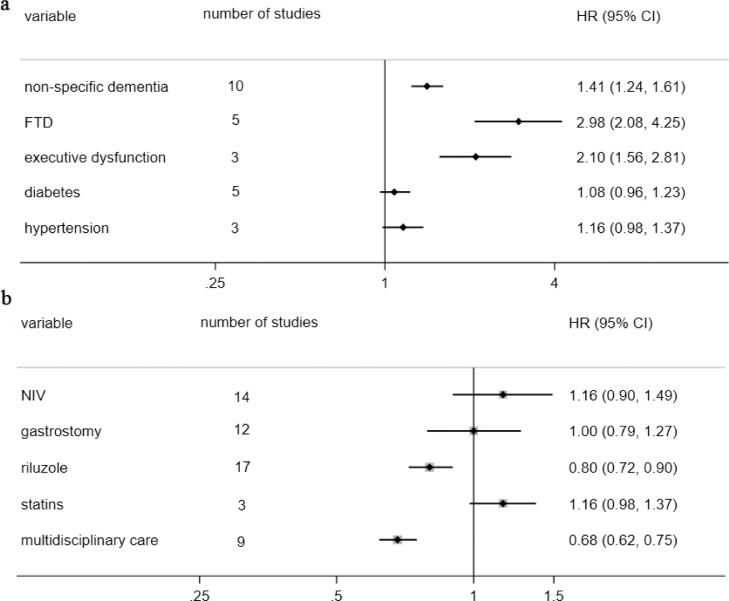
A total of 5717 reports were identified, with 115 studies meeting pre-designed inclusion criteria involving 55,169 ALS patients. Five dimensions, including demographic, environmental or lifestyle, clinical manifestations, biochemical index, therapeutic factors or comorbidities were investigated. Twenty-five prediction factors, including twenty non-intervenable and five intervenable factors, were associated with ALS survival. Among them, NFL (HR:3.70, 6.80, in serum and CSF, respectively), FTD (HR:2.98), ALSFRS-R change (HR:2.37), respiratory subtype (HR:2.20), executive dysfunction (HR:2.10) and age of onset (HR:1.03) were superior predictors for poor prognosis, but pLMN or pUMN (HR:0.32), baseline ALSFRS-R score (HR:0.95), duration (HR:0.96), diagnostic delay (HR:0.97) were superior predictors for a good prognosis. Our results did not support the involvement of gender, education level, diabetes, hypertension, NIV, gastrostomy, and statins in ALS survival.
Our study provided a comprehensive and quantitative index for assessing the prognosis for ALS patients, and the identified non-intervenable or intervenable factors will facilitate the development of treatment strategies for ALS.
This study was supported by the National Natural Science Fund of China (Grant No. 81971188), the 1.3.5 project for disciplines of excellence, West China Hospital, Sichuan University (Grant No. 2019HXFH046), and the Science and Technology Bureau Fund of Sichuan Province (No. 2019YFS0216).
肌萎缩侧索硬化症(ALS)的生存时间差异很大,潜在生存预测因素的保护或风险作用存在争议。因此,我们旨在对研究 ALS 患者非遗传预后和生存因素的研究进行全面的荟萃分析。
从 1966 年 1 月 1 日至 2020 年 12 月 2 日,我们对 PubMed、Embase、Cochrane 图书馆和其他引文进行了相关文献检索。使用 Stata MP 16.0 进行多变量或调整后的风险比(HR)的随机效应模型荟萃分析。PROSPERO 注册号:CRD42021256923。
共检索到 5717 篇报告,其中 115 项研究符合预先设计的纳入标准,涉及 55169 例 ALS 患者。研究了五个维度,包括人口统计学、环境或生活方式、临床表现、生化指标、治疗因素或合并症。25 个预测因素,包括 20 个不可干预和 5 个可干预因素,与 ALS 生存相关。其中,NFL(HR:3.70、6.80,血清和 CSF 中)、FTD(HR:2.98)、ALSFRS-R 变化(HR:2.37)、呼吸亚型(HR:2.20)、执行功能障碍(HR:2.10)和发病年龄(HR:1.03)是预后不良的较好预测因素,但 pLMN 或 pUMN(HR:0.32)、基线 ALSFRS-R 评分(HR:0.95)、持续时间(HR:0.96)、诊断延迟(HR:0.97)是预后良好的较好预测因素。我们的结果不支持性别、教育程度、糖尿病、高血压、NIV、胃造口术和他汀类药物参与 ALS 生存。
我们的研究为评估 ALS 患者预后提供了一个全面和定量的指标,确定的不可干预或可干预因素将有助于制定 ALS 的治疗策略。
本研究得到了国家自然科学基金(No. 81971188)、四川大学华西医院 1.3.5 学科卓越发展计划(Grant No. 2019HXFH046)和四川省科技厅基金(No. 2019YFS0216)的支持。