Kerr John, Panagopoulos Costas, van der Linden Sander
Department of Psychology, University of Cambridge, Downing Site, Cambridge CB2 3EB, United Kingdom.
Department of Political Science, Northeastern University, Renaissance Park 902, Boston, MA 02115, USA.
Pers Individ Dif. 2021 Sep;179:110892. doi: 10.1016/j.paid.2021.110892. Epub 2021 Apr 1.
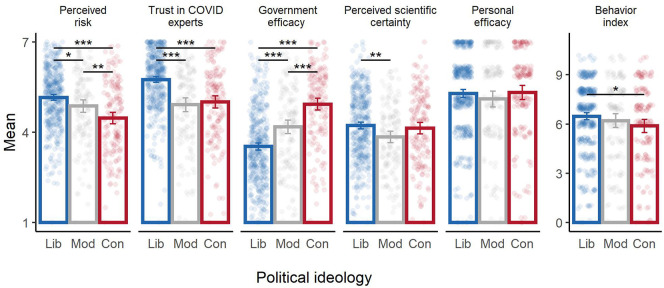
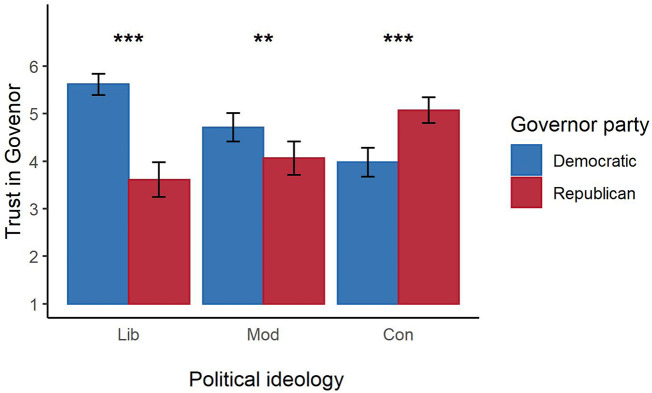
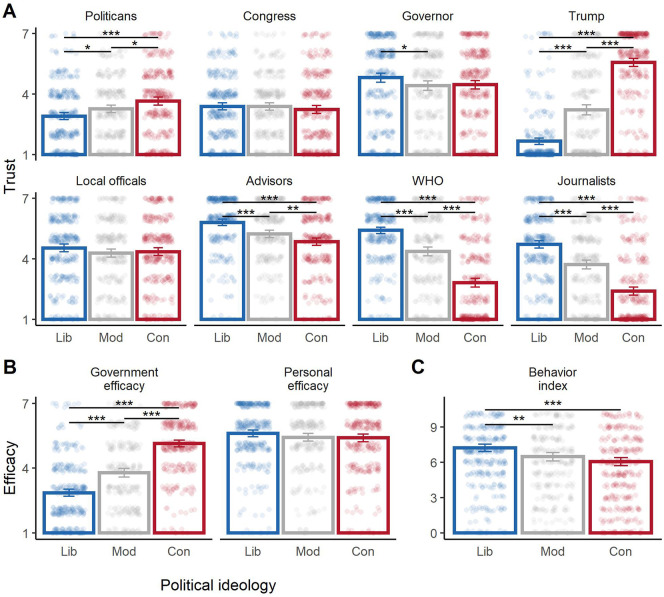
Despite calls for political consensus, there is growing evidence that the public response to the COVID-19 pandemic has been politicized in the US. We examined the extent to which this polarization exists among the US public across two national studies. In a representative US sample ( = 699, March 2020) we find that liberals (compared to conservatives) perceive higher risk, place less trust in politicians to handle the pandemic, are more trusting of medical experts such as the WHO, and are more critical of the government response. We replicate these results in a second, pre-registered study ( = 1000; April 2020), and find that results are similar when considering partisanship, rather than political ideology. In both studies we also find evidence that political polarization extends beyond attitudes, with liberals consistently reporting engaging in a significantly greater number of health protective behaviors (e.g., wearing face masks) than conservatives. We discuss the possible drivers of polarization on COVID-19 attitudes and behaviors, and reiterate the need for fostering bipartisan consensus to effectively address and manage the COVID-19 pandemic.
尽管呼吁达成政治共识,但越来越多的证据表明,美国公众对新冠疫情的反应已被政治化。我们通过两项全国性研究,考察了这种两极分化在美国公众中的存在程度。在一个具有代表性的美国样本(N = 699,2020年3月)中,我们发现,自由派(与保守派相比)认为风险更高,对政客应对疫情的信任度较低,对世卫组织等医学专家更信任,对政府的应对措施也更持批评态度。我们在第二项预先注册的研究(N = 1000;2020年4月)中重复了这些结果,并发现,在考虑党派关系而非政治意识形态时,结果相似。在两项研究中,我们还发现证据表明,政治两极分化不仅限于态度,自由派始终报告称,他们采取的健康保护行为(如戴口罩)比保守派多得多。我们讨论了新冠疫情态度和行为两极分化的可能驱动因素,并重申需要促成两党共识,以有效应对和管理新冠疫情。