Mekonen Temesgen, Admasie Amha, Leka Yakob Lencha, Darota Damene, Feleke Fentaw Wassie
Mareka District Health Office, Waka, Ethiopia.
School of Public Health, Bahirdar University, Bahirdar, Ethiopia.
Environ Health Insights. 2021 Nov 23;15:11786302211061046. doi: 10.1177/11786302211061046. eCollection 2021.
Maternal handwashing practice is an important measure to prevent the spreading of childhood disease. Handwashing is still being practiced to a very low extent especially at critical times since the global prevalence of handwashing with soap was estimated at 19% by a systematic review after compiling 42 studies all over the world.
To assess the handwashing practice and its predictors among mothers of children aged 0 to 23 months in Mareka District, south Ethiopia, 2020.
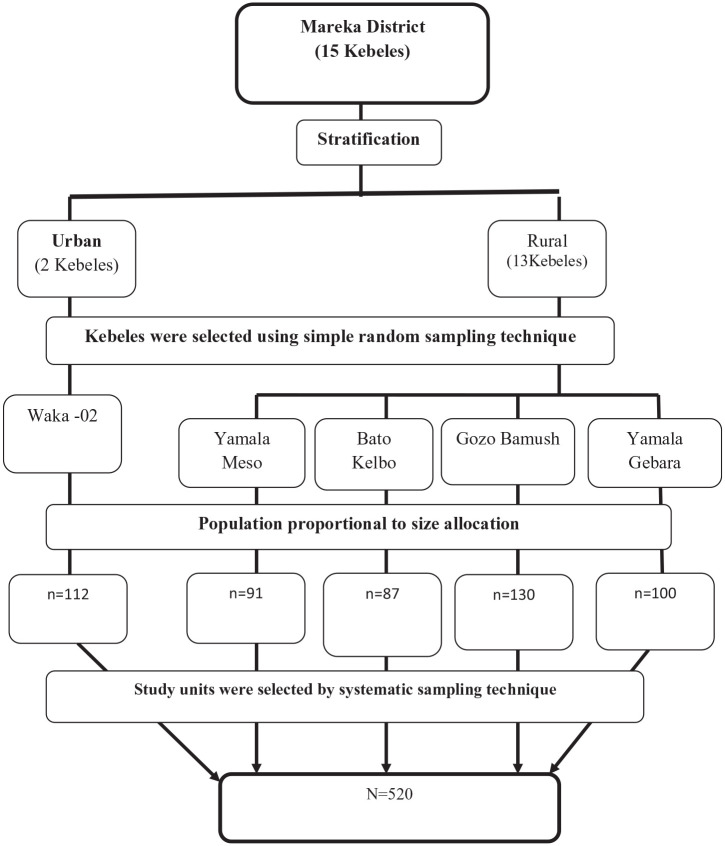
A community-based cross-sectional study was conducted with a multistage sampling technique on 520 women having children aged 0 to 23 months in Mareka District. Data were collected by using interviewer-administered pre-tested structured questionnaires. Data were checked for completeness and entered into Epi data entry 4.6.2. The data were exported into SPSS version 22 for analysis with multivariate logistic regression analysis at < .05.
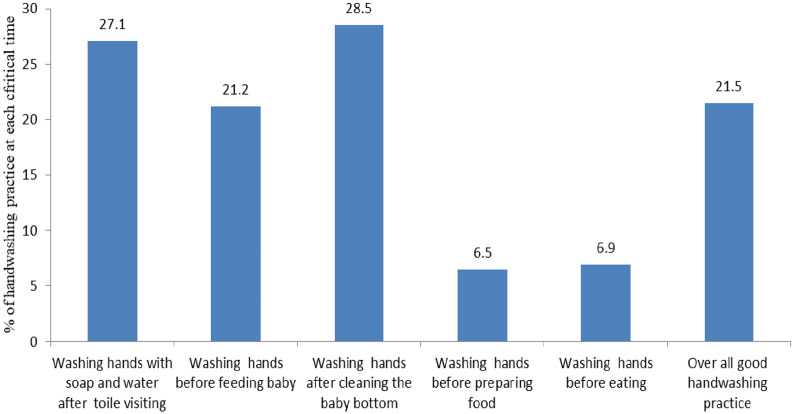
Mothers wash their hands with soap and water after visiting the latrine (27.1%), after cleaning the child's bottom (28.5%), before cooking (6.2%), before eating (6.9%), and before feeding the child (21.2%). The most important predictors were water availability near the handwashing location with an adjusted odds ratio (AOR) 5.26 (95% CI 1.99-13.69) and soap availability near the handwashing location with AOR 0.40 (95% CI 0.18-0.89) for good handwashing practice.
The handwashing practice at critical times was low. The presences of water and soap near the handwashing location were the most important predictors. It is necessary to increase the provision of both water and soap near the handwashing location for improving handwashing with soap and water at key times.
孕产妇洗手是预防儿童疾病传播的一项重要措施。洗手的实施程度仍然很低,尤其是在关键时期,因为在汇总了全球42项研究后进行的一项系统评价估计,全球用肥皂洗手的普及率为19%。
评估2020年埃塞俄比亚南部马雷卡区0至23个月儿童的母亲的洗手行为及其影响因素。
采用多阶段抽样技术,对马雷卡区520名有0至23个月儿童的妇女进行了一项基于社区的横断面研究。通过使用经过预测试的访谈员管理的结构化问卷收集数据。检查数据的完整性,并输入Epi数据录入4.6.2。将数据导出到SPSS 22版本中,以进行多变量逻辑回归分析,显著性水平<0.05。
母亲们在如厕后(27.1%)、清洁孩子臀部后(28.5%)、做饭前(6.2%)、吃饭前(6.9%)和喂孩子前(21.2%)用肥皂和水洗手。最重要的影响因素是洗手地点附近有水,调整后的优势比(AOR)为5.26(95%置信区间1.99-13.69),以及洗手地点附近有肥皂,AOR为0.40(95%置信区间0.18-0.89),以促进良好的洗手习惯。
关键时期的洗手行为发生率较低。洗手地点附近有水和肥皂是最重要的影响因素。有必要在洗手地点附近增加水和肥皂的供应,以改善关键时期用肥皂和水洗手的情况。