Reddy B Venkatashiva, Kusuma Yadlapalli S, Pandav Chandrakant S, Goswami Anil Kumar, Krishnan Anand
Department of Community Medicine, Veer Chandra Singh Garhwali Government Medical Sciences and Research Institute, Uttarakhand, India.
Centre for Community Medicine, All India Institute of Medical Sciences, New Delhi, India.
J Environ Public Health. 2017;2017:7517414. doi: 10.1155/2017/7517414. Epub 2017 May 31.
Increased mortality is associated with poor household water, sanitation, and hygiene (WaSH) practices. The objective was to study the WaSH practices for under-five children among households of Sugali Tribe, Chittoor district, Andhra Pradesh, India.
A community-based cross-sectional study was conducted in four mandals in 2012. A total of 500 households with under-five children were identified. Data was collected from mothers/caregivers. A summary WaSH score was generated from four specific indices, water, sanitation, hygiene, and hand washing practices, and determinants were identified.
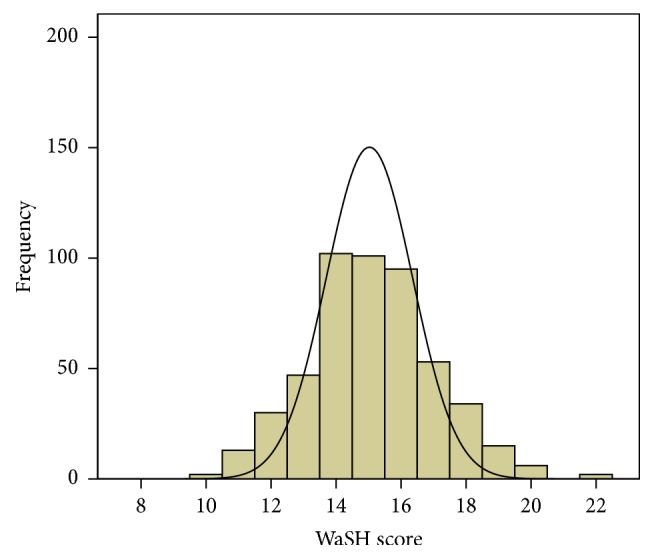
Of the total households, 69% reported doing nothing at home to make the water safe for drinking. Over 90% of the households reported storing water in a utensil covered with a lid and retrieving water by dipping glass in the vessels. Open defecation was a commonly reported practice (84.8%). About three-fifths of the study's households reported using water and soap for cleaning dirty hands and one-third (37.4%) reported using water and soap after defecation. The median WaSH score was 15. In the hierarchical stepwise multiple linear regression, only socioeconomic variables were significantly associated with WaSH score.
WaSH related practices were generally poor in people of the Sugali Tribe in Andhra Pradesh, India.
死亡率上升与家庭用水、卫生设施及卫生习惯(WaSH)不佳有关。目的是研究印度安得拉邦奇图尔区苏加利部落家庭中五岁以下儿童的WaSH习惯。
2012年在四个行政区开展了一项基于社区的横断面研究。共识别出500户有五岁以下儿童的家庭。从母亲/照料者处收集数据。根据水、卫生设施、卫生习惯和洗手习惯这四个具体指标生成WaSH综合评分,并确定相关决定因素。
在所有家庭中,69%报告称在家中未采取任何措施使饮用水安全。超过90%的家庭报告称将水储存在有盖容器中,并通过将杯子浸入容器中取水。随地大小便很常见(84.8%)。约五分之三的研究家庭报告称使用水和肥皂清洁脏手,三分之一(37.4%)报告称排便后使用水和肥皂。WaSH评分中位数为15。在分层逐步多元线性回归中,只有社会经济变量与WaSH评分显著相关。
在印度安得拉邦的苏加利部落人群中,与WaSH相关的习惯普遍较差。