Vimal Archana, Kumar Awanish
Department of Bioengineering, Integral University, Lucknow, UP India.
Department of Biotechnology, National Institute of Technology, Raipur, Chhattisgarh 492010 India.
Int J Pept Res Ther. 2022;28(1):9. doi: 10.1007/s10989-021-10312-x. Epub 2021 Dec 1.
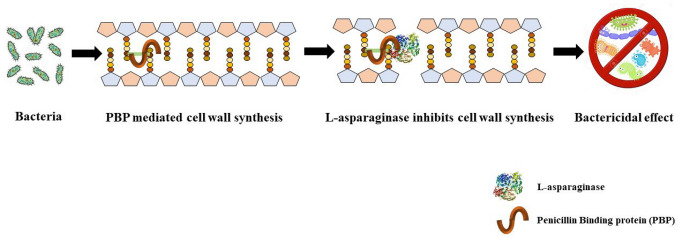
Enzymes play a vital role in the biological system as a catalyst for biochemical reactions. They have a wide range of commercial applications in many areas like the pharmaceutical industry, food industry, etc. l-asparaginase is one of the commercial enzymes with prime importance in anticancer therapy. It is mainly used in chemotherapy; however, it has the potential to cure autoimmune disorders and infectious diseases also. Previous studies reported the antimicrobial potential of l-asparaginase. Therefore, we have discussed the possibility and challenges of the antimicrobial application of l-asparaginase in the treatment of infectious diseases. This is followed by a discussion on the effective delivery of this enzyme using biopolymeric nanocarriers that ensure safe and on target action. The present article gives a perspective on the l-asparaginase molecule that could be developed/established as an approved antimicrobial drug in the future.
酶作为生物化学反应的催化剂,在生物系统中发挥着至关重要的作用。它们在制药工业、食品工业等许多领域有着广泛的商业应用。L-天冬酰胺酶是抗癌治疗中最重要的商业酶之一。它主要用于化疗;然而,它也有治愈自身免疫性疾病和传染病的潜力。先前的研究报道了L-天冬酰胺酶的抗菌潜力。因此,我们讨论了L-天冬酰胺酶在治疗传染病中的抗菌应用的可能性和挑战。接下来讨论了使用生物聚合物纳米载体有效递送这种酶,以确保安全和靶向作用。本文对L-天冬酰胺酶分子进行了展望,该分子未来有望被开发/确立为一种获批的抗菌药物。