Samuelsen Chad L, Vincis Roberto
Department of Anatomical Sciences and Neurobiology, University of Louisville, Louisville, KY, United States.
Department of Biological Science and Program in Neuroscience, Florida State University, Tallahassee, FL, United States.
Front Syst Neurosci. 2021 Nov 15;15:772286. doi: 10.3389/fnsys.2021.772286. eCollection 2021.
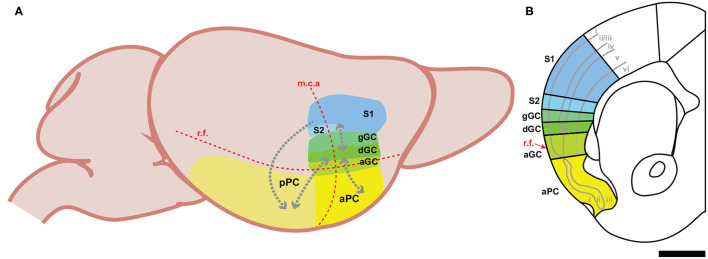
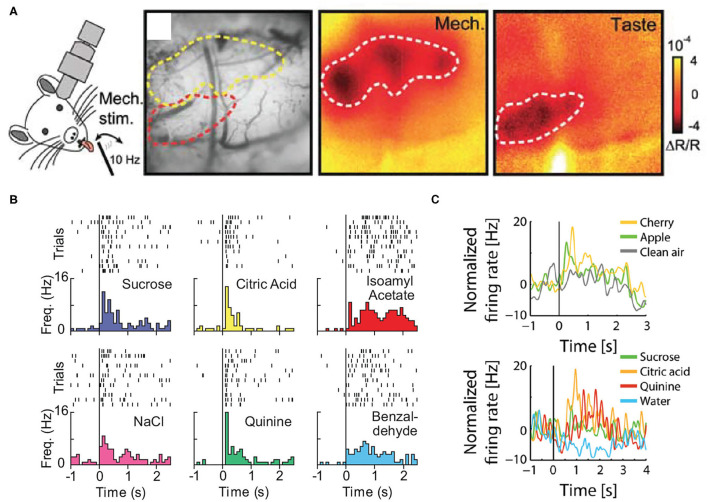
The experience of eating is inherently multimodal, combining intraoral gustatory, olfactory, and somatosensory signals into a single percept called flavor. As foods and beverages enter the mouth, movements associated with chewing and swallowing activate somatosensory receptors in the oral cavity, dissolve tastants in the saliva to activate taste receptors, and release volatile odorant molecules to retronasally activate olfactory receptors in the nasal epithelium. Human studies indicate that sensory cortical areas are important for intraoral multimodal processing, yet their circuit-level mechanisms remain unclear. Animal models allow for detailed analyses of neural circuits due to the large number of molecular tools available for tracing and neuronal manipulations. In this review, we concentrate on the anatomical and neurophysiological evidence from rodent models toward a better understanding of the circuit-level mechanisms underlying the cortical processing of flavor. While more work is needed, the emerging view pertaining to the multimodal processing of food and beverages is that the piriform, gustatory, and somatosensory cortical regions do not function solely as independent areas. Rather they act as an intraoral cortical hub, simultaneously receiving and processing multimodal sensory information from the mouth to produce the rich and complex flavor experience that guides consummatory behavior.
进食体验本质上是多模态的,它将口腔内的味觉、嗅觉和体感信号整合为一种单一的感知,即味道。当食物和饮料进入口腔时,与咀嚼和吞咽相关的动作会激活口腔中的体感感受器,使味觉物质溶解在唾液中以激活味觉感受器,并释放挥发性气味分子,通过鼻后通路激活鼻上皮中的嗅觉感受器。人体研究表明,感觉皮层区域对口腔内的多模态处理很重要,但其回路层面的机制仍不清楚。由于有大量可用于追踪和神经元操作的分子工具,动物模型能够对神经回路进行详细分析。在这篇综述中,我们专注于来自啮齿动物模型的解剖学和神经生理学证据,以便更好地理解皮层对味道处理的回路层面机制。虽然还需要更多的研究工作,但关于食物和饮料多模态处理的新观点是,梨状皮层、味觉皮层和体感皮层区域并非仅仅作为独立区域发挥作用。相反,它们充当口腔内的皮层枢纽,同时接收和处理来自口腔的多模态感觉信息,以产生丰富而复杂的味道体验,从而指导进食行为。