Chandna Arvind, Ghahghaei Saeideh, Foster Susan, Kumar Ram
The Smith-Kettlewell Eye Research Institute, San Francisco, CA, United States.
Alder Hey Children's Hospital, Liverpool, United Kingdom.
Front Hum Neurosci. 2021 Nov 16;15:711873. doi: 10.3389/fnhum.2021.711873. eCollection 2021.
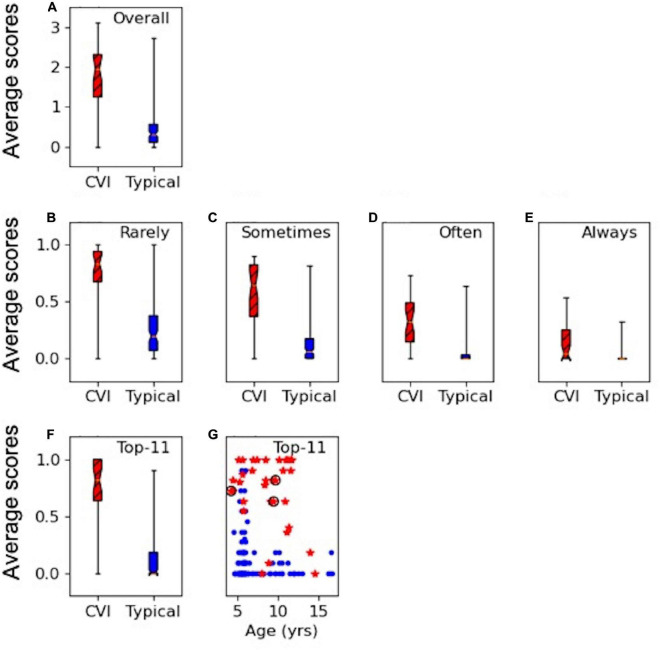
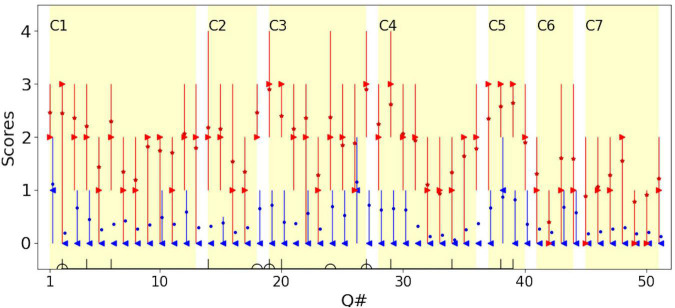
In clinical practice Cerebral Visual Impairment (CVI) is typically diagnosed by observation of abnormal visually guided behaviors which indicate higher visual function deficits (HVFDs) suggesting abnormal brain development or brain damage in a child with a suitable clinical history. HVFDs can occur even in the presence of good visual acuity and may remain undiagnosed the good visual acuity does not prompt further investigation. This leads to a lack of understanding of the child's visual perceptual difficulties. In a prospective study, we determined the spectrum of HVFDs in a group of children with history suggestive of brain damage or disruption of brain development and an independent diagnosis of CVI in comparison with typically developing children with a structured 51 question inventory, the Higher Visual Function Question Inventory (HVFQI-51) adapted from the Cerebral Vision Impairment Inventory, CVI-I. Here, we show that the HVFQI-51 can detect a range of HVFDs in children with CVI with good visual acuity and clearly distinguishes these children from typically developing children. HVFDs in our study group could mostly be attributed to dorsal stream visual processing dysfunction though the spectrum varied between children. We report on the inclusion of the "not applicable" response option in analysis providing a picture of HVFDs more in tune with the overall disability of each child. We also propose a subset of 11 questions (Top-11) which discriminate between children with CVI vs. behaviors seen in typical children: this provides both a screening tool for initial assessment of HVFDs and a measure of CVI-related impairment, and needs further validation in a secondary independent sample.
在临床实践中,脑性视觉障碍(CVI)通常是通过观察异常的视觉引导行为来诊断的,这些行为表明存在较高视觉功能缺陷(HVFDs),提示患有适当临床病史的儿童存在脑发育异常或脑损伤。即使视力良好,HVFDs也可能出现,并且由于良好的视力未促使进一步检查,这些缺陷可能仍未被诊断出来。这导致对儿童视觉感知困难缺乏了解。在一项前瞻性研究中,我们使用一份由51个问题组成的结构化问卷——从脑性视觉障碍问卷CVI-I改编而来的较高视觉功能问题问卷(HVFQI-51),确定了一组有脑损伤或脑发育中断病史且已独立诊断为CVI的儿童与正常发育儿童相比的HVFDs范围。在此,我们表明HVFQI-51能够检测出视力良好的CVI儿童中的一系列HVFDs,并能将这些儿童与正常发育儿童清楚地区分开来。尽管不同儿童的HVFDs范围有所不同,但我们研究组中的HVFDs大多可归因于背侧视觉处理功能障碍。我们报告了在分析中纳入“不适用”回答选项,从而更全面地呈现与每个儿童整体残疾情况相符的HVFDs情况。我们还提出了一个由11个问题组成的子集(前11项),用于区分CVI儿童与正常儿童的行为表现:这既提供了一个用于初步评估HVFDs的筛查工具,也提供了一种衡量与CVI相关损伤的方法,并且需要在第二个独立样本中进一步验证。