Wu Chunxiao, Xu Yingshan, Guo Hongji, Tang Chunzhi, Chen Dongfeng, Zhu Meiling
Shenzhen Hospital of Integrated Traditional Chinese and Western Medicine, Guangzhou University of Chinese Medicine, Guangdong, China.
The Research Center of Basic Integrative Medicine, Guangzhou University of Chinese Medicine, Guangzhou, China.
Front Aging Neurosci. 2021 Nov 18;13:739115. doi: 10.3389/fnagi.2021.739115. eCollection 2021.
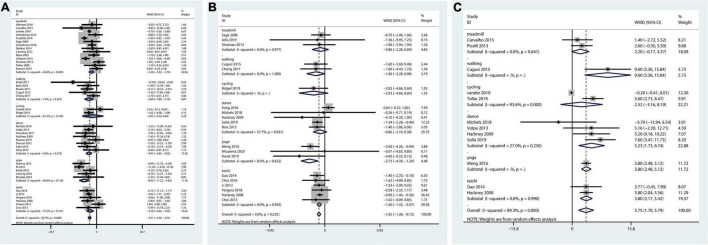
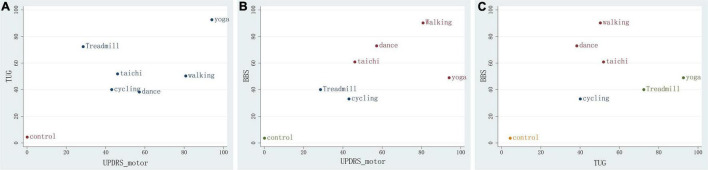
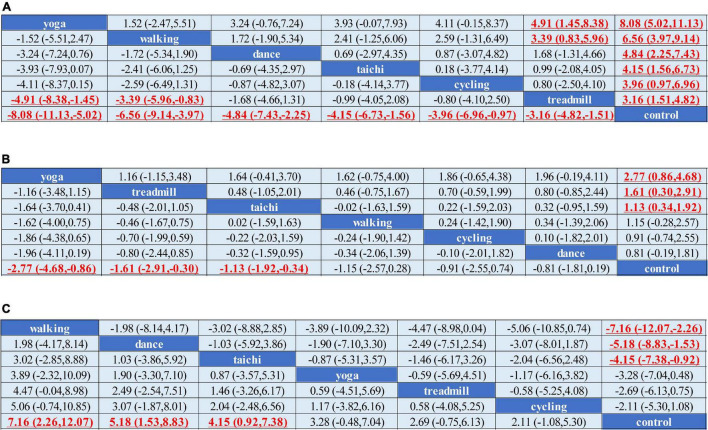
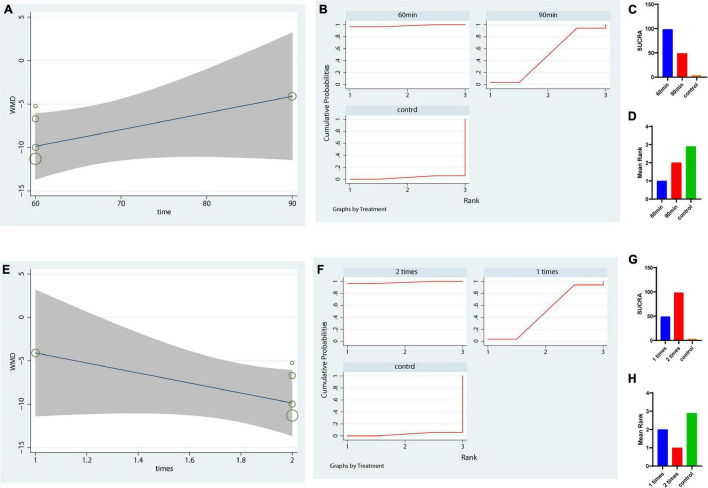
Aerobic exercise and mind-body exercise, are vital for improving motor and non-motor functional performance of Parkinson's disease (PD). However, evidence-based recommendations on which type of exercise is most suitable for each individual are still lacking. Therefore, we conduct a network meta-analysis to assess the relative efficacy of aerobic and mind-body exercise on motor function and non-motor symptoms in Parkinson's disease and to determine which of these therapies are the most suitable. A network meta-analysis and dose-response analysis. Medline, Embase (all via Ovid), and the Cochrane Central Register of Controlled Trials were comprehensively searched for related trials through April 2021. Study quality was evaluated using the Cochrane Risk of Bias Tool. The effect sizes of continuous outcomes were calculated using mean differences (MDs) or standardized mean differences (SMDs). A network meta-analysis with a frequentist approach was conducted to estimate the efficacy and probability rankings of the therapies. The dose-response relationship was determined based on metaregression and SUCRA. Fifty-two trials with 1971 patients evaluating six different therapies were identified. For the UPDRS-motor score and TUG score, yoga all ranked highest (SUCRA = 92.8%, 92.6%, respectively). The SUCRA indicated that walking may best improve the BBS score (SUCRA = 90.2%). Depression, cognitive and activities of daily living scores were significantly improved by yoga (SUCRA: 86.3, 95.1, and 79.5%, respectively). In the dose-response analysis, 60-min sessions, two times a week might be the most suitable dose of yoga for reducing the UPDRS-motor score of PD patients. Yoga and walking are important options for increasing functional mobility and balance function, and yoga might be particularly effective for decreasing depressive symptoms and cognitive impairment and improving activities of daily living in PD. The potential optimal dose of yoga for enhancing motor ability in PD patients is 60-min sessions, two times a week. PROSPERO CRD42021224823.
有氧运动和身心锻炼对于改善帕金森病(PD)的运动和非运动功能表现至关重要。然而,关于哪种类型的锻炼最适合每个个体的循证推荐仍然缺乏。因此,我们进行了一项网状Meta分析,以评估有氧运动和身心锻炼对帕金森病运动功能和非运动症状的相对疗效,并确定这些疗法中哪种最合适。一项网状Meta分析和剂量反应分析。通过全面检索Medline、Embase(均通过Ovid)以及截至2021年4月的Cochrane对照试验中央注册库来查找相关试验。使用Cochrane偏倚风险工具评估研究质量。连续结局的效应量使用平均差(MDs)或标准化平均差(SMDs)计算。采用频率学派方法进行网状Meta分析以估计疗法的疗效和概率排名。基于Meta回归和累积排序曲线下面积(SUCRA)确定剂量反应关系。共纳入52项试验,涉及1971例患者,评估六种不同疗法。对于统一帕金森病评定量表运动评分(UPDRS - motor score)和定时起立行走测试(TUG)评分,瑜伽均排名最高(SUCRA分别为92.8%和92.6%)。SUCRA表明步行可能最有助于改善伯格平衡量表(BBS)评分(SUCRA = 90.2%)。瑜伽能显著改善抑郁、认知和日常生活评分(SUCRA分别为86.3%、95.1%和79.5%)。在剂量反应分析中,每周两次60分钟的瑜伽课程可能是降低帕金森病患者UPDRS - motor评分的最合适剂量。瑜伽和步行是增加功能活动能力和平衡功能的重要选择,并且瑜伽可能对减轻帕金森病患者的抑郁症状和认知障碍以及改善日常生活活动尤其有效。改善帕金森病患者运动能力的瑜伽潜在最佳剂量是每周两次60分钟的课程。国际前瞻性系统评价注册库(PROSPERO)注册号:CRD42021224823。