Huang Xiaohua, Hamza Shereen M, Zhuang Wenqing, Cupples William A, Braam Branko
Division of Nephrology, Department of Medicine, University of Alberta, Edmonton, AB, Canada.
The First Affiliated Hospital of Shantou University Medical College, Shantou, China.
Front Physiol. 2021 Nov 16;12:753355. doi: 10.3389/fphys.2021.753355. eCollection 2021.
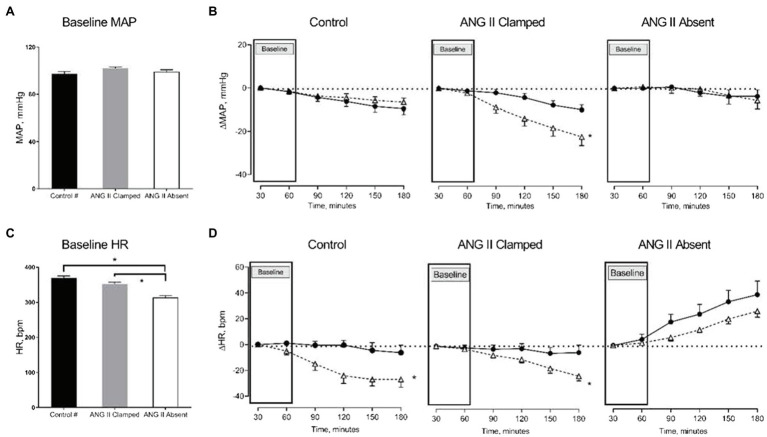
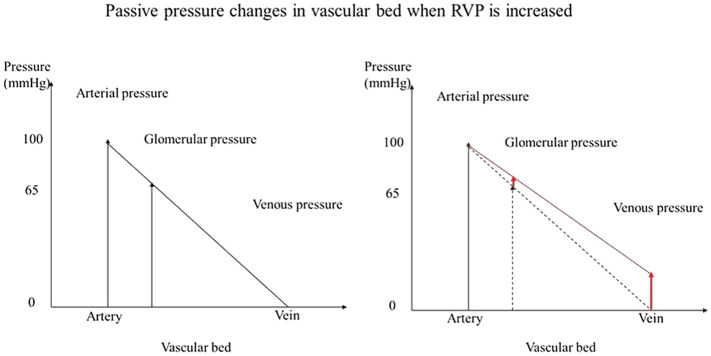
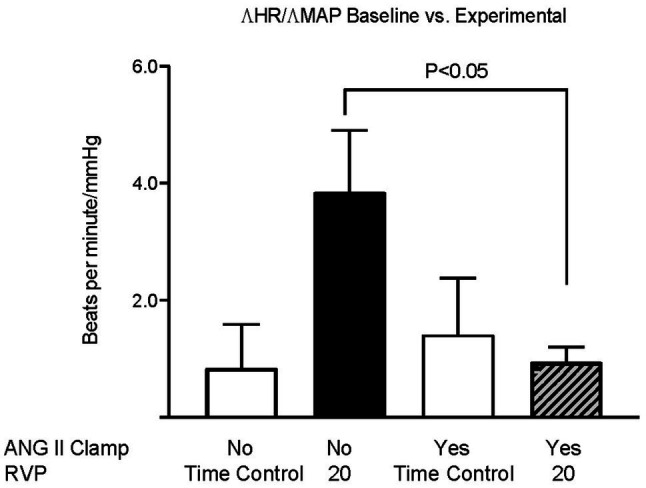
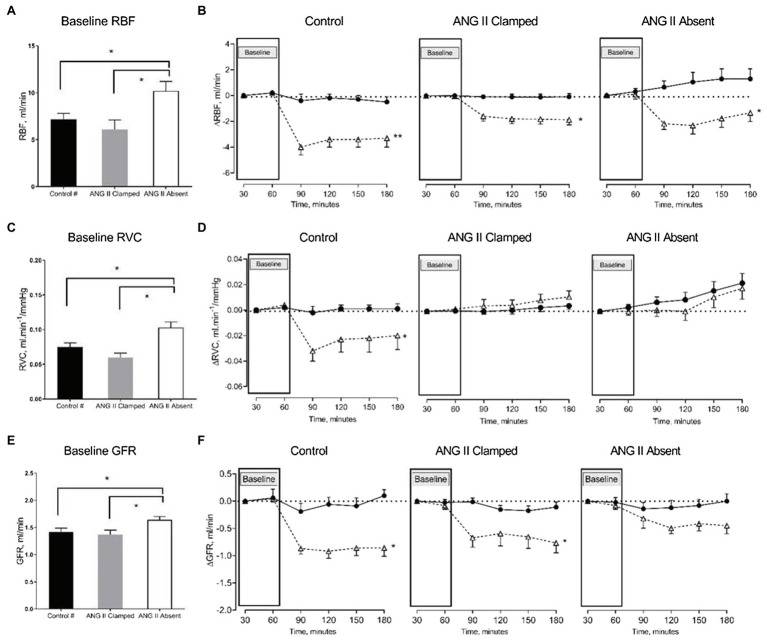
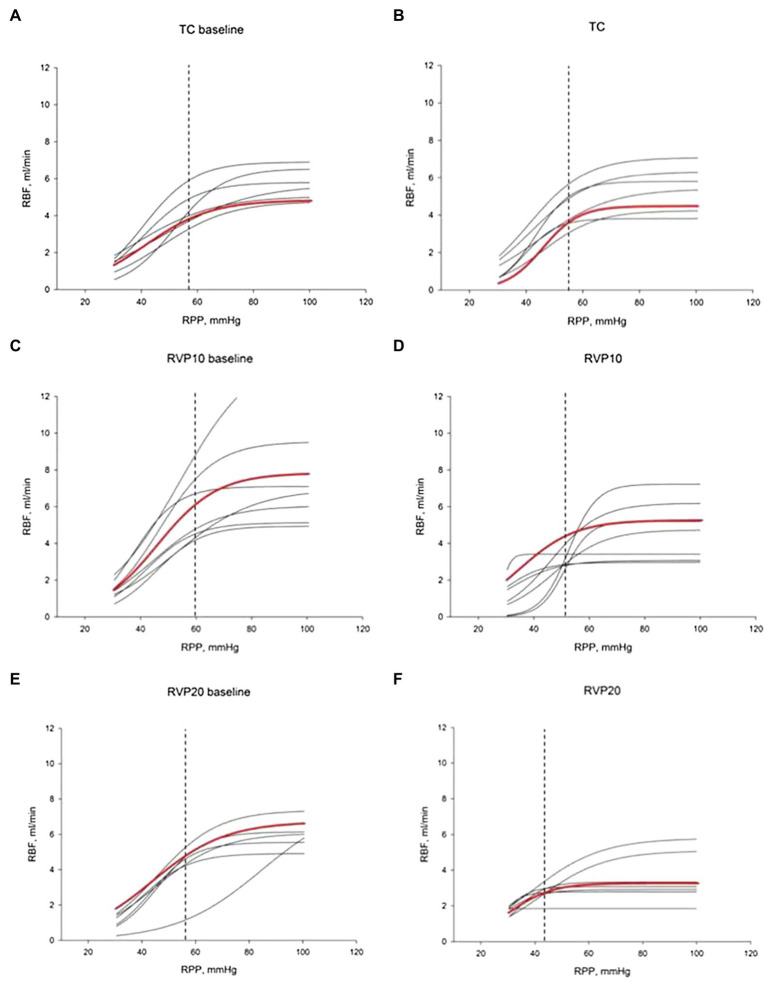
Elevated central venous pressure increases renal venous pressure (RVP) which can affect kidney function. We previously demonstrated that increased RVP reduces renal blood flow (RBF), glomerular filtration rate (GFR), and renal vascular conductance (RVC). We now investigate whether the RAS and RBF autoregulation are involved in the renal hemodynamic response to increased RVP. Angiotensin II (ANG II) levels were clamped by infusion of ANG II after administration of an angiotensin-converting enzyme (ACE) inhibitor in male Lewis rats. This did not prevent the decrease in ipsilateral RBF (-1.9±0.4ml/min, <0.05) and GFR (-0.77±0.18ml/min, <0.05) upon increased RVP; however, it prevented the reduction in RVC entirely. Systemically, the RVP-induced decline in mean arterial pressure (MAP) was more pronounced in ANG II clamped animals vs. controls (-22.4±4.1 vs. -9.9±2.3mmHg, <0.05), whereas the decrease in heart rate (HR) was less (-5±6bpm vs. -23±4bpm, <0.05). In animals given vasopressin to maintain a comparable MAP after ACE inhibition (ACEi), increased RVP did not impact MAP and HR. RVC also did not change (0.018±0.008ml/minˑmmHg), and the reduction of GFR was no longer significant (-0.54±0.15ml/min). Furthermore, RBF autoregulation remained intact and was reset to a lower level when RVP was increased. In conclusion, RVP-induced renal vasoconstriction is attenuated when ANG II is clamped or inhibited. The systemic effect of increased RVP, a decrease in HR related to a mild decrease in blood pressure, is attenuated also during ANG II clamp. Last, RBF autoregulation remains intact when RVP is elevated and is reduced to lower levels of RBF. This suggests that in venous congestion, the intact RBF autoregulation could be partially responsible for the vasoconstriction.
中心静脉压升高会增加肾静脉压力(RVP),进而可能影响肾功能。我们之前证实,升高的RVP会降低肾血流量(RBF)、肾小球滤过率(GFR)和肾血管传导性(RVC)。我们现在研究肾素-血管紧张素系统(RAS)和RBF自身调节是否参与了对升高的RVP的肾血流动力学反应。在雄性Lewis大鼠中给予血管紧张素转换酶(ACE)抑制剂后,通过输注血管紧张素II(ANG II)来钳制ANG II水平。这并不能阻止升高RVP时同侧RBF(-1.9±0.4ml/min,<0.05)和GFR(-0.77±0.18ml/min,<0.05)的降低;然而,它完全阻止了RVC的降低。在全身水平上,与对照组相比,ANG II钳制的动物中RVP诱导的平均动脉压(MAP)下降更为明显(-22.4±4.1 vs. -9.9±2.3mmHg,<0.05),而心率(HR)的下降则较小(-5±6bpm vs. -23±4bpm,<0.05)。在给予血管加压素以在ACE抑制(ACEi)后维持可比MAP的动物中,升高的RVP并未影响MAP和HR。RVC也没有变化(0.018±0.008ml/minˑmmHg),GFR的降低也不再显著(-0.54±0.15ml/min)。此外,当RVP升高时,RBF自身调节保持完整并被重置到较低水平。总之,当ANG II被钳制或抑制时,RVP诱导的肾血管收缩会减弱。升高的RVP的全身效应,即与血压轻度下降相关的HR下降,在ANG II钳制期间也会减弱。最后,当RVP升高时,RBF自身调节保持完整并降低到较低的RBF水平。这表明在静脉淤血时,完整的RBF自身调节可能部分导致血管收缩。