• 文献检索
  • 文档翻译
  • 深度研究
  • 学术资讯
  • Suppr Zotero 插件Zotero 插件
  • 邀请有礼
  • 套餐&价格
  • 历史记录
应用&插件
Suppr Zotero 插件Zotero 插件浏览器插件Mac 客户端Windows 客户端微信小程序
定价
高级版会员购买积分包购买API积分包
服务
文献检索文档翻译深度研究API 文档MCP 服务
关于我们
关于 Suppr公司介绍联系我们用户协议隐私条款
关注我们

Suppr 超能文献

核心技术专利:CN118964589B侵权必究
粤ICP备2023148730 号-1Suppr @ 2026

文献检索

告别复杂PubMed语法,用中文像聊天一样搜索,搜遍4000万医学文献。AI智能推荐,让科研检索更轻松。

立即免费搜索

文件翻译

保留排版,准确专业,支持PDF/Word/PPT等文件格式,支持 12+语言互译。

免费翻译文档

深度研究

AI帮你快速写综述,25分钟生成高质量综述,智能提取关键信息,辅助科研写作。

立即免费体验

关于……的有害生物分类

Pest categorisation of .

作者信息

Bragard Claude, Di Serio Francesco, Gonthier Paolo, Jaques Miret Josep Anton, Justesen Annemarie Fejer, Magnusson Christer Sven, Milonas Panagiotis, Navas-Cortes Juan A, Parnell Stephen, Potting Roel, Reignault Philippe Lucien, Thulke Hans-Hermann, Van der Werf Wopke, Vicent Civera Antonio, Yuen Jonathan, Zappalà Lucia, Gregoire Jean-Claude, Malumphy Chris, Czwienczek Ewelina, Kertesz Virag, Maiorano Andrea, MacLeod Alan

出版信息

EFSA J. 2021 Nov 26;19(11):e06928. doi: 10.2903/j.efsa.2021.6928. eCollection 2021 Nov.

DOI:10.2903/j.efsa.2021.6928
PMID:34868371
原文链接:https://pmc.ncbi.nlm.nih.gov/articles/PMC8622315/
Abstract

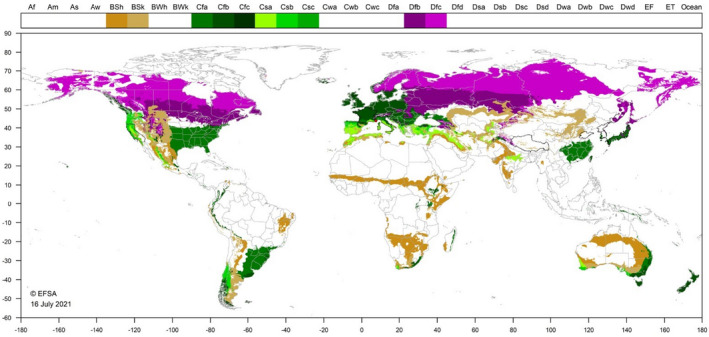
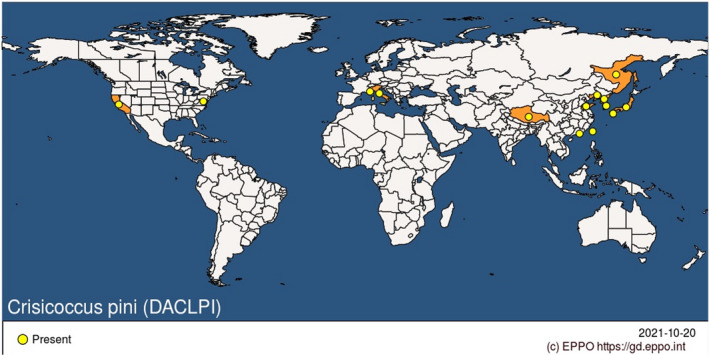
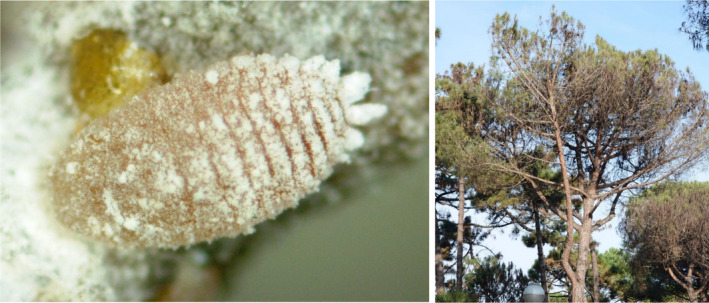
The EFSA Panel on Plant Health performed a pest categorisation of (Hemiptera: Pseudococcidae) for the EU territory. This species is not included in the EU Commission Implementing Regulation 2019/2072. , a mealybug native to Japan, has spread to other parts of Asia, as well as to North America and Europe. It has been introduced to northern Italy (Emilia-Romagna), where it is under official control. It has also been mistakenly reported from France, although the report refers to a single finding in Monaco. It develops on and species (Pinaceae). It feeds on the needles, especially new growth. It is sexually reproductive, has one or more generations each year and overwinters in the nymphal stage. The main natural dispersal stage is the first instar, which crawls over the plant or may be dispersed further by wind and animals. It can be transported over longer distances with plants for planting. Large populations cause yellowing, needle loss, reduction in growth and recruitment, dieback and mortality. It has had a significant impact to (Japanese red pine) and (black pine) in China, and (maritime pine) and (stone pine) in Italy. Adult and immature could enter the EU with conifer plants for planting. The import of the host genera Abies, Larix and Pinus, from third countries is largely prohibited, although there are derogations for dwarfed coming from Japan and the Republic of Korea. The host genus may be imported with a phytosanitary certificate. Host availability and climate suitability indicate that most of the EU would be suitable for establishment. Phytosanitary measures are available to inhibit further introductions and slow the spread within the EU. satisfies all the criteria that are within the remit of EFSA to assess for it to be regarded as a potential Union quarantine pest.

摘要

欧洲食品安全局植物健康小组对**(半翅目:粉蚧科)进行了欧盟区域内有害生物分类。该物种未被列入欧盟委员会实施条例2019/2072。,一种原产于日本的粉蚧,已扩散到亚洲其他地区以及北美和欧洲。它已被引入意大利北部(艾米利亚 - 罗马涅),目前处于官方管控之下。法国也有误报,不过该报告指的是在摩纳哥的单次发现。它在和物种(松科)上生长。以针叶为食,尤其是新长出的针叶。它进行有性繁殖,每年有一代或多代,以若虫阶段越冬。主要的自然扩散阶段是一龄若虫,它会在植物上爬行,也可能被风和动物进一步传播。它可以随种植用植物远距离传播。大量虫口会导致发黄、针叶脱落、生长和新梢减少、枝梢枯死和树木死亡。它对中国的**(日本赤松)和(黑松)以及意大利的(海岸松)和(石松)造成了重大影响。成年和未成熟的可能随针叶树种植植物进入欧盟。尽管对来自日本和韩国的矮化有豁免规定,但从第三国进口冷杉属、落叶松属和松属寄主植物在很大程度上是被禁止的。寄主属可以凭植物检疫证书进口。寄主可用性和气候适宜性表明欧盟大部分地区都适合其定殖。现有的植物检疫措施可抑制其进一步传入并减缓其在欧盟境内的传播。**满足欧洲食品安全局评估范围内的所有标准,可被视为潜在的欧盟检疫性有害生物。
https://cdn.ncbi.nlm.nih.gov/pmc/blobs/5646/8622315/9491f34cb0e2/EFS2-19-e06928-g002.jpg
https://cdn.ncbi.nlm.nih.gov/pmc/blobs/5646/8622315/12044fda5bba/EFS2-19-e06928-g001.jpg
https://cdn.ncbi.nlm.nih.gov/pmc/blobs/5646/8622315/ee0a392ca1cd/EFS2-19-e06928-g003.jpg
https://cdn.ncbi.nlm.nih.gov/pmc/blobs/5646/8622315/9491f34cb0e2/EFS2-19-e06928-g002.jpg
https://cdn.ncbi.nlm.nih.gov/pmc/blobs/5646/8622315/12044fda5bba/EFS2-19-e06928-g001.jpg
https://cdn.ncbi.nlm.nih.gov/pmc/blobs/5646/8622315/ee0a392ca1cd/EFS2-19-e06928-g003.jpg
https://cdn.ncbi.nlm.nih.gov/pmc/blobs/5646/8622315/9491f34cb0e2/EFS2-19-e06928-g002.jpg

相似文献

1
Pest categorisation of .关于……的有害生物分类
EFSA J. 2021 Nov 26;19(11):e06928. doi: 10.2903/j.efsa.2021.6928. eCollection 2021 Nov.
2
Pest categorisation of .关于……的有害生物分类
EFSA J. 2022 Mar 7;20(3):e07146. doi: 10.2903/j.efsa.2022.7146. eCollection 2022 Mar.
3
Pest categorisation of .关于……的有害生物分类
EFSA J. 2021 Aug 18;19(8):e06801. doi: 10.2903/j.efsa.2021.6801. eCollection 2021 Aug.
4
Pest categorisation of , and .[具体物种名称1]、[具体物种名称2]和[具体物种名称3]的有害生物分类
EFSA J. 2023 Nov 30;21(11):e08408. doi: 10.2903/j.efsa.2023.8408. eCollection 2023 Nov.
5
Pest categorisation of .……的有害生物分类
EFSA J. 2024 Jul 19;22(7):e8970. doi: 10.2903/j.efsa.2024.8970. eCollection 2024 Jul.
6
Pest categorisation of .……的有害生物分类
EFSA J. 2024 Apr 22;22(4):e8740. doi: 10.2903/j.efsa.2024.8740. eCollection 2024 Apr.
7
First record of the Kuwana pine mealybug Crisicoccus pini (Kuwana) in Italy: a new threat to Italian pine forests?日本松粉蚧Crisicoccus pini(久保田)在意大利的首次记录:对意大利松林的新威胁?
Zootaxa. 2016 Feb 19;4083(2):293-6. doi: 10.11646/zootaxa.4083.2.8.
8
Pest categorisation of .……的有害生物分类
EFSA J. 2022 Mar 7;20(3):e07145. doi: 10.2903/j.efsa.2022.7145. eCollection 2022 Mar.
9
Pest categorisation of .关于……的有害生物分类
EFSA J. 2022 Mar 31;20(3):e07207. doi: 10.2903/j.efsa.2022.7207. eCollection 2022 Mar.
10
Pest categorisation of .……的有害生物分类
EFSA J. 2017 Nov 8;15(11):e05029. doi: 10.2903/j.efsa.2017.5029. eCollection 2017 Nov.

引用本文的文献

1
Pest categorisation of .……的有害生物分类
EFSA J. 2024 Apr 3;22(4):e8666. doi: 10.2903/j.efsa.2024.8666. eCollection 2024 Apr.
2
Using Species Distribution Models (SDMs) to Estimate the Suitability of European Mediterranean Non-Native Area for the Establishment of (Hemiptera: Coccidae).利用物种分布模型(SDMs)评估欧洲地中海非原生地区对 (半翅目:蚧科) 建立种群的适宜性。
Insects. 2023 Jan 3;14(1):46. doi: 10.3390/insects14010046.

本文引用的文献

1
Commodity risk assessment of black pine ( Parl.) bonsai from Japan.来自日本的黑松(Parl.)盆景的商品风险评估。
EFSA J. 2019 May 15;17(5):e05667. doi: 10.2903/j.efsa.2019.5667. eCollection 2019 May.
2
Guidance on quantitative pest risk assessment.有害生物定量风险评估指南。
EFSA J. 2018 Aug 3;16(8):e05350. doi: 10.2903/j.efsa.2018.5350. eCollection 2018 Aug.
3
Guidance on the use of the weight of evidence approach in scientific assessments.科学评估中证据权重方法的使用指南。
EFSA J. 2017 Aug 3;15(8):e04971. doi: 10.2903/j.efsa.2017.4971. eCollection 2017 Aug.
4
First record of the Kuwana pine mealybug Crisicoccus pini (Kuwana) in Italy: a new threat to Italian pine forests?日本松粉蚧Crisicoccus pini(久保田)在意大利的首次记录:对意大利松林的新威胁?
Zootaxa. 2016 Feb 19;4083(2):293-6. doi: 10.11646/zootaxa.4083.2.8.
5
ScaleNet: a literature-based model of scale insect biology and systematics.ScaleNet:基于文献的蚧壳虫生物学与系统学模型。
Database (Oxford). 2016 Feb 9;2016. doi: 10.1093/database/bav118. Print 2016.