Dechanuwong Pornchai, Phuan-Udom Ratanapha
Department of Medicine, Faculty of Medicine Vajira Hospital, Navamindradhiraj University, Bangkok, Thailand.
Ann Med Surg (Lond). 2021 Nov 19;72:103085. doi: 10.1016/j.amsu.2021.103085. eCollection 2021 Dec.
Alterations in the hematological profile have been linked to disease activity in rheumatoid arthritis (RA). We aimed to evaluate the levels of hematological parameters in different phases of rheumatoid arthritis (RA) and determine whether hematological parameters could be used to predict RA remission.
The medical records of 365 RA patients were reviewed. Multivariate logistic regression analysis was used to compare hematological parameters among RA patients who were categorized into 4 groups according to disease activity: disease remission or low, moderate or high disease activity. Receiver operating characteristic curves were used to determine the predictive performances of significant parameters for RA remission.
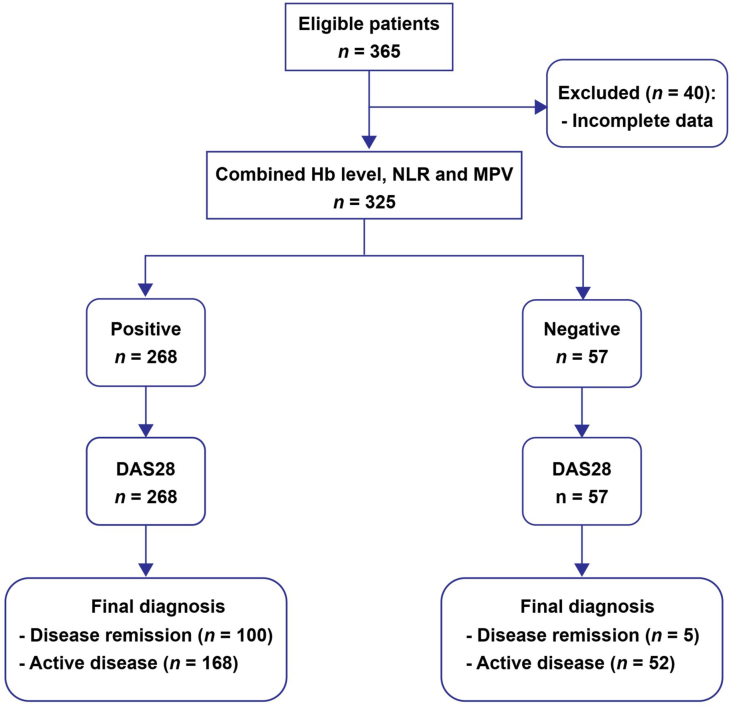
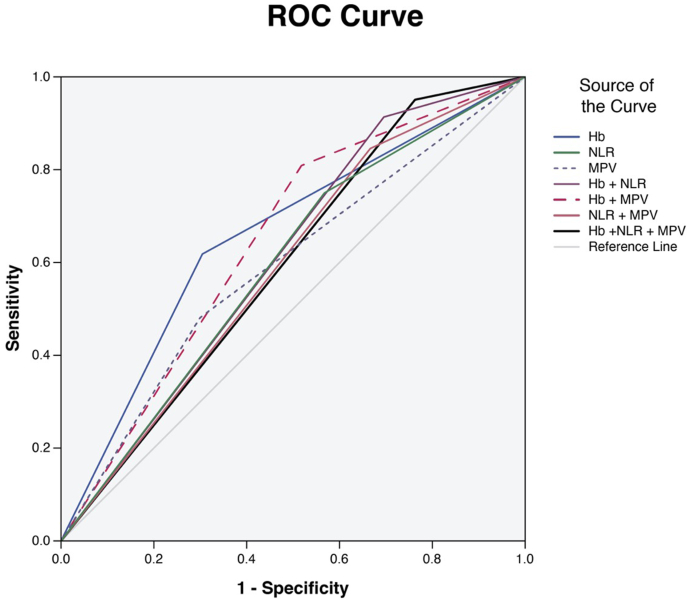
Complete data were obtained from 325 patients. The 4 groups of patients had different levels of hemoglobin (Hb), red blood cell, white blood cell, and platelet values. In multivariate analysis, Hb level, neutrophil-to-lymphocyte ratio (NLR), and mean platelet volume (MPV) were independent factors associated with disease activity. The combination of these 3 parameters yielded a sensitivity of 95.2% (95% confidence interval [CI] 88.7-98.2), specificity of 23.6% (95% CI 18.3-29.9), positive predictive value of 37.3% (95% CI 31.6-43.4), and negative predictive value of 91.2% (95% CI 80.0-96.7) in predicting disease remission.
Hb level, NLR and MPV were independently associated with RA disease activity. The high sensitivity and negative predictive value of the model consisting of Hb level, NLR and MPV may serve as a simple and inexpensive tool to identify patients who are less likely to have disease remission.
血液学指标的改变与类风湿关节炎(RA)的疾病活动相关。我们旨在评估类风湿关节炎(RA)不同阶段的血液学参数水平,并确定血液学参数是否可用于预测RA缓解。
回顾了365例RA患者的病历。采用多因素逻辑回归分析比较根据疾病活动分为4组的RA患者的血液学参数:疾病缓解或低、中、高疾病活动组。采用受试者工作特征曲线确定显著参数对RA缓解的预测性能。
从325例患者中获得了完整数据。4组患者的血红蛋白(Hb)、红细胞、白细胞和血小板值水平不同。在多因素分析中,Hb水平、中性粒细胞与淋巴细胞比值(NLR)和平均血小板体积(MPV)是与疾病活动相关的独立因素。这3个参数的组合在预测疾病缓解方面的敏感性为95.2%(95%置信区间[CI]88.7 - 98.2),特异性为23.6%(95%CI 18.3 - 29.9),阳性预测值为37.3%(95%CI 31.6 - 43.4),阴性预测值为91.2%(95%CI 80.0 - 96.7)。
Hb水平、NLR和MPV与RA疾病活动独立相关。由Hb水平、NLR和MPV组成的模型具有高敏感性和阴性预测值,可作为一种简单且廉价的工具来识别疾病缓解可能性较小的患者。