Kashif Muhammad, Fatima Iayla, Ahmed Abdul Moiz, Arshad Ali Shajeea, Memon Roha Saeed, Afzal Muhammad, Saeed Usama, Gul Sana, Ahmad Junaid, Malik Farheen, Malik Mehreen, Ahmed Jawad
Anaesthesiology, Aga Khan University, Karachi, PAK.
General Surgery, St. Luke's General Hospital, Killenny, IRL.
Cureus. 2021 Oct 28;13(10):e19106. doi: 10.7759/cureus.19106. eCollection 2021 Oct.
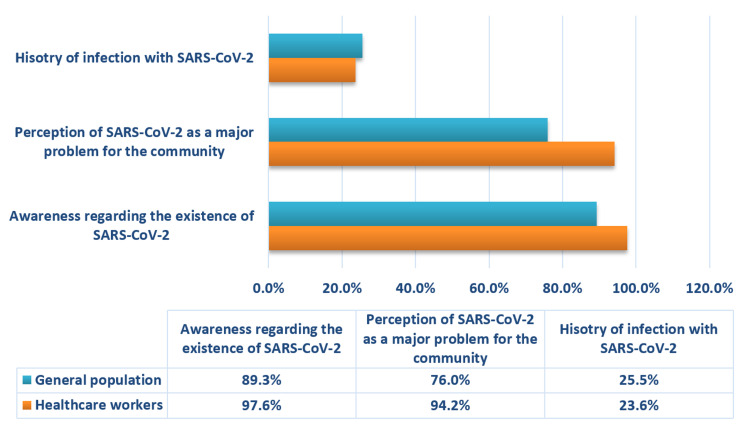
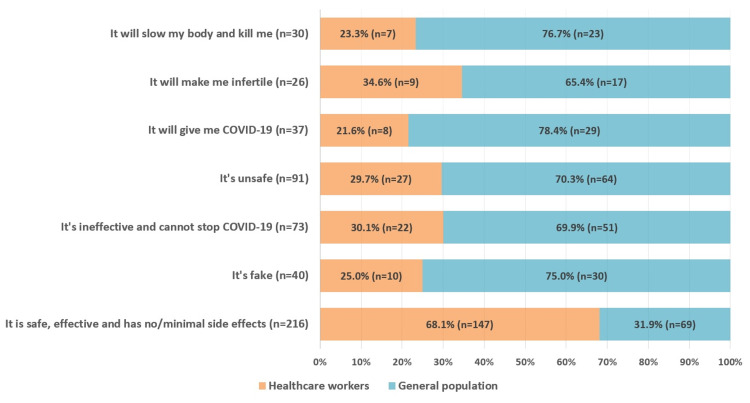
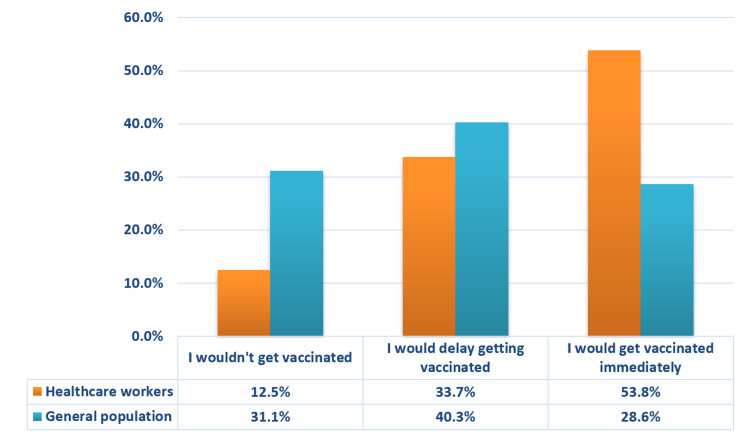
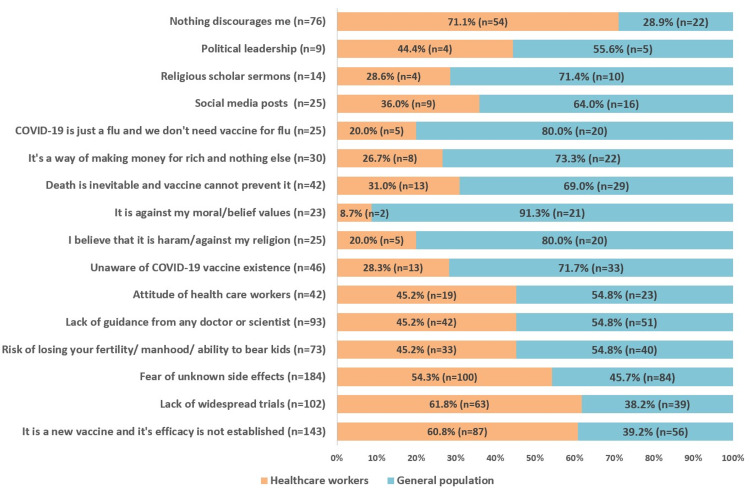
Background Vaccine hesitancy has been a huge challenge in controlling preventable diseases. With the emergence of coronavirus disease 2019 (COVID-19) vaccines, it is vital to know their acceptance rates among the masses. No comparative data is available on the current subject from Pakistan yet. Therefore, this study aimed to evaluate the acceptance of a potential COVID-19 vaccine among the general population and healthcare workers (HCWs) of Pakistan, along with their perceptions and barriers to acceptance. Methods An online cross-sectional study was carried out in Pakistan from December 19, 2020, to January 10, 2021, using convenience sampling. A self-administered questionnaire consisting of 31 items was distributed after informed consent. Inclusion criteria consisted of HCWs and non-HCWs (general population) aged 18 years and above, residing in Pakistan. All analyses were done using Statistical Package for Social Sciences (SPSS) version 23.0 (IBM Corp., Armonk, NY, USA). Chi-square and T-test were used and a p-value of less than 0.05 was considered significant for all cases. Results Of the 404 respondents (n=196 general population and n=208 HCWs), 73.5% were willing to get a proven, safe, and effective COVID-19 vaccine if it was free of cost. This was reduced to only 64.3% if the vaccine was not free and had to be paid for. A total of 168 (41.6%) participants agreed to get vaccinated immediately, while 149 (36.9%) participants concurred to get it on a delayed basis. Eighty-seven (21.5%) participants refused to receive the COVID-19 vaccine, amongst which a significant majority (p<0.001) of the participants were from the general population. Doctors or scientists/scholarly journals were found to be the most trusted source of information (67.6%; n=273), while fear of unknown side effects (45.5%; n=184) was found to be the most common barrier towards COVID-19 vaccination. More than half (53.5%) participants believed that the vaccine is safe, effective, and has minimal side effects, amongst which a significantly large fraction (p<0.001) belonged to the HCWs. Conclusion The acceptance rate of a safe, effective, proven, and free COVID-19 vaccine was 73.5%. The fear of unknown side effects was the most common barrier to COVID-19 vaccine uptake. The general population demonstrated less knowledge, more false perceptions, and barriers to COVID-19 vaccine. Adequate measures should be taken to educate the masses about the COVID-19 vaccine, and its safety, and further studies are required.
背景
疫苗犹豫一直是控制可预防疾病的巨大挑战。随着2019冠状病毒病(COVID-19)疫苗的出现,了解其在大众中的接受率至关重要。巴基斯坦目前尚无关于该主题的比较数据。因此,本研究旨在评估巴基斯坦普通人群和医护人员对潜在COVID-19疫苗的接受情况,以及他们对疫苗的看法和接受障碍。
方法
2020年12月19日至2021年1月10日在巴基斯坦进行了一项在线横断面研究,采用便利抽样。在获得知情同意后,分发了一份由31个项目组成的自填式问卷。纳入标准包括年龄在18岁及以上、居住在巴基斯坦的医护人员和非医护人员(普通人群)。所有分析均使用社会科学统计软件包(SPSS)23.0版(美国纽约州阿蒙克市IBM公司)进行。使用卡方检验和t检验,所有情况下p值小于0.05被认为具有统计学意义。
结果
在404名受访者中(n = 196名普通人群和n = 208名医护人员),如果COVID-19疫苗免费,73.5%的人愿意接种经过验证的、安全有效的疫苗。如果疫苗不免费且需要付费,这一比例仅降至64.3%。共有168名(41.6%)参与者同意立即接种疫苗,而149名(36.9%)参与者同意延迟接种。87名(21.5%)参与者拒绝接种COVID-19疫苗,其中绝大多数(p < 0.001)参与者来自普通人群。医生或科学家/学术期刊被认为是最值得信赖的信息来源(67.6%;n = 273),而对未知副作用的恐惧(45.5%;n = 184)被认为是接种COVID-19疫苗最常见的障碍。超过一半(53.5%)的参与者认为疫苗是安全、有效的,且副作用最小,其中很大一部分(p < 0.001)属于医护人员。
结论
安全、有效、经过验证且免费的COVID-19疫苗的接受率为73.5%。对未知副作用的恐惧是接种COVID-19疫苗最常见的障碍。普通人群对COVID-19疫苗的了解较少,存在更多错误认知和接种障碍。应采取适当措施对大众进行COVID-19疫苗及其安全性方面的教育,还需要进一步研究。