Piras Antonio, Boldrini Luca, Menna Sebastiano, Venuti Valeria, Pernice Gianfranco, Franzese Ciro, Angileri Tommaso, Daidone Antonino
UO Radioterapia Oncologica, Villa Santa Teresa, Palermo, Italy.
Dipartimento di Diagnostica per Immagini, Radioterapia Oncologica ed Ematologia, UOC Radioterapia Oncologica-Fondazione Policlinico Universitario Agostino Gemelli (IRCCS), Rome, Italy.
Front Oncol. 2021 Nov 12;11:761393. doi: 10.3389/fonc.2021.761393. eCollection 2021.
Radiotherapy (RT) in the head and neck (H&N) site are undoubtedly the most challenging treatments for patients. Older and frail patients are not always able to tolerate it, and there are still no clear guidelines on the type of treatments to be preferred for them. The recommendations for Risk-Adapted H&N Cancer Radiation Therapy during the coronavirus disease 2019 (COVID-19) pandemic provided by the ASTRO-ESTRO consensus statement achieved a strong agreement about hypofractionated RT (HFRT). A systematic literature review was conducted in order to evaluate the feasibility and safety of HFRT for older patients affected by H&N malignancies.
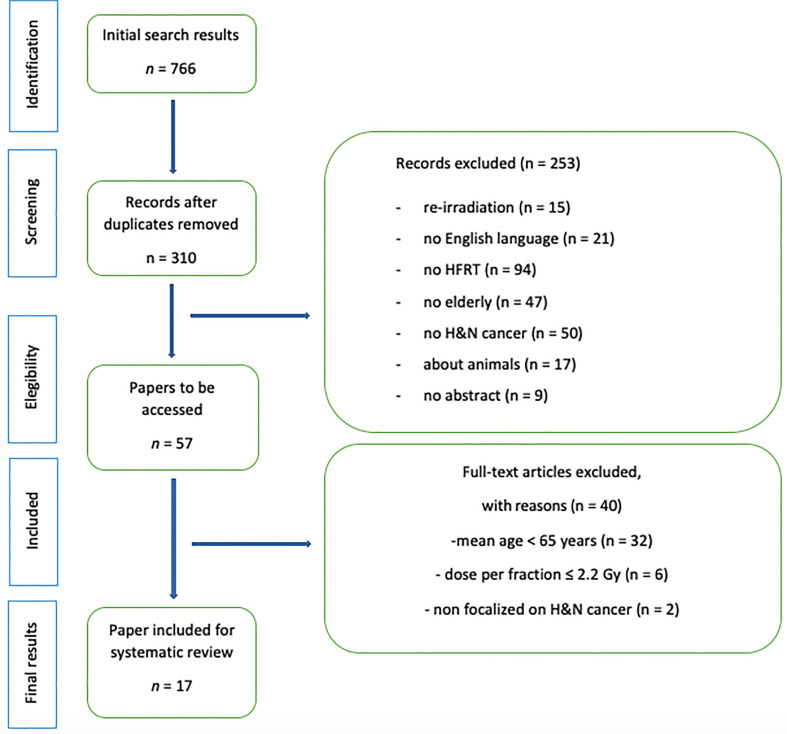
A systematic database search was performed on PubMed and Embase according to Preferred Reporting Items for Systematic Reviews and Meta-analyses (PRISMA) guidelines. Original studies, case series, and case reports describing the use of HFRT (with at least 2.2 Gy fractions) in patients with mean age ≥65 years were included. The analysis was based on the type of study, number of patients, mean age, tumor site, histology, performance status (PS), RT details, concomitant chemotherapy (CT), and described clinical outcomes. All the reported doses have been calculated in equivalent dose in 2 Gy fractions (EQD2) and biologically effective dose (BED) using α/β = 10 Gy or α/β = 12 Gy.
We selected 17 papers that met the inclusion criteria and divided them in 4 categories: 6 articles analyze HFRT performed twice daily in repeated cycles, 3 once a day in repeated cycles, 4 in alternative days, and the last 4 in consecutive days.
HFRT seems to be a good treatment with an acceptable prolonged disease control. In older patients fit for radical treatments, a 55 Gy in 20 fractions regimen can be proposed as a valid alternative to the standard fractionated RT, but there are a multitude of hypofractionated regimens, ranging from single fraction, quad shot, and 1-, 2-, 3-, 4-, and 5-week schedules that all may be appropriate. The correct regimen for a patient depends on many factors, and it represents the result of a more specific and complex decision.
对头颈部(H&N)部位进行放射治疗(RT)无疑是对患者最具挑战性的治疗方法。老年体弱患者往往无法耐受,而且对于他们首选的治疗类型仍没有明确的指导方针。美国放射肿瘤学会(ASTRO)和欧洲放射肿瘤学会(ESTRO)共识声明提供的关于2019冠状病毒病(COVID-19)大流行期间头颈部癌症风险适应性放射治疗的建议,就大分割放疗(HFRT)达成了强烈共识。进行了一项系统的文献综述,以评估HFRT对老年头颈部恶性肿瘤患者的可行性和安全性。
根据系统评价和Meta分析的首选报告项目(PRISMA)指南,在PubMed和Embase上进行了系统的数据库检索。纳入了描述平均年龄≥65岁患者使用HFRT(每次分割剂量至少2.2 Gy)的原始研究、病例系列和病例报告。分析基于研究类型、患者数量、平均年龄、肿瘤部位、组织学、体能状态(PS)、放疗细节、同步化疗(CT)以及描述的临床结果。所有报告的剂量均已使用α/β = 10 Gy或α/β = 12 Gy计算为2 Gy分割的等效剂量(EQD2)和生物有效剂量(BED)。
我们选择了17篇符合纳入标准的论文,并将它们分为4类:6篇文章分析了在重复周期中每天进行两次的HFRT,3篇分析了在重复周期中每天进行一次的HFRT,4篇分析了隔日进行的HFRT,最后4篇分析了连续进行的HFRT。
HFRT似乎是一种有效的治疗方法,具有可接受的疾病长期控制效果。对于适合根治性治疗的老年患者,可以提出20次分割给予55 Gy的方案作为标准分割放疗的有效替代方案,但有多种大分割方案,从单次分割、四程照射以及1、2、3、4和5周方案等,所有这些方案可能都适用。适合患者的正确方案取决于许多因素,它代表了一个更具体、更复杂决策的结果。