Department of Infectious Diseases, University Hospital Essen, University of Duisburg-Essen, Essen, Germany.
Bioinformatics and Computational Biophysics, University Duisburg-Essen, Essen, Germany.
Front Cell Infect Microbiol. 2021 Nov 17;11:747816. doi: 10.3389/fcimb.2021.747816. eCollection 2021.
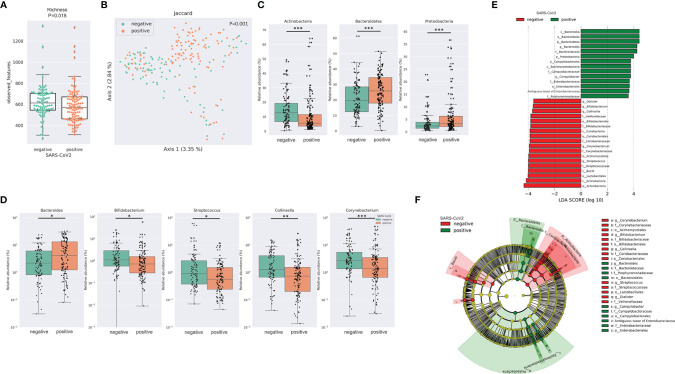
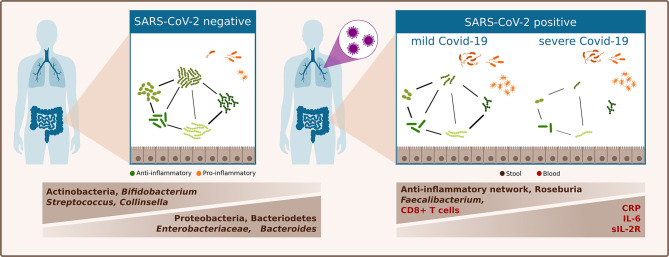
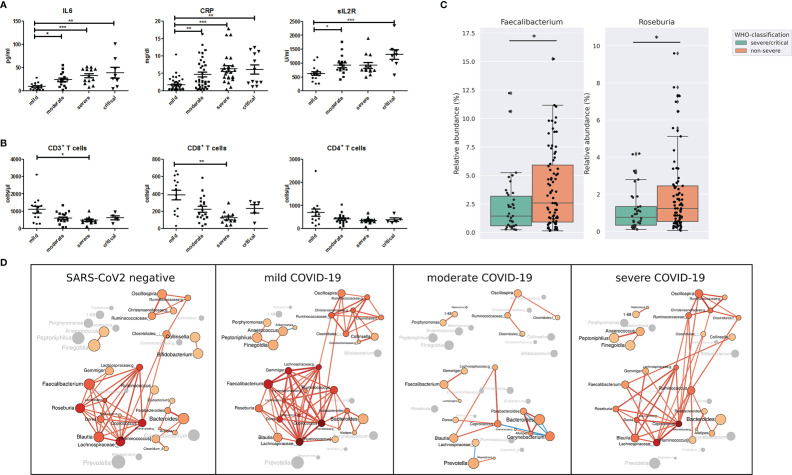
The gut microbiota contributes to maintaining human health and regulating immune responses. Severe COVID-19 illness is associated with a dysregulated pro-inflammatory immune response. The effect of SARS-CoV-2 on altering the gut microbiome and the relevance of the gut microbiome on COVID-19 severity needs to be clarified. In this prospective study, we analyzed the gut microbiome of 212 patients of a tertiary care hospital (117 patients infected with SARS-CoV-2 and 95 SARS-CoV-2 negative patients) using gene sequencing of the V3-V4 region. Inflammatory markers and immune cells were quantified from blood. The gut microbiome in SARS-CoV-2 infected patients was characterized by a lower bacterial richness and distinct differences in the gut microbiome composition, including an enrichment of the phyla Proteobacteria and Bacteroidetes and a decrease of Actinobacteria compared to SARS-CoV-2 negative patients. The relative abundance of several genera including , and was lower in SARS-CoV-2 positive patients while the abundance of and was increased. Higher pro-inflammatory blood markers and a lower CD8 T cell number characterized patients with severe COVID-19 illness. The gut microbiome of patients with severe/critical COVID-19 exhibited a lower abundance of butyrate-producing genera and and a reduction in the connectivity of a distinct network of anti-inflammatory genera that was observed in patients with mild COVID-19 illness and in SARS-CoV-2 negative patients. Dysbiosis of the gut microbiome associated with a pro-inflammatory signature may contribute to the hyperinflammatory immune response characterizing severe COVID-19 illness.
肠道微生物群有助于维持人体健康和调节免疫反应。严重的 COVID-19 疾病与失调的促炎免疫反应有关。需要阐明 SARS-CoV-2 对改变肠道微生物组的影响以及肠道微生物组对 COVID-19 严重程度的相关性。在这项前瞻性研究中,我们使用 V3-V4 区域的基因测序分析了一家三级保健医院的 212 名患者(117 名感染 SARS-CoV-2 的患者和 95 名 SARS-CoV-2 阴性患者)的肠道微生物组。从血液中定量测定炎症标志物和免疫细胞。SARS-CoV-2 感染患者的肠道微生物组特征为细菌丰富度较低,肠道微生物组组成存在明显差异,包括厚壁菌门和拟杆菌门的丰度增加,放线菌门的丰度降低。与 SARS-CoV-2 阴性患者相比,一些属的相对丰度,如 、 和 ,在 SARS-CoV-2 阳性患者中较低,而 和 的丰度增加。高促炎血液标志物和 CD8 T 细胞数量减少的特点是严重 COVID-19 疾病患者。严重/危重症 COVID-19 患者的肠道微生物组中,产丁酸盐的属 和 的丰度较低,抗炎属的特定网络连接减少,而轻度 COVID-19 疾病患者和 SARS-CoV-2 阴性患者则存在这种网络连接。与促炎特征相关的肠道微生物组失调可能有助于严重 COVID-19 疾病中特征性的过度炎症免疫反应。