Department of Infectious Diseases, University Hospital Essen, University of Duisburg-Essen, Essen, Germany.
Bioinformatics and Computational Biophysics, University of Duisburg-Essen, Essen, Germany.
Front Cell Infect Microbiol. 2022 Apr 19;12:848650. doi: 10.3389/fcimb.2022.848650. eCollection 2022.
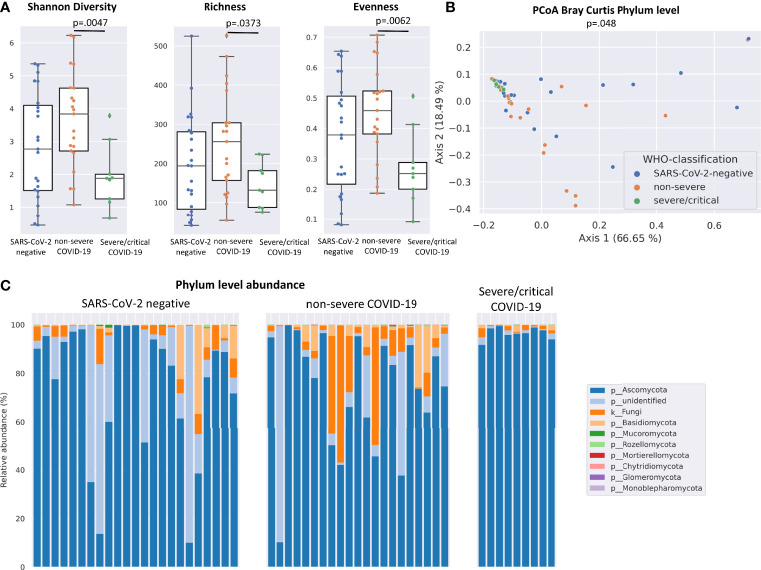
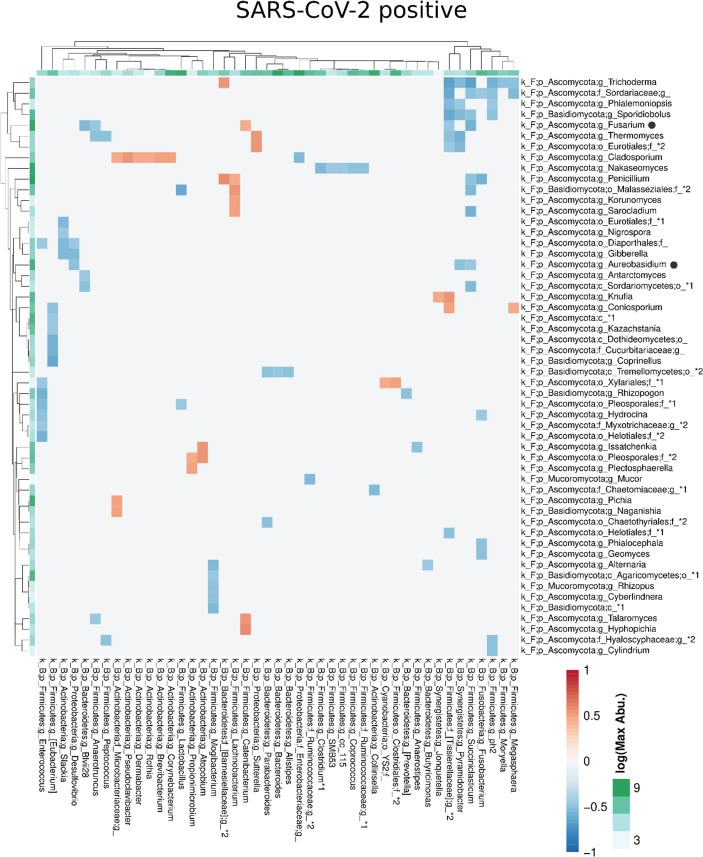
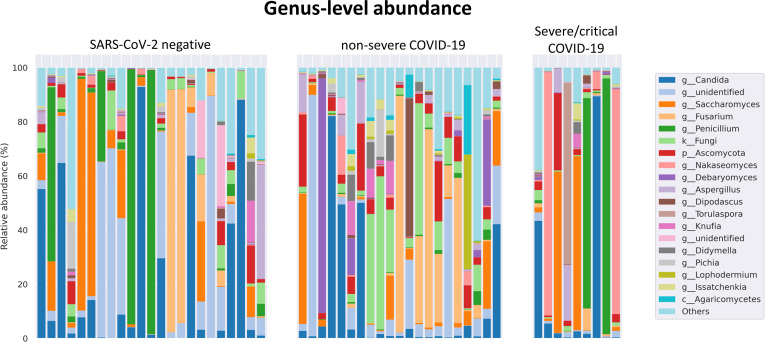
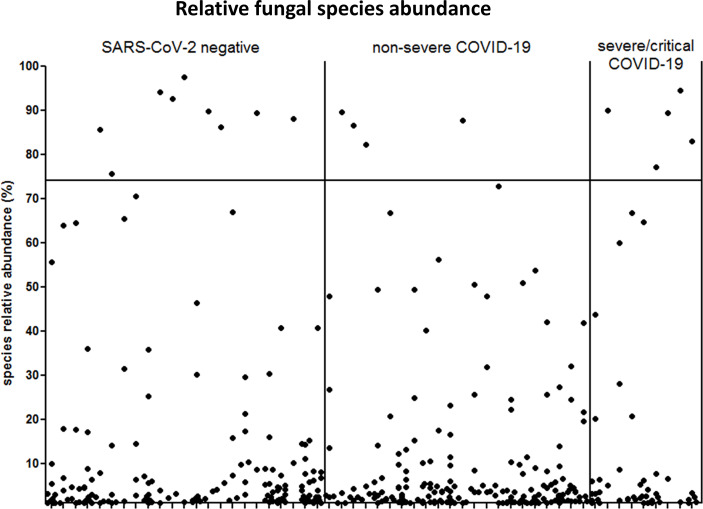
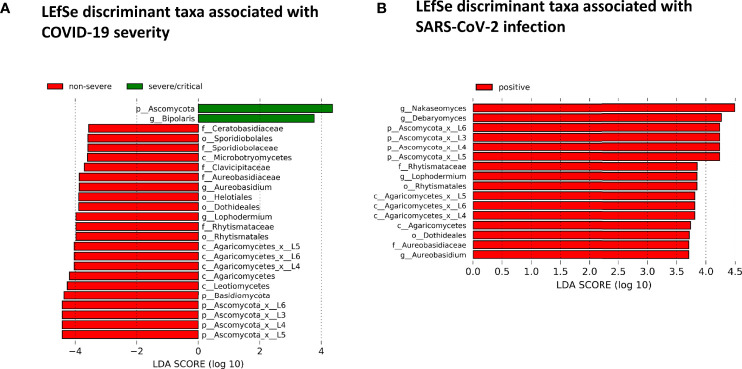
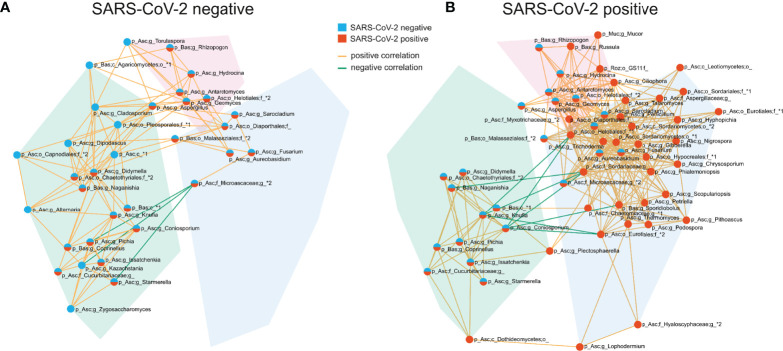
Clinical and experimental studies indicate that the bacterial and fungal gut microbiota modulates immune responses in distant organs including the lungs. Immune dysregulation is associated with severe SARS-CoV-2 infection, and several groups have observed gut bacterial dysbiosis in SARS-CoV-2 infected patients, while the fungal gut microbiota remains poorly defined in these patients. We analyzed the fungal gut microbiome from rectal swabs taken prior to anti-infective treatment in 30 SARS-CoV-2 positive (21 non-severe COVID-19 and 9 developing severe/critical COVID-19 patients) and 23 SARS-CoV-2 negative patients by ITS2-sequencing. Pronounced but distinct interconnected fungal communities distinguished SARS-CoV-2 positive and negative patients. Fungal gut microbiota in severe/critical COVID-19 illness was characterized by a reduced diversity, richness and evenness and by an increase of the relative abundance of the Ascomycota phylum compared with non-severe COVID-19 illness. A dominance of a single fungal species with a relative abundance of >75% was a frequent feature in severe/critical COVID-19. The dominating fungal species were highly variable between patients even within the groups. Several fungal taxa were depleted in patients with severe/critical COVID-19.The distinct compositional changes of the fungal gut microbiome in SARS-CoV-2 infection, especially in severe COVID-19 illness, illuminate the necessity of a broader approach to investigate whether the differences in the fungal gut microbiome are consequences of SARS-CoV-2 infection or a predisposing factor for critical illness.
临床和实验研究表明,细菌和真菌肠道微生物群会调节包括肺部在内的远处器官的免疫反应。免疫失调与严重的 SARS-CoV-2 感染有关,有几个研究小组观察到 SARS-CoV-2 感染患者存在肠道细菌失调,而这些患者的肠道真菌微生物群尚未得到明确界定。我们通过 ITS2 测序分析了 30 名 SARS-CoV-2 阳性(21 名非重症 COVID-19 和 9 名发展为重症/危重症 COVID-19 的患者)和 23 名 SARS-CoV-2 阴性患者在接受抗感染治疗前直肠拭子中的真菌肠道微生物组。明显但不同的相互连接的真菌群落区分了 SARS-CoV-2 阳性和阴性患者。与非重症 COVID-19 相比,重症/危重症 COVID-19 患者的肠道真菌微生物多样性、丰富度和均匀度降低,厚壁菌门的相对丰度增加。单一真菌物种相对丰度 >75%的优势是重症/危重症 COVID-19 的一个常见特征。即使在重症 COVID-19 患者中,主导真菌物种的相对丰度也存在高度变异性。重症/危重症 COVID-19 患者中几种真菌类群减少。SARS-CoV-2 感染中真菌肠道微生物组的明显组成变化,特别是在重症 COVID-19 中,说明有必要更广泛地研究肠道真菌微生物组的差异是否是 SARS-CoV-2 感染的结果,还是重症疾病的易感因素。