Chen Yuan-Yuan, Li Hai, Xu Bao-Yan, Zheng Xin, Li Bei-Ling, Wang Xian-Bo, Huang Yan, Gao Yan-Hang, Qian Zhi-Ping, Liu Feng, Lu Xiao-Bo, Shang Jia, Li Hai, Wang Shao-Yang, Zhang Yin-Hua, Meng Zhong-Ji
Department of Infectious Diseases, Hubei Clinical Research Center for Precise Diagnosis and Therapy of Liver Cancer, Taihe Hospital, Hubei University of Medicine, Shiyan, China.
Key Laboratory of Gastroenterology and Hepatology, Department of Gastroenterology, Renji Hospital, School of Medicine, Shanghai Institute of Digestive Disease, Shanghai Jiao Tong University, Chinese Ministry of Health (Shanghai Jiao Tong University), Shanghai, China.
Front Med (Lausanne). 2021 Nov 16;8:779744. doi: 10.3389/fmed.2021.779744. eCollection 2021.
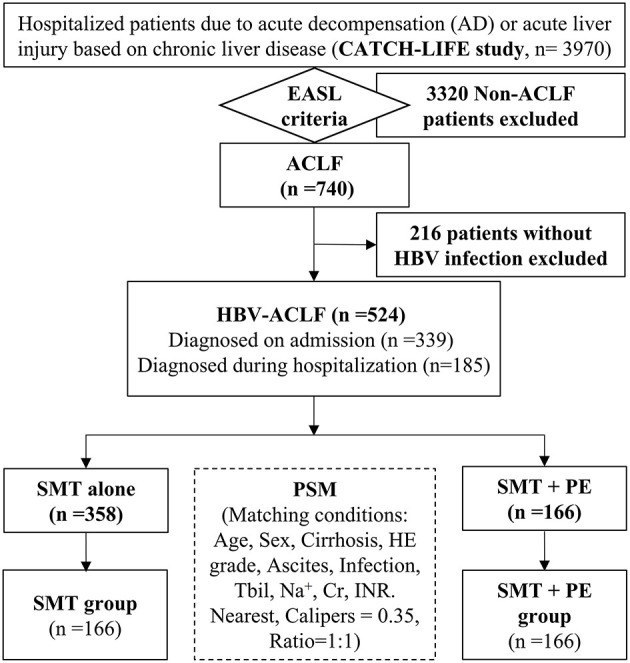
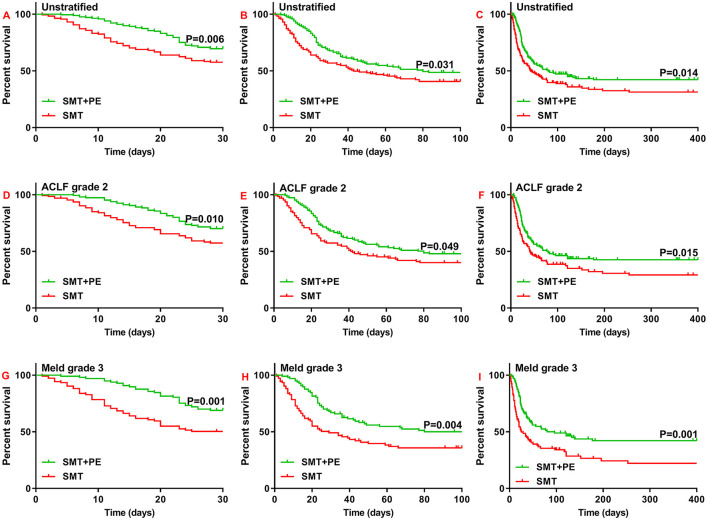
Hepatitis B virus-associated acute-on-chronic liver failure (HBV-ACLF) is a complicated syndrome with extremely high short-term mortality. Whether plasma exchange (PE) improves HBV-ACLF outcomes remains controversial. Here, PE-based non-bioartificial liver support system (NB-ALSS) effects on short-term HBV-ACLF patient outcomes were investigated. HBV-ACLF patients from Chinese Acute-on-chronic Liver Failure (CATCH-LIFE) cohort receiving standard medical therapy (SMT) alone or PE-based NB-ALSS in addition to SMT were allocated to SMT and SMT+PE groups, respectively; propensity score matching (PSM) was used to eliminate confounding bias. Short-term (28/90-day and 1-year) survival rates were calculated (Kaplan-Meier). In total, 524 patients with HBV-ACLF were enrolled in this study; 358 received SMT alone (SMT group), and the remaining 166 received PE-based NB-ALSS in addition to SMT (SMT+PE group). PSM generated 166 pairs of cases. In the SMT+PE group, 28-day, 90-day, and 1-year survival rates were 11.90, 8.00, and 10.90%, respectively, higher than those in the SMT group. Subgroup analysis revealed that PE-based NB-ALSS had the best efficacy in patients with ACLF grade 2 or MELD scores of 30-40 (MELD grade 3). In MELD grade 3 patients who received SMT+PE, 28-day, 90-day, and 1-year survival rates were improved by 18.60, 14.20, and 20.10%, respectively. According to multivariate Cox regression analysis, PE-based NB-ALSS was the only independent protective factor for HBV-ACLF patient prognosis at 28 days, 90 days, and 1 year (28 days, HR = 0.516, = 0.001; 90 days, HR = 0.663, = 0.010; 1 year, HR = 0.610, = 0.051). For those who received SMT+PE therapy, PE-based NB-ALSS therapy frequency was the only independent protective factor for short-term prognosis (28-day, HR = 0.597, = 0.001; 90-day, HR = 0.772, = 0.018). This multicenter prospective study showed that the addition of PE-based NB-ALSS to SMT improves short-term (28/90 days and 1-year) outcomes in patients with HBV-ACLF, especially in MELD grade 3 patients. Optimization of PE-based NB-ALSS may improve prognosis or even save lives among HBV-ACLF patients.
乙型肝炎病毒相关慢加急性肝衰竭(HBV-ACLF)是一种短期死亡率极高的复杂综合征。血浆置换(PE)是否能改善HBV-ACLF的预后仍存在争议。在此,研究了基于PE的非生物人工肝支持系统(NB-ALSS)对HBV-ACLF患者短期预后的影响。来自中国慢加急性肝衰竭(CATCH-LIFE)队列的HBV-ACLF患者,分别单独接受标准药物治疗(SMT)或在SMT基础上联合基于PE的NB-ALSS,被分配至SMT组和SMT+PE组;采用倾向得分匹配(PSM)消除混杂偏倚。计算短期(28/90天和1年)生存率(Kaplan-Meier法)。本研究共纳入524例HBV-ACLF患者;358例单独接受SMT(SMT组),其余166例在SMT基础上联合基于PE的NB-ALSS(SMT+PE组)。PSM产生166对病例。在SMT+PE组中,28天、90天和1年生存率分别为11.90%、8.00%和10.90%,高于SMT组。亚组分析显示,基于PE的NB-ALSS在ACLF 2级或终末期肝病模型(MELD)评分30 - 40(MELD 3级)的患者中疗效最佳。在接受SMT+PE的MELD 3级患者中,28天、90天和1年生存率分别提高了18.60%、14.20%和20.10%。根据多因素Cox回归分析,基于PE的NB-ALSS是HBV-ACLF患者在28天、90天和1年时预后的唯一独立保护因素(28天,风险比[HR]=0.516,P=0.001;90天,HR=0.663,P=0.010;1年,HR=0.610,P=0.051)。对于接受SMT+PE治疗的患者,基于PE的NB-ALSS治疗频率是短期预后的唯一独立保护因素(28天,HR=0.597,P=0.001;90天,HR=0.772,P=0.018)。这项多中心前瞻性研究表明,在SMT基础上联合基于PE的NB-ALSS可改善HBV-ACLF患者的短期(28/90天和1年)预后,尤其是在MELD 3级患者中。优化基于PE的NB-ALSS可能改善HBV-ACLF患者的预后甚至挽救生命。