Felici Nicholas, Liu Da, Maret Josh, Restrepo Mariana, Borovskiy Yuliya, Hajj Jihane, Chung Wesley, Laudanski Krzysztof
Independence Blue Cross, Philadelphia, PA, United States.
Department of Obstetrics and Gynecology, Shengjing Hospital of China Medical University, Shenyang, China.
Front Cardiovasc Med. 2021 Nov 15;8:674248. doi: 10.3389/fcvm.2021.674248. eCollection 2021.
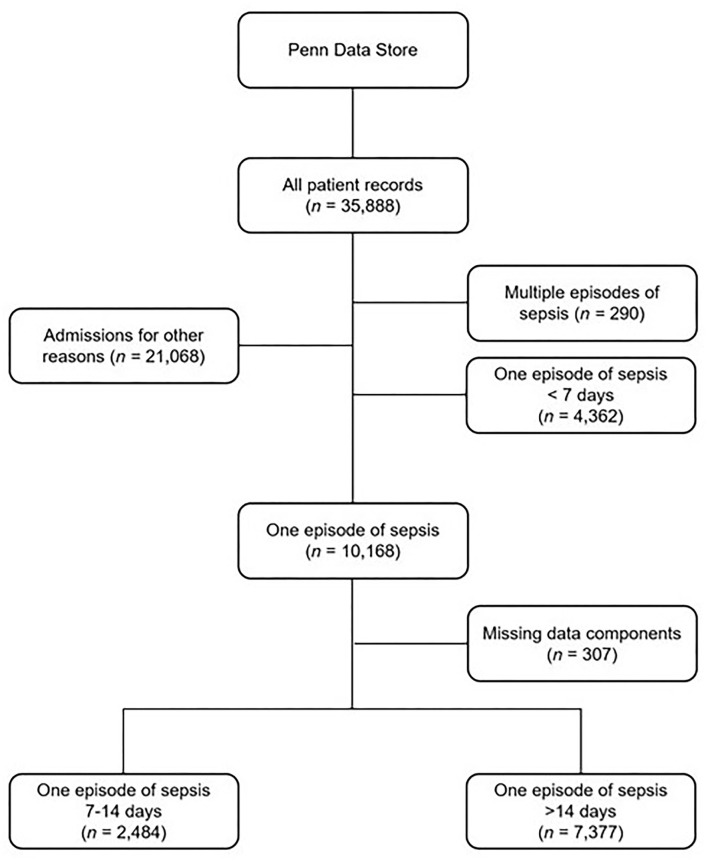
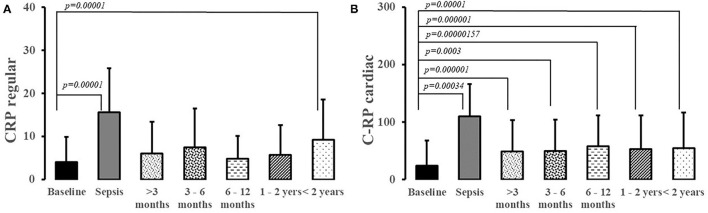
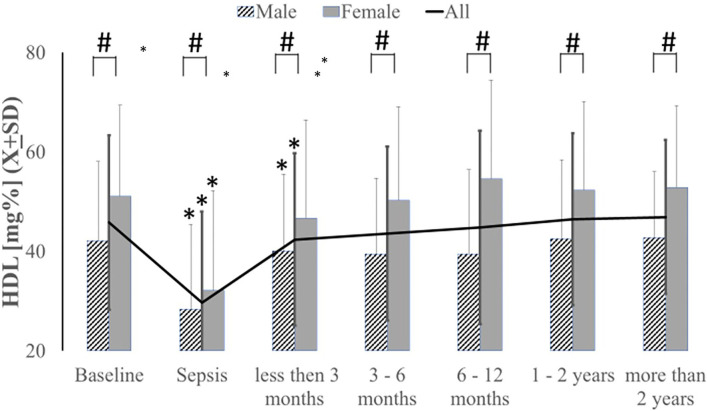
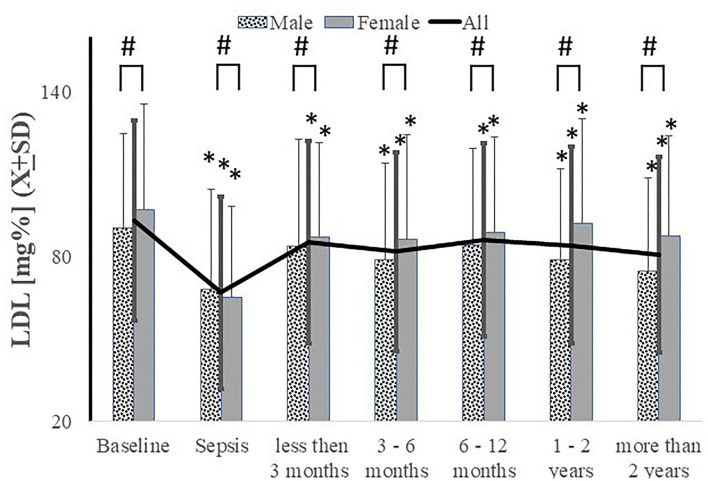
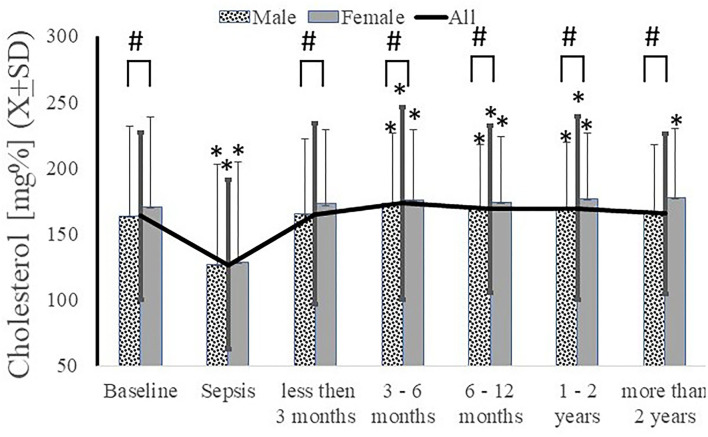
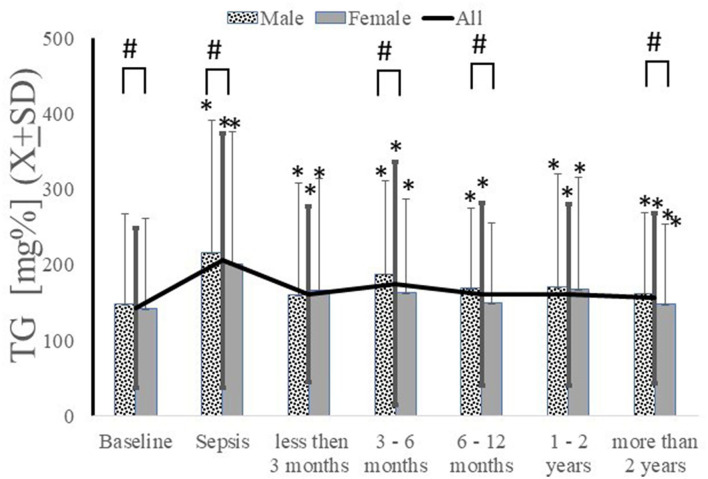
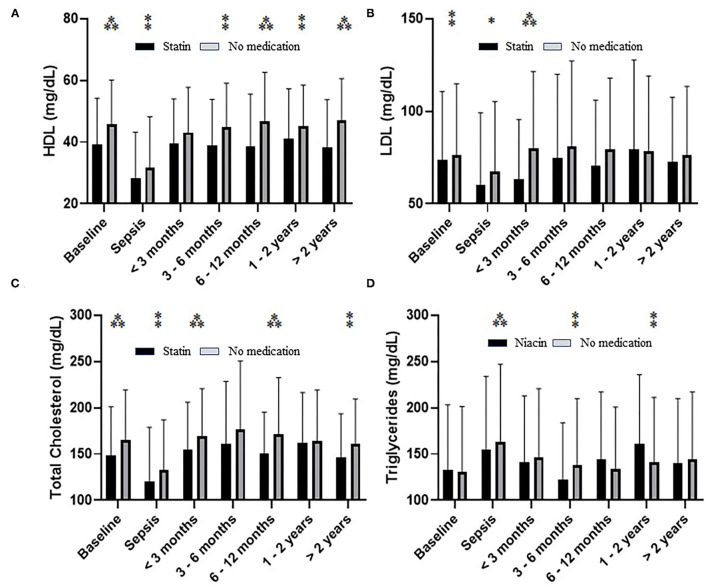
Acute disturbances of the lipid profile are commonplace during acute sepsis episode. However, their long-term persistence has not to be investigated despite pivotal role of dyslipidemia in several comorbidities excessively noted in sepsis survivors (stroke, cardiomyopathy). A total of 9,861 individuals hospitalized for a singular episode of sepsis between 2009 and 2019 were identified from electronic medical records. Lab measurements of total cholesterol (Tchol), high-density lipoprotein (HDL-c), low-density lipoprotein (LDL-c), very low-density lipoprotein (VLDL), triglycerides (TG), lipoprotein(a) [Lp (a)], apolipoprotein B (ApoB), and C-reactive protein (CRP). The data were examined as baseline values before sepsis, during hospitalization, and <3 months, 3-6 months, 6-12 months, 1-2 years, and more than 2 years from initial sepsis. Significant reductions in HDL-c (HDL = 44.06 vs. HDL = 28.2; = -37.79, < 0.0001, Cohen's = 0.22) and LDL-c serum levels were observed during and up to three months post sepsis, with females much less affected. In contrast, male subjects had derangement in HDL present for up to two years after a singular septic episode. Total cholesterol levels were slightly yet significantly elevated for up to two years after sepsis. TG were elevated up to one year [TG = 128.26 vs. TG = 170.27, (8255) = -21.33, < 0.0001, Cohen's = 0.49] and normalized. Lp(a) was elevated up to two years after initial episode [Lp(a) = 24.6 ± 16.06; Lp(a) = 8.25 ± 5.17; Lp(a) = 61.4 ± 40.1; ANOVA = 7.39; = 0.0032]. Response to statin therapy was blunted in sepsis survivors for several years after sepsis resolution. Significant drop-out in prescription of statins and niacin after sepsis was observed. Serum high sensitivity C-reactive protein was elevated for up to five years after sepsis resolution (H [6;1685] = 502.2; < 0.0001). Lipid abnormalities persisted long after the initial septic insult suggesting potential role in accelerating atherosclerosis and other abnormalities. In addition, sepsis seems to blunt statin effectiveness. Additionally, a significant and unexplained drop in statin use was seen in post-septic period. Our study suggests that persistent derangements of lipid profile components for up to two years after sepsis may be associated with altered risk of atherosclerosis-related events among sepsis survivors.
在急性脓毒症发作期间,脂质谱的急性紊乱很常见。然而,尽管血脂异常在脓毒症幸存者中过度出现的几种合并症(中风、心肌病)中起关键作用,但尚未对其长期持续性进行研究。从电子病历中识别出2009年至2019年间因单次脓毒症发作住院的9861名个体。对总胆固醇(Tchol)、高密度脂蛋白(HDL-c)、低密度脂蛋白(LDL-c)、极低密度脂蛋白(VLDL)、甘油三酯(TG)、脂蛋白(a) [Lp (a)]、载脂蛋白B(ApoB)和C反应蛋白(CRP)进行实验室测量。将数据作为脓毒症前的基线值、住院期间以及初始脓毒症后<3个月、3 - 6个月、6 - 12个月、1 - 2年和超过2年进行检查。在脓毒症期间及脓毒症后三个月内,观察到HDL-c(HDL = 44.06 vs. HDL = 28.2; = -37.79, < 0.0001,科恩d = 0.22)和LDL-c血清水平显著降低,女性受影响较小。相比之下,男性受试者在单次脓毒症发作后长达两年的时间里HDL出现紊乱。脓毒症后长达两年的时间里,总胆固醇水平略有但显著升高。TG升高至一年[TG = 128.26 vs. TG = 170.27, (8255) = -21.33, < 0.0001, 科恩d = 0.49]然后恢复正常。初始发作后长达两年的时间里Lp(a)升高[Lp(a) = 24.6 ± 16.06;Lp(a) = 8.25 ± 5.17;Lp(a) = 61.4 ± 40.1;方差分析 = 7.39; = 0.0032]。脓毒症幸存者在脓毒症缓解后的几年里对他汀类药物治疗的反应减弱。脓毒症后观察到他汀类药物和烟酸处方的显著停药情况。脓毒症缓解后长达五年的时间里血清高敏C反应蛋白升高(H [6;1685] = 502.2; < 0.0001)。脂质异常在初始脓毒症损伤后长期持续存在,表明在加速动脉粥样硬化和其他异常方面可能发挥作用。此外,脓毒症似乎会削弱他汀类药物的有效性。此外,在脓毒症后期观察到他汀类药物使用的显著且无法解释的下降。我们的研究表明,脓毒症后长达两年的时间里脂质谱成分的持续紊乱可能与脓毒症幸存者中动脉粥样硬化相关事件风险的改变有关。