Liu Tong, Zhou Zhen, Bo Kairui, Gao Yifeng, Wang Hui, Wang Rui, Liu Wei, Chang Sanshuai, Liu Yuanyuan, Sun Yuqing, Firmin David, Yang Guang, Dong Jianzeng, Xu Lei
Department of Cardiology, Beijing Anzhen Hospital, Capital Medical University, Beijing, China.
National Clinical Research Center for Cardiovascular Diseases, Capital Medical University, Beijing, China.
Front Cardiovasc Med. 2021 Nov 16;8:751907. doi: 10.3389/fcvm.2021.751907. eCollection 2021.
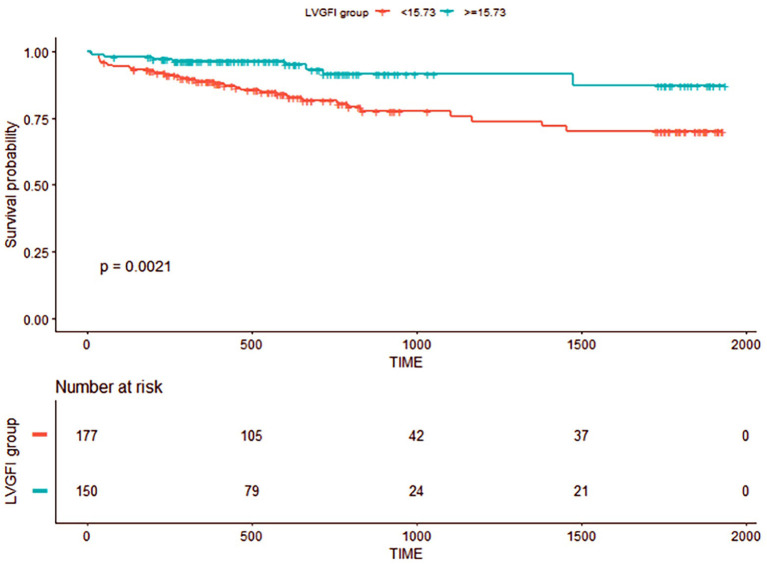
Left ventricular global function index (LVGFI) assessed using cardiac magnetic resonance (CMR) seems promising in the prediction of clinical outcomes. However, the role of the LVGFI is uncertain in patients with heart failure (HF) with dilated cardiomyopathy (DCM). To describe the association of LVGFI and outcomes in patients with DCM, it was hypothesized that LVGFI is associated with decreased major adverse cardiac events (MACEs) in patients with DCM. This prospective cohort study was conducted from January 2015 to April 2020 in consecutive patients with DCM who underwent CMR. The association between outcomes and LVGFI was assessed using a multivariable model adjusted with confounders. LVGFI was the primary exposure variable. The long-term outcome was a composite endpoint, including death or heart transplantation. A total of 334 patients (mean age: 55 years) were included in this study. The average of CMR-LVGFI was 16.53%. Over a median follow-up of 565 days, 43 patients reached the composite endpoint. Kaplan-Meier analysis revealed that patients with LVGFI lower than the cutoff values (15.73%) had a higher estimated cumulative incidence of the endpoint compared to those with LVGFI higher than the cutoff values ( = 0.0021). The hazard of MACEs decreased by 38% for each 1 SD increase in LVGFI (hazard ratio 0.62[95%CI 0.43-0.91]) and after adjustment by 46% (HR 0.54 [95%CI 0.32-0.89]). The association was consistent across subgroup analyses. In this study, an increase in CMR-LVGFI was associated with decreasing the long-term risk of MACEs with DCM after adjustment for traditional confounders.
使用心脏磁共振成像(CMR)评估的左心室整体功能指数(LVGFI)在预测临床结局方面似乎很有前景。然而,LVGFI在扩张型心肌病(DCM)所致心力衰竭(HF)患者中的作用尚不确定。为了描述LVGFI与DCM患者结局之间的关联,研究假设LVGFI与DCM患者主要不良心脏事件(MACE)的减少相关。这项前瞻性队列研究于2015年1月至2020年4月对连续接受CMR检查的DCM患者进行。使用经混杂因素调整的多变量模型评估结局与LVGFI之间的关联。LVGFI是主要暴露变量。长期结局是一个复合终点,包括死亡或心脏移植。本研究共纳入334例患者(平均年龄:55岁)。CMR-LVGFI的平均值为16.53%。在中位随访565天期间,43例患者达到复合终点。Kaplan-Meier分析显示,LVGFI低于临界值(15.73%)的患者与LVGFI高于临界值的患者相比,终点事件的估计累积发生率更高(P = 0.0021)。LVGFI每增加1个标准差,MACE的风险降低38%(风险比0.62[95%置信区间0.43 - 0.91]),调整后降低46%(风险比0.54[95%置信区间0.32 - 0.89])。该关联在亚组分析中一致。在本研究中,经传统混杂因素调整后,CMR-LVGFI的增加与降低DCM患者MACE的长期风险相关。