Ebert Max L A, Schmidt Vanessa F, Pfaff Lena, von Thaden Anne, Kimm Melanie A, Wildgruber Moritz
Department for Radiology, University Hospital, Ludwigs Maximilian University (LMU), Munich, Germany.
Biomedical Center Munich, Ludwigs Maximilian University (LMU), Munich, Germany.
JACC Basic Transl Sci. 2021 Aug 11;6(11):900-917. doi: 10.1016/j.jacbts.2021.06.006. eCollection 2021 Nov.
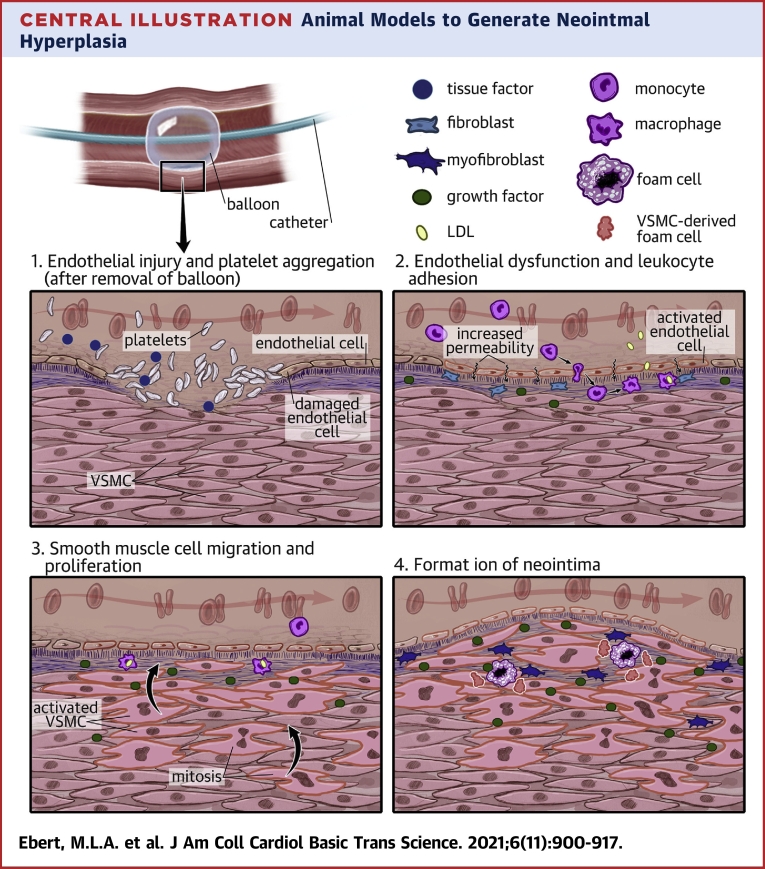
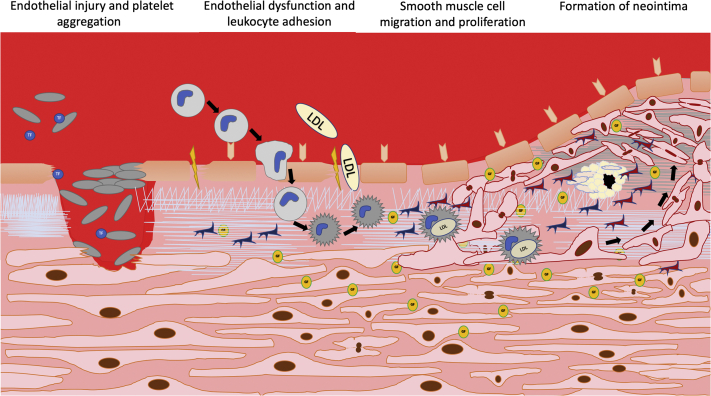
The process of restenosis is based on the interplay of various mechanical and biological processes triggered by angioplasty-induced vascular trauma. Early arterial recoil, negative vascular remodeling, and neointimal formation therefore limit the long-term patency of interventional recanalization procedures. The most serious of these processes is neointimal hyperplasia, which can be traced back to 4 main mechanisms: endothelial damage and activation; monocyte accumulation in the subintimal space; fibroblast migration; and the transformation of vascular smooth muscle cells. A wide variety of animal models exists to investigate the underlying pathophysiology. Although mouse models, with their ease of genetic manipulation, enable cell- and molecular-focused fundamental research, and rats provide the opportunity to use stent and balloon models with high throughput, both rodents lack a lipid metabolism comparable to humans. Rabbits instead build a bridge to close the gap between basic and clinical research due to their human-like lipid metabolism, as well as their size being accessible for clinical angioplasty procedures. Every different combination of animal, dietary, and injury model has various advantages and disadvantages, and the decision for a proper model requires awareness of species-specific biological properties reaching from vessel morphology to distinct cellular and molecular features.
再狭窄过程基于血管成形术诱导的血管损伤引发的各种机械和生物学过程的相互作用。因此,早期动脉回缩、负性血管重塑和新生内膜形成限制了介入再通手术的长期通畅性。这些过程中最严重的是新生内膜增生,其可追溯到4个主要机制:内皮损伤和激活;单核细胞在内膜下空间积聚;成纤维细胞迁移;以及血管平滑肌细胞的转化。存在多种动物模型来研究潜在的病理生理学。尽管小鼠模型易于进行基因操作,能够进行聚焦细胞和分子的基础研究,大鼠则提供了使用高通量支架和球囊模型的机会,但这两种啮齿动物都缺乏与人类相当的脂质代谢。相反,兔子由于其类似人类的脂质代谢,以及其大小便于进行临床血管成形术,为弥合基础研究和临床研究之间的差距搭建了桥梁。动物、饮食和损伤模型的每一种不同组合都有各自的优缺点,选择合适的模型需要了解从血管形态到独特细胞和分子特征的物种特异性生物学特性。