University Hospital for Children and Adolescents, Universitätsmedizin Rostock, Ernst-Heydemann-Straße 8, Rostock, 18057, Germany.
Clinical Pharmacy, Institute of Pharmacy, Medical Faculty, Leipzig University and Drug Safety Center, Leipzig University and University Hospital, Bruederstraße 32, Leipzig, 04103, Germany.
Eur J Pediatr. 2022 Apr;181(4):1487-1495. doi: 10.1007/s00431-021-04335-1. Epub 2021 Dec 7.
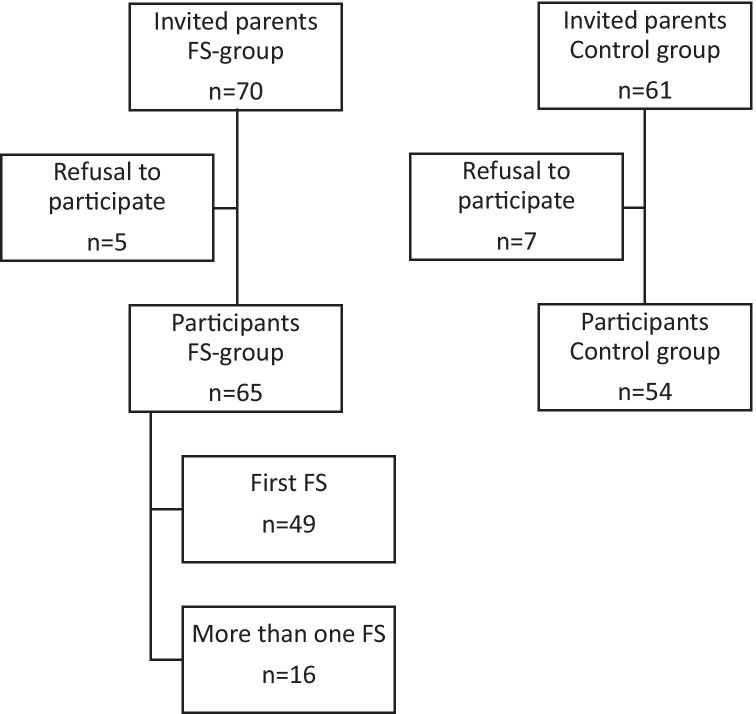
Febrile seizures (FS) in children are common, but little is known about parents' perceptions and knowledge of FS. We interviewed parents of children aged 6 months to 6 years affected by FS (FS group, 65 parents) or unaffected (control group, 54 parents). In the FS group, 32% said they knew their child had an FS when the first event occurred, and 89% described fear when the child had a seizure, with a median intensity of 10/10 (Q25/Q75: 9/10). Related to follow-up, 77% in the FS group (will) observe their child more carefully after the first seizure happened, and 63% (will) give antipyretics earlier at a median temperature of 38.2 °C (100.8 °F). In the FS group, 62% were unaware of FS before the first event (54% of control group did not know about FS thus far, n.s.). In the FS group, 20% would put a solid object in the mouth of a child having a seizure (control group, 39%, p = 0.030), and 92% would administer an available anti-seizure rescue medication (control group, 78%, p = 0.019). In the FS group, 71% feared that children with FS might suffocate (control group, 70%, n.s.).
Information about FS and their management should be more available to improve parents' coping and patient safety.
• Febrile seizures in children are common. • The prognosis of children suffering from febrile seizures is usually rather good.
• Over half of parents had not informed themselves about febrile seizures so far; and only 32% of parents realized their child had a febrile seizure when it occurred. • Most parents described own fear with a median intensity of 10/10; and 63% (will) give antipyretics earlier at a median temperature of 38.2 °C (100.8 °F).
儿童热性惊厥(FS)很常见,但家长对 FS 的认知和了解甚少。我们对 6 个月至 6 岁患有 FS(FS 组,65 位家长)或未患有 FS(对照组,54 位家长)的患儿家长进行了访谈。在 FS 组中,32%的家长表示,他们在首次发作时就知道自己的孩子有 FS,89%的家长在孩子发作时感到恐惧,中位数强度为 10/10(四分位距 25/75:9/10)。与随访相关,FS 组中 77%(将会)在首次发作后更仔细地观察孩子,63%(将会)在中位数体温为 38.2°C(100.8°F)时更早地使用退烧药。在 FS 组中,62%的家长在首次发作前不知道 FS(对照组中,54%迄今不知道 FS,无统计学差异)。在 FS 组中,20%的家长(对照组中 39%,p=0.030)会在孩子发作时将固体物体放入口中,92%的家长(对照组中 78%,p=0.019)会使用可用的抗惊厥急救药物。在 FS 组中,71%的家长担心患有 FS 的孩子可能会窒息(对照组中,70%,无统计学差异)。
应提供更多关于 FS 及其管理的信息,以改善家长的应对能力和患者安全。
•儿童热性惊厥很常见。•患有热性惊厥的儿童的预后通常较好。
•超过一半的家长迄今尚未了解热性惊厥;只有 32%的家长在发作时意识到自己的孩子患有热性惊厥。•大多数家长描述自己的恐惧程度为中位数强度 10/10;并且 63%(将会)在中位数体温为 38.2°C(100.8°F)时更早地使用退烧药。