Department of Pathology, Anatomy and Cell Biology, Sidney Kimmel Medical College, Thomas Jefferson University, Philadelphia, Pennsylvania, USA.
Department of Anatomy and Cell Biology, George Washington University School of Medicine and Health Sciences, Washington, District of Columbia, USA.
FASEB J. 2022 Jan;36(1):e21995. doi: 10.1096/fj.202101098R.
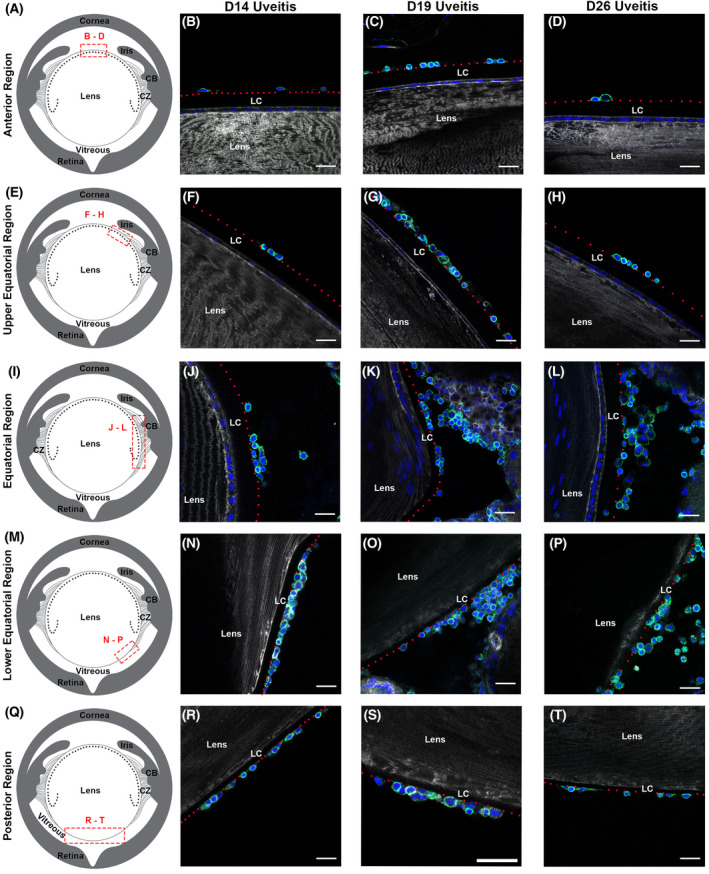
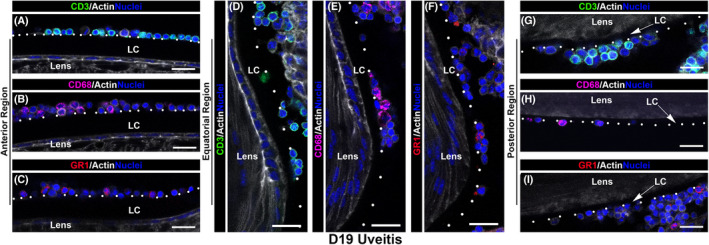
While the eye is considered an immune privileged site, its privilege is abrogated when immune cells are recruited from the surrounding vasculature in response to trauma, infection, aging, and autoimmune diseases like uveitis. Here, we investigate whether in uveitis immune cells become associated with the lens capsule and compromise its privilege in studies of C57BL/6J mice with experimental autoimmune uveitis. These studies show that at D14, the peak of uveitis in these mice, T cells, macrophages, and Ly6G/Ly6C+ immune cells associate with the lens basement membrane capsule, burrow into the capsule matrix, and remain integrated with the capsule as immune resolution is occurring at D26. 3D surface rendering image analytics of confocal z-stacks and scanning electron microscopy imaging of the lens surface show the degradation of the lens capsule as these lens-associated immune cells integrate with and invade the lens capsule, with a subset infiltrating both epithelial and fiber cell regions of lens tissue, abrogating its immune privilege. Those immune cells that remain on the surface often become entwined with a fibrillar net-like structure. Immune cell invasion of the lens capsule in uveitis has not been described previously and may play a role in induction of lens and other eye pathologies associated with autoimmunity.
虽然眼睛被认为是免疫特惠部位,但当免疫细胞从周围血管募集以响应创伤、感染、衰老和自身免疫性疾病(如葡萄膜炎)时,其特惠性就会丧失。在这里,我们研究了在葡萄膜炎中,免疫细胞是否与晶状体囊膜相关联,并损害了 C57BL/6J 实验性自身免疫性葡萄膜炎小鼠中对其特惠性的研究。这些研究表明,在这些小鼠的葡萄膜炎高峰期 D14 时,T 细胞、巨噬细胞和 Ly6G/Ly6C+免疫细胞与晶状体基底膜囊膜相关联,钻入囊膜基质,并在 D26 发生免疫缓解时保持与囊膜的整合。共聚焦 z 堆栈的 3D 表面渲染图像分析和晶状体表面的扫描电子显微镜成像显示,随着这些与晶状体相关的免疫细胞与晶状体囊膜整合并侵入晶状体囊膜,晶状体囊膜的降解,有一部分渗透到晶状体组织的上皮和纤维细胞区域,从而破坏了其免疫特惠性。那些仍在表面的免疫细胞往往与纤维状的网状结构缠绕在一起。以前没有描述过免疫细胞对晶状体囊膜的入侵,这可能在诱导与自身免疫相关的晶状体和其他眼部病变中发挥作用。