Department of Computer Science, Federal University of Minas Gerais, Belo Horizonte, Minas Gerais, Brazil.
Department of Motor Vehicles, Government of the State of Ceará, Fortaleza, Ceará, Brazil.
PLoS One. 2021 Dec 7;16(12):e0260610. doi: 10.1371/journal.pone.0260610. eCollection 2021.
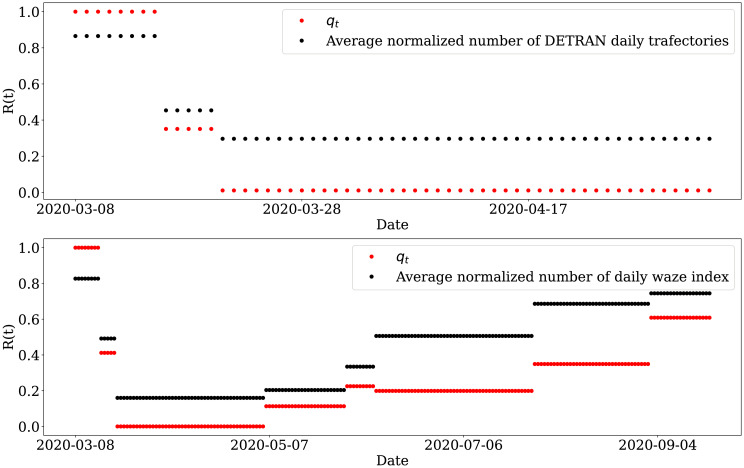
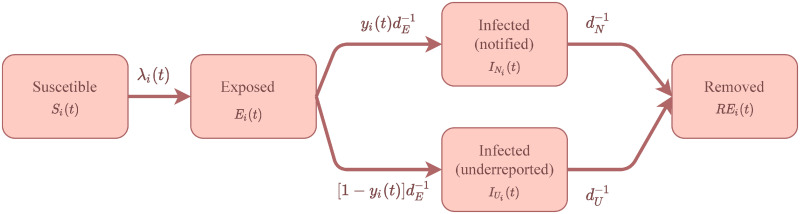
This article proposes a study of the SARS-CoV-2 virus spread and the efficacy of public policies in Brazil. Using both aggregated (from large Internet companies) and fine-grained (from Departments of Motor Vehicles) mobility data sources, our work sheds light on the effect of mobility on the pandemic situation in the Brazilian territory. Our main contribution is to show how mobility data, particularly fine-grained ones, can offer valuable insights into virus propagation. For this, we propose a modification in the SENUR model to add mobility information, evaluating different data availability scenarios (different information granularities), and finally, we carry out simulations to evaluate possible public policies. In particular, we conduct a case study that shows, through simulations of hypothetical scenarios, that the contagion curve in several Brazilian cities could have been milder if the government had imposed mobility restrictions soon after reporting the first case. Our results also show that if the government had not taken any action and the only safety measure taken was the population's voluntary isolation (out of fear), the time until the contagion peak for the first wave would have been postponed, but its value would more than double.
本文研究了 SARS-CoV-2 病毒在巴西的传播情况和公共政策的效果。本研究使用聚合(来自大型互联网公司)和细粒度(来自车辆管理部门)移动性数据源,深入了解了流动性对巴西境内大流行情况的影响。我们的主要贡献在于展示移动性数据,特别是细粒度数据,如何为病毒传播提供有价值的见解。为此,我们提出了对 SENUR 模型的修改,以添加有关流动性的信息,评估不同数据可用性情况(不同的信息粒度),最后,我们进行了模拟以评估可能的公共政策。具体来说,我们进行了一项案例研究,通过模拟假设情况,表明如果政府在报告首例病例后不久就实施了流动性限制,巴西几个城市的感染曲线可能会更平缓。我们的研究结果还表明,如果政府没有采取任何行动,而唯一采取的安全措施是民众出于恐惧而自愿隔离,那么第一波感染高峰的时间将会推迟,但感染人数将增加一倍以上。