Sills E Scott, Wood Samuel H
Plasma Research Section, FertiGen CAG/Regenerative Biology Group, San Clemente, CA, USA.
Department of Obstetrics and Gynecology, Palomar Medical Center, Escondido, CA, USA.
Clin Exp Reprod Med. 2021 Dec;48(4):311-315. doi: 10.5653/cerm.2021.04651. Epub 2021 Nov 23.
As clinicians and patients await consensus on intraovarian platelet-rich plasma (PRP) treatment, this project evaluated contemporary research trends in the literature.
A PubMed/NLM search aggregated all ovarian PRP-related publications (n=54) to evaluate their scope, abstract utility, submission-to-publication interval, journal selected, article processing charge (APC), free reader access to full-text manuscripts, number and nationality of authors, and inclusion of international collaborators. The NIH Clinical Trials database was also audited.
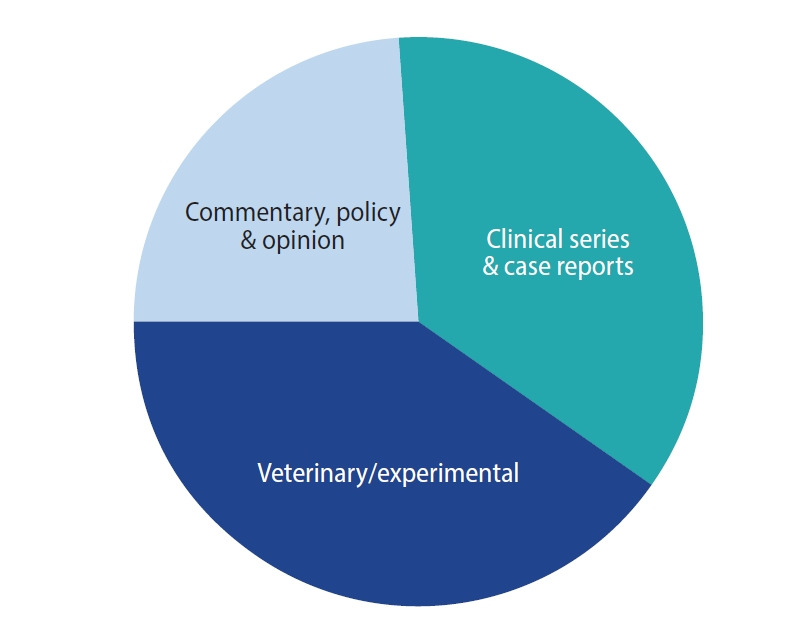
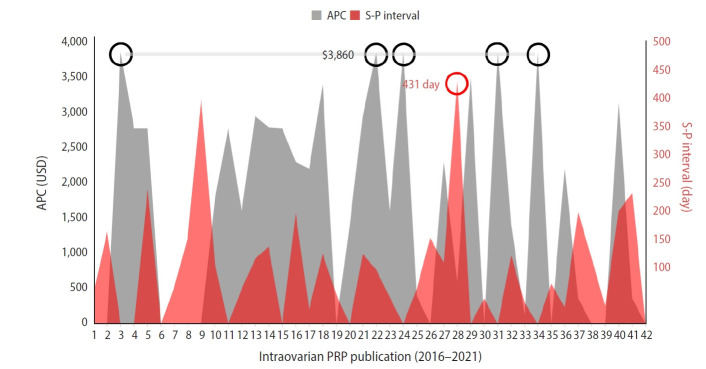
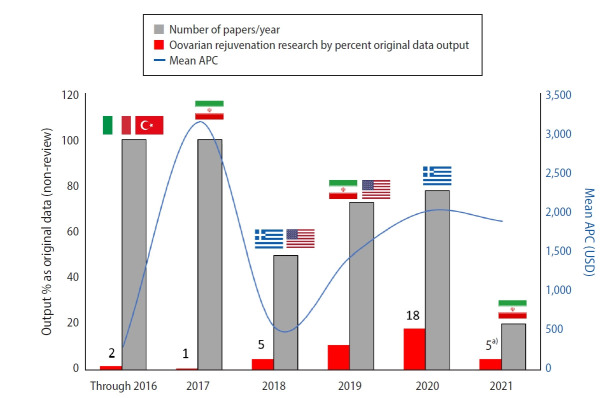
Published output on intraovarian PRP has increased consistently since 2016, especially among investigators in Greece, Iran, USA, and Turkey. Between 2013 and 2021, 42 articles met the relevancy criteria, of which 40.5% reported clinical studies, small series, or case reports, 33% described experimental animal models, and 23.8% were opinion/review papers. Only two works included a placebo control group. The submission-to-publication interval (mean±standard deviation) was 130±96 days, there were 5.9±3.2 authors per project, and journals invoiced US $1,613±1,466 (range, $0-$3,860) for APCs.
There was no correlation between APC and time to publish (Pearson's r=-0.01). Abstract content was inconsistent; sample size and patient age were often missing, yet free full-text "open access" was available for most publications (59.5%). The NIH Clinical Trials portal lists eight registered studies on "ovarian rejuvenation," of which two are actively recruiting patients, while four have been terminated or have an uncertain status. Two studies have concluded, with results from one posted to the NIH website. PRP and its derivatives for ovarian treatment show early promise, but require further investigation. Research is accelerating and should be encouraged, particularly placebo-controlled randomized clinical trials.
在临床医生和患者等待关于卵巢内富血小板血浆(PRP)治疗的共识之际,本项目评估了文献中的当代研究趋势。
通过PubMed/NLM搜索汇总了所有与卵巢PRP相关的出版物(n = 54),以评估其范围、摘要实用性、投稿到发表的间隔时间、所选期刊、文章处理费(APC)、读者免费获取全文手稿的情况、作者数量和国籍以及国际合作者的参与情况。还对美国国立医学图书馆临床试验数据库进行了审核。
自2016年以来,关于卵巢内PRP的发表成果持续增加,尤其是在希腊、伊朗、美国和土耳其的研究人员中。2013年至2021年期间,有42篇文章符合相关性标准,其中40.5%报告了临床研究、小样本系列或病例报告,33%描述了实验动物模型,23.8%是观点/综述论文。只有两项研究纳入了安慰剂对照组。投稿到发表的间隔时间(平均值±标准差)为130±96天,每个项目有5.9±3.2名作者,期刊收取的APC费用为1613±1466美元(范围为0至3860美元)。
APC与发表时间之间没有相关性(Pearson相关系数r = -0.01)。摘要内容不一致;样本量和患者年龄常常缺失,但大多数出版物(59.5%)可免费获取全文“开放获取”版本。美国国立医学图书馆临床试验门户网站列出了八项关于“卵巢年轻化”的注册研究,其中两项正在积极招募患者,四项已终止或状态不明。两项研究已经结束,其中一项的结果已发布到美国国立医学图书馆网站。PRP及其衍生物用于卵巢治疗显示出早期前景,但需要进一步研究。研究正在加速,应予以鼓励,特别是安慰剂对照的随机临床试验。