Department of Vascular Surgery, University Hospital Zurich, Raemistrasse 100, CH-8006, Zurich, Switzerland.
Swiss Air-Ambulance, Rega (Rettungsflugwacht/Guarde Aérienne), Swiss Air-Rescue, Zurich, Switzerland.
Scand J Trauma Resusc Emerg Med. 2021 Dec 7;29(1):168. doi: 10.1186/s13049-021-00981-4.
The goal of improving quality through centralisation of specialised medical services must be balanced against potential harm caused by delayed access to emergency treatments in rural areas. This study aims to assess the duration of transfers of critically ill patients with cardiovascular emergencies from smaller hospitals to major medical centres by a helicopter emergency medical service (HEMS) in Switzerland.
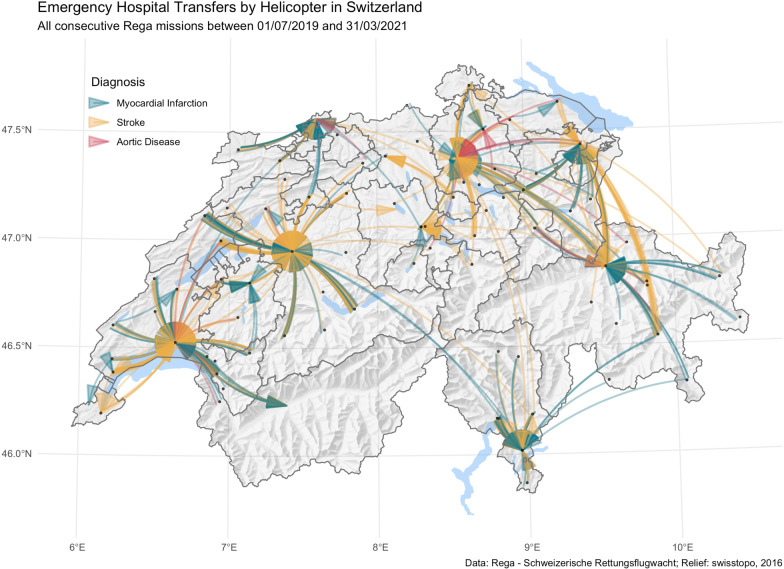
This retrospective observational cohort study includes all consecutive emergency interfacility transfers (IFTs) conducted by Switzerland's largest HEMS provider between July 3rd, 2019, and March 31st, 2021. All patients with acute myocardial infarction, non-traumatic strokes, ruptured aortic aneurysms, and other acute vascular emergencies were included. The duration and distance of each HEMS IFT were compared to calculated distances and duration of travel for the same missions using ground-based transportation (GEMS). The ground-based mission distance beyond which the total mission duration of HEMS is expected to be faster than GEMS was calculated.
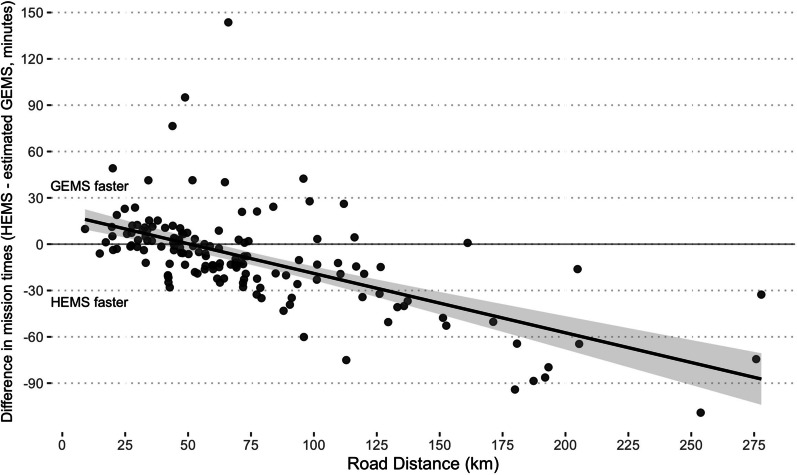
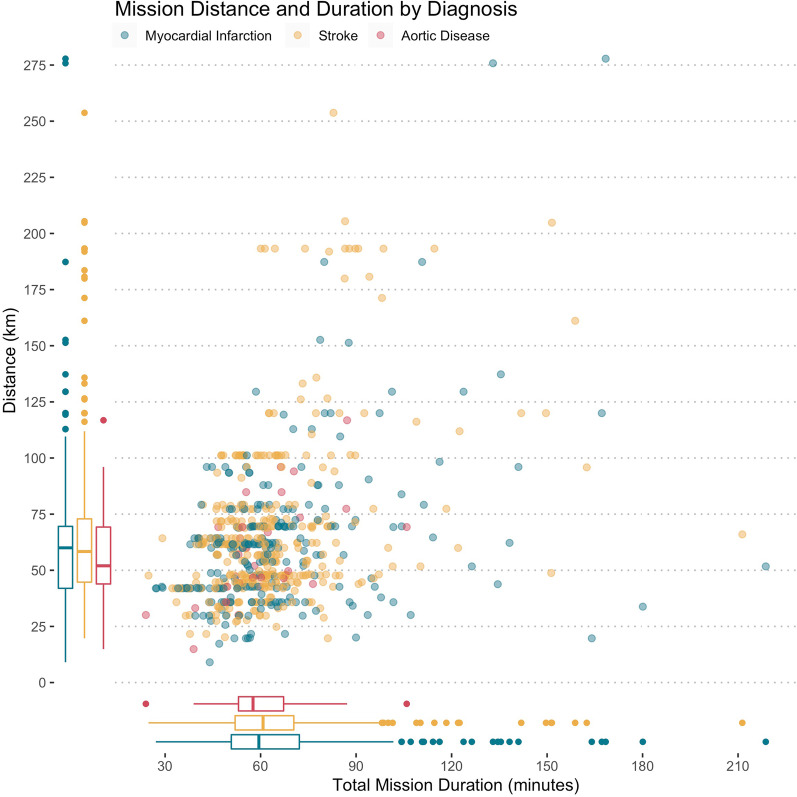
A total of 645 patients were transferred for stroke (n = 364), myocardial infarction (n = 252) and other acute vascular emergencies (n = 29). The median total mission duration from emergency call to landing at the destination was 59.9 (IQR 51.5 to 70.5) minutes. The median road distance for the same missions was 60 (IQR 43 to 72) km. Regression analysis revealed that HEMS is expected to be faster if the road distance is more than 51.3 km.
Centralisation of specialised medical services should be accompanied by a comprehensive and specialised rescue chain. HEMS in Switzerland ensures time-sensitive IFT in medical emergencies, even in topographically challenging terrain.
通过集中专业化医疗服务来提高质量的目标必须与农村地区紧急治疗延迟带来的潜在危害相平衡。本研究旨在评估瑞士直升机紧急医疗服务(HEMS)将心血管急症重症患者从较小的医院转至主要医疗中心的转移时间。
这是一项回顾性观察队列研究,纳入了 2019 年 7 月 3 日至 2021 年 3 月 31 日期间瑞士最大的 HEMS 提供商进行的所有连续紧急院内转移(IFT)。所有急性心肌梗死、非创伤性中风、破裂的主动脉瘤和其他急性血管急症患者均纳入研究。比较了每个 HEMS IFT 的持续时间和距离,以及使用地面运输(GEMS)进行相同任务的计算距离和持续时间。计算了 HEMS 总任务持续时间预计快于 GEMS 的地面任务距离。
共有 645 名患者因中风(n=364)、心肌梗死(n=252)和其他急性血管急症(n=29)被转院。从紧急呼叫到降落在目的地的总任务持续时间中位数为 59.9(IQR 51.5 至 70.5)分钟。相同任务的道路距离中位数为 60(IQR 43 至 72)公里。回归分析表明,如果道路距离超过 51.3 公里,HEMS 预计会更快。
专业化医疗服务的集中化应辅以全面和专业化的救援链。瑞士的 HEMS 确保了在医疗紧急情况下进行及时的 IFT,即使在地形复杂的情况下也是如此。