Department of Anesthesiology, University Hospital Greifswald, Sauerbruchstr, 17475, Greifswald, Germany.
Department of Anaesthesiology and Critical Care, EvKB, OWL University Medical Center, Campus Bielefeld Bethel, Burgsteig 13, 33617, Bielefeld, Germany.
Eur J Pediatr. 2023 Nov;182(11):5057-5065. doi: 10.1007/s00431-023-05178-8. Epub 2023 Sep 1.
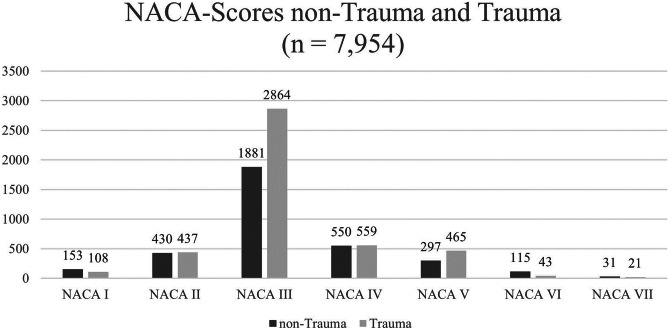
This study primarily aims to determine the frequency of life-threatening conditions among pediatric patients served by the DRF, a German helicopter emergency service (HEMS) provider. It also seeks to explore the necessity of invasive procedures in this population, discussing the implications for HEMS crew training and service configuration based on current literature. We analyzed the mission registry from 31 DRF helicopter bases in Germany, focusing on 7954 children aged 10 or younger over a 5-year period (2014-2018). Out of 7954 identified children (6.2% of all primary missions), 2081 (26.2%) had critical conditions. Endotracheal intubation was needed in 6.5% of cases, while alternative airway management methods were rare (n = 14). Half of the children required intravenous access, and 3.6% needed intraosseous access. Thoracostomy thoracentesis and sonography were only performed in isolated cases. Conclusions: Critically ill or injured children are infrequent in German HEMS operations. Our findings suggest that the likelihood of HEMS teams encountering such cases is remarkably low. Besides endotracheal intubation, life-saving invasive procedures are seldom necessary. Consequently, we conclude that on-the-job training and mission experience alone are insufficient for acquiring and maintaining the competencies needed to care for critically ill or injured children. What is Known: • Pediatric emergencies are relatively rare in the prehospital setting, but their incidence is higher in helicopter emergency medical services (HEMS) compared to ground-based emergency services. What is New: • On average, HEMS doctors in Germany encounter a critically ill or injured child approximately every 1.5 years in their practice, establish an IV or IO access in infants or toddlers every 2 years, and intubate an infant every 46 years. • This low frequency highlights the insufficiency of on-the-job training alone to develop and maintain pediatric skills among HEMS crews. Specific interdisciplinary training for HEMS crews is needed to ensure effective care for critically unwell pediatric patients.
本研究主要旨在确定德国直升机紧急医疗服务(HEMS)提供商 DRF 服务的儿科患者中危及生命情况的频率。它还试图根据现有文献探讨在该人群中进行有创程序的必要性,讨论对 HEMS 机组人员培训和服务配置的影响。我们分析了德国 31 个 DRF 直升机基地的任务登记册,重点关注了 5 年内(2014-2018 年)的 7954 名 10 岁或以下的儿童。在确定的 7954 名儿童中(所有主要任务的 6.2%),2081 名(26.2%)存在危急情况。在这些情况下,6.5%需要进行气管插管,而替代气道管理方法很少见(n=14)。一半的儿童需要静脉通路,3.6%需要骨髓通路。仅在个别情况下进行胸腔穿刺和超声检查。结论:德国 HEMS 操作中危重症或受伤的儿童很少见。我们的发现表明,HEMS 团队遇到此类病例的可能性极低。除了气管插管外,很少需要救生性有创程序。因此,我们得出结论,仅凭在职培训和任务经验不足以获得和维持照顾危重症或受伤儿童所需的能力。已知:• 在院前环境中,儿科急症相对少见,但在直升机紧急医疗服务(HEMS)中比地面紧急服务更为常见。新内容:• 平均而言,德国的 HEMS 医生在其执业中每 1.5 年左右会遇到一名危重症或受伤的儿童,每 2 年为婴儿或幼儿建立 IV 或 IO 通路,每 46 年为婴儿进行气管插管。• 这种低频率突显了仅通过在职培训来发展和维持 HEMS 机组人员儿科技能的不足。需要对 HEMS 机组人员进行特定的跨学科培训,以确保为病情严重的儿科患者提供有效护理。