Department of Medicine, University of Florida, Gainesville, Florida, USA.
Precision and Intelligent Systems in Medicine (PrismaP), University of Florida, Gainesville, Florida, USA.
BMJ Health Care Inform. 2021 Dec;28(1). doi: 10.1136/bmjhci-2021-100458.
Acute kidney injury (AKI) affects up to one-quarter of hospitalised patients and 60% of patients in the intensive care unit (ICU). We aim to understand the baseline characteristics of patients who will develop distinct AKI trajectories, determine the impact of persistent AKI and renal non-recovery on clinical outcomes, resource use, and assess the relative importance of AKI severity, duration and recovery on survival.
In this retrospective, longitudinal cohort study, 156 699 patients admitted to a quaternary care hospital between January 2012 and August 2019 were staged and classified (no AKI, rapidly reversed AKI, persistent AKI with and without renal recovery). Clinical outcomes, resource use and short-term and long-term survival adjusting for AKI severity were compared among AKI trajectories in all cohort and subcohorts with and without ICU admission.
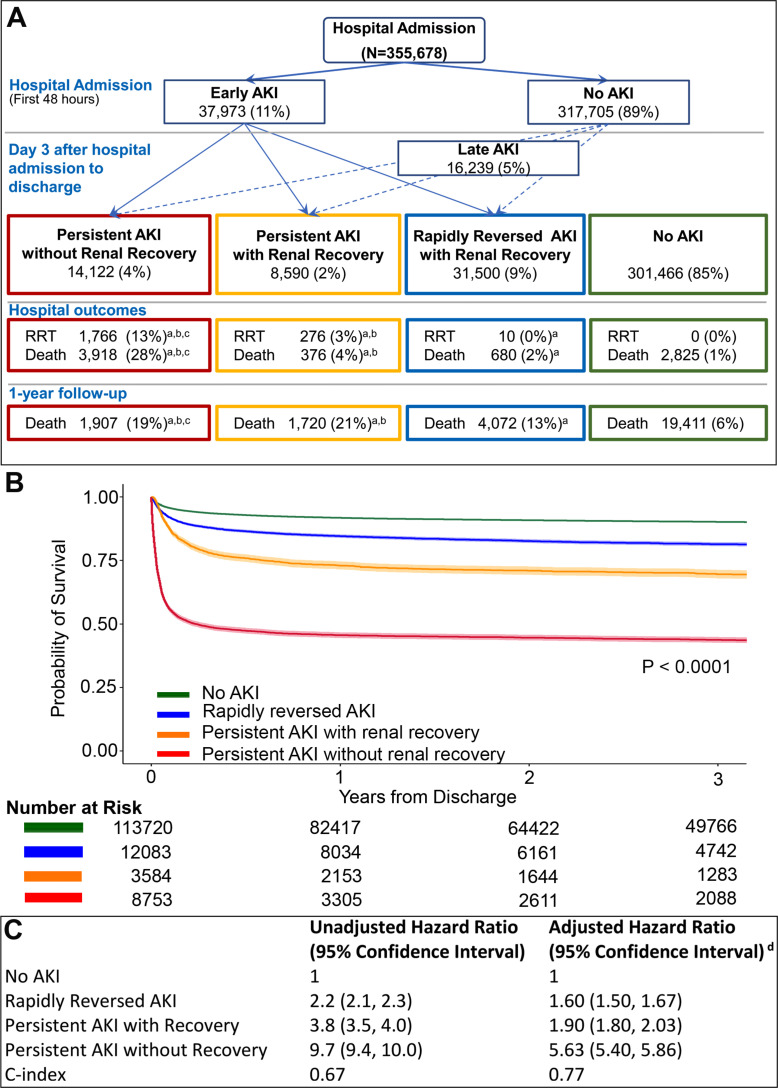
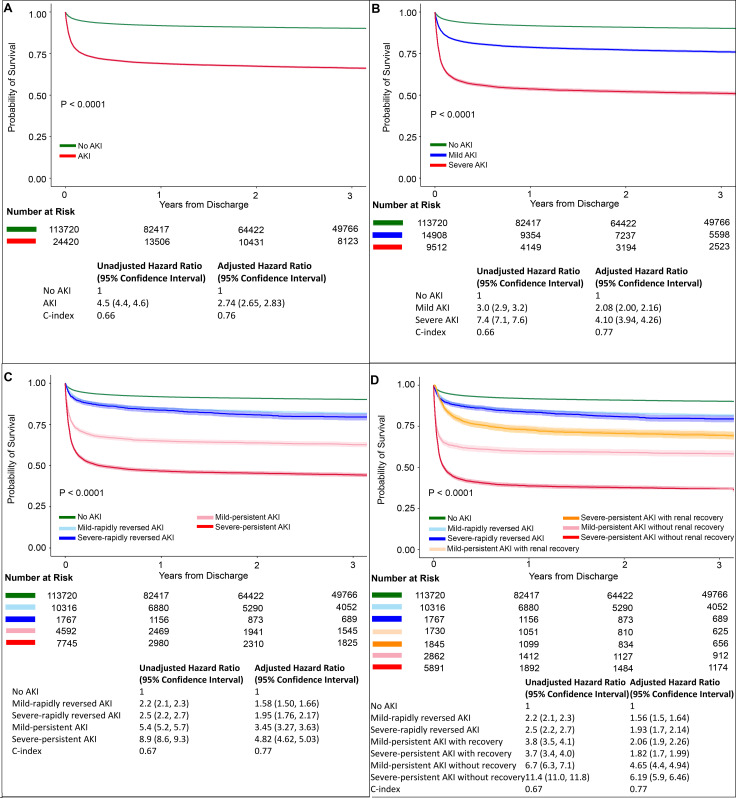
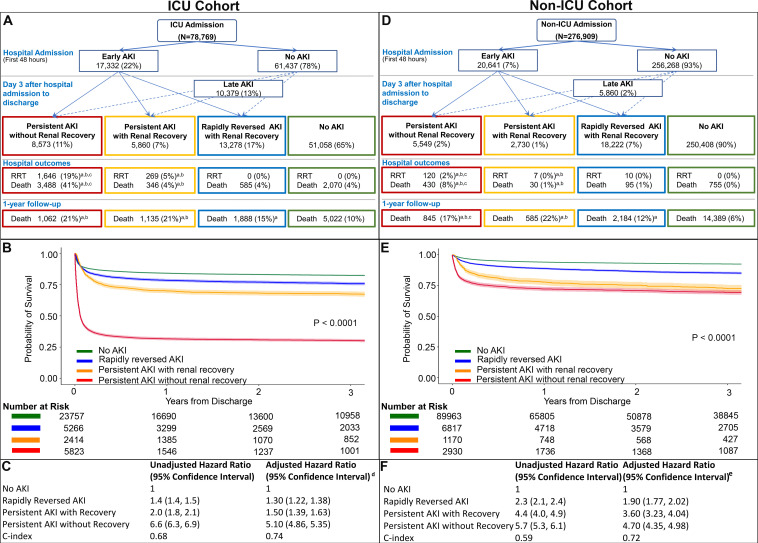
Fifty-eight per cent (31 500/54 212) had AKI that rapidly reversed within 48 hours; among patients with persistent AKI, two-thirds (14 122/22 712) did not have renal recovery by discharge. One-year mortality was significantly higher among patients with persistent AKI (35%, 7856/22 712) than patients with rapidly reversed AKI (15%, 4714/31 500) and no AKI (7%, 22 117/301 466). Persistent AKI without renal recovery was associated with approximately fivefold increased hazard rates compared with no AKI in all cohort and ICU and non-ICU subcohorts, independent of AKI severity.
Among hospitalised, ICU and non-ICU patients, persistent AKI and the absence of renal recovery are associated with reduced long-term survival, independent of AKI severity.
It is essential to identify patients at risk of developing persistent AKI and no renal recovery to guide treatment-related decisions.
急性肾损伤(AKI)影响多达四分之一的住院患者和 60%的重症监护病房(ICU)患者。我们旨在了解将出现不同 AKI 轨迹的患者的基线特征,确定持续性 AKI 和肾恢复不良对临床结局、资源利用的影响,并评估 AKI 严重程度、持续时间和恢复对生存的相对重要性。
在这项回顾性、纵向队列研究中,对 2012 年 1 月至 2019 年 8 月期间在一家四级保健医院住院的 156699 名患者进行分期和分类(无 AKI、AKI 迅速逆转、持续性 AKI 伴或不伴肾恢复)。在所有队列和伴有或不伴有 ICU 入院的亚队列中,根据 AKI 严重程度比较 AKI 轨迹之间的临床结局、资源利用以及短期和长期生存情况。
58%(31500/54212)的患者发生 AKI,在 48 小时内迅速逆转;在持续性 AKI 患者中,三分之二(14122/22712)在出院时未恢复肾功能。持续性 AKI 患者的 1 年死亡率(35%,7856/22712)显著高于 AKI 迅速逆转的患者(15%,4714/31500)和无 AKI 的患者(7%,22117/301466)。在所有队列和 ICU 和非 ICU 亚队列中,与无 AKI 相比,持续性 AKI 且无肾恢复与危险率增加约 5 倍相关,独立于 AKI 严重程度。
在住院、ICU 和非 ICU 患者中,持续性 AKI 和肾恢复不良与长期生存降低相关,独立于 AKI 严重程度。
识别有发展为持续性 AKI 和无肾恢复风险的患者对于指导治疗相关决策至关重要。