Department of Biomedical Engineering, New Jersey Institute of Technology, Newark, NJ, USA.
Department of Biomedical Engineering, Rutgers New Jersey Medical School, Newark, NJ, USA.
Sci Rep. 2021 Dec 7;11(1):23540. doi: 10.1038/s41598-021-00328-0.
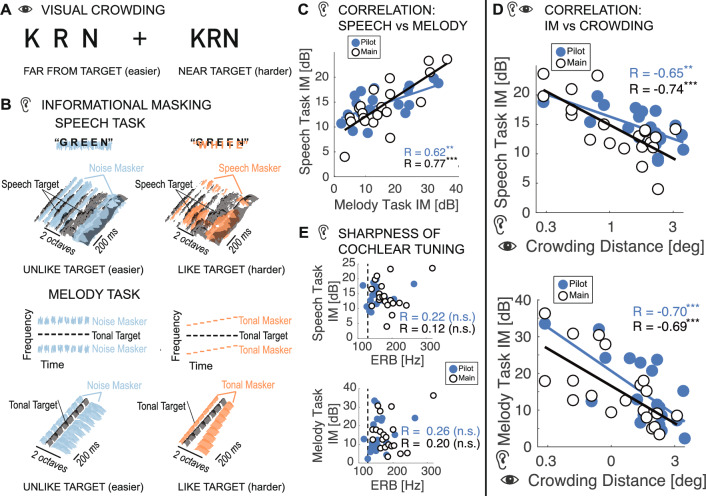
Sensory cortical mechanisms combine auditory or visual features into perceived objects. This is difficult in noisy or cluttered environments. Knowing that individuals vary greatly in their susceptibility to clutter, we wondered whether there might be a relation between an individual's auditory and visual susceptibilities to clutter. In auditory masking, background sound makes spoken words unrecognizable. When masking arises due to interference at central auditory processing stages, beyond the cochlea, it is called informational masking. A strikingly similar phenomenon in vision, called visual crowding, occurs when nearby clutter makes a target object unrecognizable, despite being resolved at the retina. We here compare susceptibilities to auditory informational masking and visual crowding in the same participants. Surprisingly, across participants, we find a negative correlation (R = -0.7) between susceptibility to informational masking and crowding: Participants who have low susceptibility to auditory clutter tend to have high susceptibility to visual clutter, and vice versa. This reveals a tradeoff in the brain between auditory and visual processing.
感觉皮层机制将听觉或视觉特征组合成感知对象。在嘈杂或混乱的环境中,这是很困难的。鉴于个体对混乱的敏感性差异很大,我们想知道个体对听觉和视觉混乱的敏感性之间是否存在关系。在听觉掩蔽中,背景声音会使口语单词无法识别。当掩蔽由于耳蜗以外的中枢听觉处理阶段的干扰而产生时,称为信息掩蔽。在视觉中,一种非常相似的现象称为视觉拥挤,当附近的杂乱物使目标物体无法识别时,尽管在视网膜上已经解析,但仍会发生这种现象。我们在这里比较了同一参与者对听觉信息掩蔽和视觉拥挤的敏感性。令人惊讶的是,在参与者之间,我们发现信息掩蔽和拥挤的敏感性之间存在负相关(R = -0.7):对听觉混乱的敏感性低的参与者往往对视觉混乱的敏感性高,反之亦然。这揭示了大脑在听觉和视觉处理之间的权衡。