Bai Huiran, Li Honglei, Zheng Simeng, Sun Lihong, Wu Xiaoming
Qingdao Eye Hospital of Shandong First Medical University, Qingdao, People's Republic of China.
State Key Laboratory Cultivation Base, Shandong Provincial Key Laboratory of Ophthalmology, Shandong Eye Institute, Shandong First Medical University & Shandong Academy of Medical Sciences, Qingdao, People's Republic of China.
Int J Gen Med. 2021 Nov 30;14:8975-8980. doi: 10.2147/IJGM.S342039. eCollection 2021.
To investigate the incidence of Nd:YAG capsulotomy after implantation of two types of multifocal intraocular lenses (MIOLs).
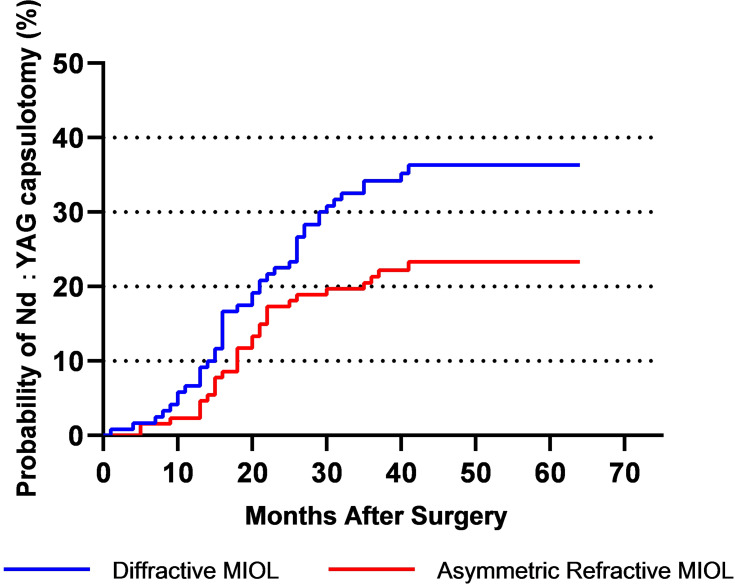
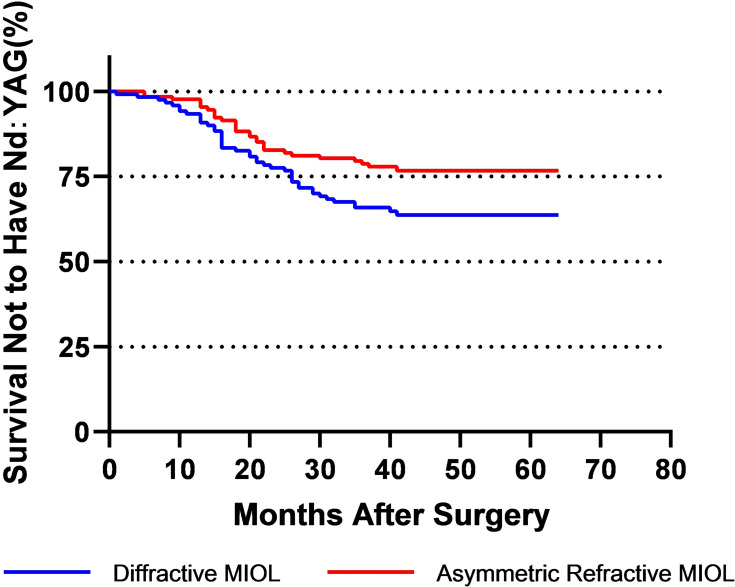
This retrospective analysis included patients who had undergone cataract extraction and implanted diffractive MIOL (Acri. LISA tri 839M) or asymmetric refractive MIOL (SBL-3) from May 2016 to September 2018. They were followed up for at least 3 years. During the follow-up period, the relevant data of patients were kept by special person in the hospital. The rates of Nd:YAG capsulotomy and the Kaplan-Meier survival curve were used to analyze the two groups.
The Asymmetric Refractive MIOL group was comprised of 98 patients (121 eyes), while the Diffractive MIOL group was comprised of 99 patients (120 eyes). There were no significant differences in age, sex, or IOL power between the two groups. The Nd:YAG rate of the asymmetric refractive MIOL group and the diffractive MIOL group was 3.3% and 7.5% respectively (P = 0.15) in the first year, 14.88% and 22.5% respectively (P = 0.129) in the second year, and 21.49% and 34.17% respectively (P = 0.028) in the third year. In the first 7 months of follow-up, the two groups showed the same performance in the Nd:YAG rate. After that, there was a difference between the two groups, and the difference gradually increased. Until the 27th month of follow-up, the difference was significant (P < 0.05). What is more, there were significant differences in survival (without Nd:YAG capsulotomy)/failure (with Nd:YAG capsulotomy) functions (P = 0.0035).
The incidence of Nd:YAG laser capsulotomy in patients with diffractive MIOLs was higher than that in patients with asymmetric refractive MIOLs.
研究两种类型的多焦点人工晶状体(MIOL)植入术后钕钇铝石榴石(Nd:YAG)囊切开术的发生率。
这项回顾性分析纳入了2016年5月至2018年9月期间接受白内障摘除并植入衍射型MIOL(Acri.LISA tri 839M)或非对称折射型MIOL(SBL-3)的患者。对他们进行了至少3年的随访。随访期间,患者的相关数据由医院专人保存。采用Nd:YAG囊切开术发生率和Kaplan-Meier生存曲线对两组进行分析。
非对称折射型MIOL组有98例患者(121只眼),衍射型MIOL组有99例患者(120只眼)。两组在年龄、性别或人工晶状体屈光度方面无显著差异。非对称折射型MIOL组和衍射型MIOL组的Nd:YAG发生率在第一年分别为3.3%和7.5%(P = 0.15),第二年分别为14.88%和22.5%(P = 0.129),第三年分别为21.49%和34.17%(P = 0.028)。在随访的前7个月,两组在Nd:YAG发生率方面表现相同。此后,两组之间出现差异,且差异逐渐增大。直到随访的第27个月,差异具有统计学意义(P < 0.05)。此外,在生存(无Nd:YAG囊切开术)/失败(有Nd:YAG囊切开术)功能方面存在显著差异(P = 0.0035)。
衍射型MIOL患者的Nd:YAG激光囊切开术发生率高于非对称折射型MIOL患者。