Al-Hindi Mohammed Y, Almahdi Bashaer H, Alasmari Dinah A, Alwagdani Raghad K, Hunjur Wujud M, Khalel Abdullah F, AlQurashi Mansour A
College of Medicine, King Saud Bin Abdulaziz University for Health Sciences, Jeddah, SAU.
Research Office, King Abdullah International Medical Research Center, Jeddah, SAU.
Cureus. 2021 Dec 1;13(12):e20092. doi: 10.7759/cureus.20092. eCollection 2021 Dec.
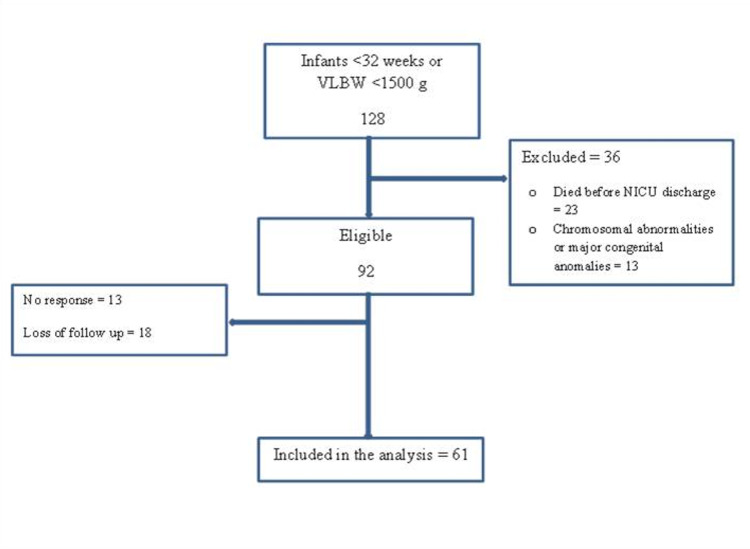
Background Preterm infants are more susceptible to death, short-term complications, and long-term complications such as neurodevelopmental impairments. However, definitive assessment tools are not available in a resource-limited setting. Hence a screening tool is needed the Arabic-speaking population. Method Infants born at a gestational age of <32 weeks or a very low birth weight (VLBW) of less than 1500 g were recruited into a cross-sectional study. We identified infants (n = 61) admitted to the neonatal ICU at King Abdulaziz Medical City and reached 18 up to 24 months of corrected gestational age (CGA). The developmental assessment was done at 18, 20, 22, and 24 CGAs using the Ages and Stages Questionnaire third edition - Arabic version (ASQ3-A). The primary outcomes are early detection rate of neurodevelopmental delay (NDD), defined as a delay in one or more of the following: communication, gross motor, fine motor, problem-solving, and personal-social skills as per ASQ3-A. Results Sixty-one out of 92 eligible infants (36 excluded) completed the sufficient assessment. Twenty-six infants (42.6%) had at least one NDD in one of the following domains: communication skills: (11.5%), gross motor: (11.5%), fine motor: (19.7%), problem-solving skills: twelve infants (19.7%), and personal-social skills: twenty infants (23%). Perinatal events and periventricular leukomalacia (PVL) were significant independent predictors for the NDD. Conclusion This single-center study in Saudi Arabia screened preterm, VLBW infants based on ASQ3-A, twenty infants (42.6%) had an abnormal NDD at a corrected age of 18-24 months. Perinatal events and PVL were independent predictors of NDD. We recommend that all preterm VLBW infants in Saudi Arabia be evaluated by a neurodevelopmental screening tool, ASQ3-A, especially in resource-limited settings to start early intervention. Also, more extensive multicenter studies are to be carried out with definitive diagnostic tools to have a national benchmark for the long-term neurodevelopmental impairment.
早产儿更容易出现死亡、短期并发症以及诸如神经发育障碍等长期并发症。然而,在资源有限的环境中,尚无确定性的评估工具。因此,需要一种针对讲阿拉伯语人群的筛查工具。方法:将孕周小于32周或出生体重极低(VLBW)低于1500克的婴儿纳入一项横断面研究。我们确定了在阿卜杜勒阿齐兹国王医疗城新生儿重症监护病房住院的婴儿(n = 61),并随访至矫正胎龄(CGA)18至24个月。在矫正胎龄18、20、22和24个月时,使用《年龄与发育进程问卷》第三版 - 阿拉伯语版(ASQ3 - A)进行发育评估。主要结局是神经发育延迟(NDD)的早期检出率,根据ASQ3 - A,NDD定义为以下一项或多项发育延迟:沟通、大运动、精细运动、解决问题和个人社交技能。结果:92名符合条件的婴儿中有61名(36名被排除)完成了充分评估。26名婴儿(42.6%)在以下至少一个领域存在至少一项NDD:沟通技能:(11.5%),大运动:(11.5%),精细运动:(19.7%),解决问题技能:12名婴儿(19.7%),个人社交技能:20名婴儿(23%)。围产期事件和脑室周围白质软化(PVL)是NDD的显著独立预测因素。结论:在沙特阿拉伯进行的这项单中心研究基于ASQ3 - A对早产、VLBW婴儿进行筛查,20名婴儿(42.6%)在矫正年龄18 - 24个月时存在异常NDD。围产期事件和PVL是NDD的独立预测因素。我们建议沙特阿拉伯所有早产VLBW婴儿都应使用神经发育筛查工具ASQ3 - A进行评估,尤其是在资源有限的环境中,以便尽早开始干预。此外,还应使用确定性诊断工具开展更广泛的多中心研究,以建立全国长期神经发育障碍的基准。