Jeldu Meseret, Asres Tadios, Arusi Temesgen, Gutulo Muluken Gunta
Wolkite University, Ethiopia.
Saint Paul's Millennium Medical College, Ethiopia.
Int J Reprod Med. 2021 Nov 28;2021:6680112. doi: 10.1155/2021/6680112. eCollection 2021.
Uterine myoma occurs in 20-50% of reproductive age women. Uterine myomas may be associated with 5-10% of cases of infertility, but it is the sole cause or factor in only 2-3% of all infertility cases. Myomectomy is surgery done to remove myoma regardless of the methods.
To assess impact of myomectomy on pregnancy rate and associated factors among reproductive age women who had myomectomy at St. Paul's Hospital Millennium Medical College, in Addis Ababa. . Hospital-based retrospective cross-sectional study was conducted to determine pregnancy rate after myomectomy and its associated factors. Patients who had myomectomy in SPHMMC from September 2012 to September 2017 were enrolled. Information was retrieved from hospital records and phone interviews with the patients. The strength of statistical association was measured by adjusted odds ratios and 95% confidence intervals. Statistical significance was declared at value < 0.05.
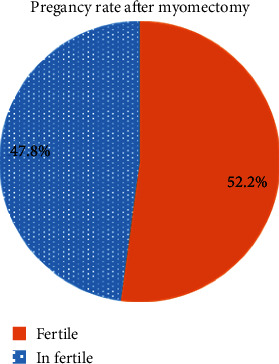
Among 180 females participated in this study, 52.2% got pregnant after myomectomy. The result showed that females with age > 35 years were 0.31 times less likely to get pregnant after surgery than those ages 20-25 years [AOR = 0.31 (95% CI: 0.29-0.54)]. People with no infertility before surgery were 1.19 times more likely to be pregnant after surgery than those with unexplained infertility before the surgery [AOR = 1.19 (95% CI: 1.06-1.57)]. People with two uterine incisions were 0.06 times less likely [AOR = 0.06 (95% CI: 0.043-0.51)] while those with three or more than three incisions were 0.02 times less likely [AOR = 0.02 (95% CI: 0.002-0.22)] to get pregnant compared with those with one incision on uterine wall.
Age, number of incision, and infertility before surgery were significantly associated with rate of pregnancy after myomectomy.
子宫肌瘤在20%至50%的育龄女性中出现。子宫肌瘤可能与5%至10%的不孕病例相关,但在所有不孕病例中,它仅是2%至3%病例的唯一病因或因素。子宫肌瘤切除术是指无论采用何种方法切除肌瘤的手术。
评估在亚的斯亚贝巴圣保罗医院千禧医学院接受子宫肌瘤切除术的育龄女性中,子宫肌瘤切除术对妊娠率的影响及相关因素。开展了一项基于医院的回顾性横断面研究,以确定子宫肌瘤切除术后的妊娠率及其相关因素。纳入了2012年9月至2017年9月在圣保罗医院千禧医学院接受子宫肌瘤切除术的患者。信息从医院记录以及对患者的电话访谈中获取。统计关联强度通过调整后的比值比和95%置信区间来衡量。当P值<0.05时,宣布具有统计学显著性。
在参与本研究的180名女性中,52.2%在子宫肌瘤切除术后怀孕。结果显示,年龄>35岁的女性术后怀孕的可能性是20至25岁女性的0.31倍[AOR = 0.31(95%CI: 0.29 - 0.54)]。术前无不孕的人术后怀孕的可能性是术前有不明原因不孕的人的1.19倍[AOR = 1.19(95%CI: 1.06 - 1.57)]。子宫有两个切口的人怀孕的可能性是子宫壁有一个切口的人的0.06倍[AOR = 0.06(95%CI: 0.043 - 0.51)],而有三个或三个以上切口的人怀孕的可能性是子宫壁有一个切口的人的0.02倍[AOR = 0.02(95%CI: 0.002 - 0.22)]。
年龄、切口数量和术前不孕与子宫肌瘤切除术后的妊娠率显著相关。