Chair of Medical Biotechnology, Faculty of Chemistry, Warsaw University of Technology, Noakowskiego 3, Warsaw 00-664, Poland.
Faculty of Chemistry, University of Warsaw, Pasteura 1, Warsaw 02-093, Poland.
Inorg Chem. 2021 Dec 20;60(24):19448-19456. doi: 10.1021/acs.inorgchem.1c03285. Epub 2021 Dec 8.
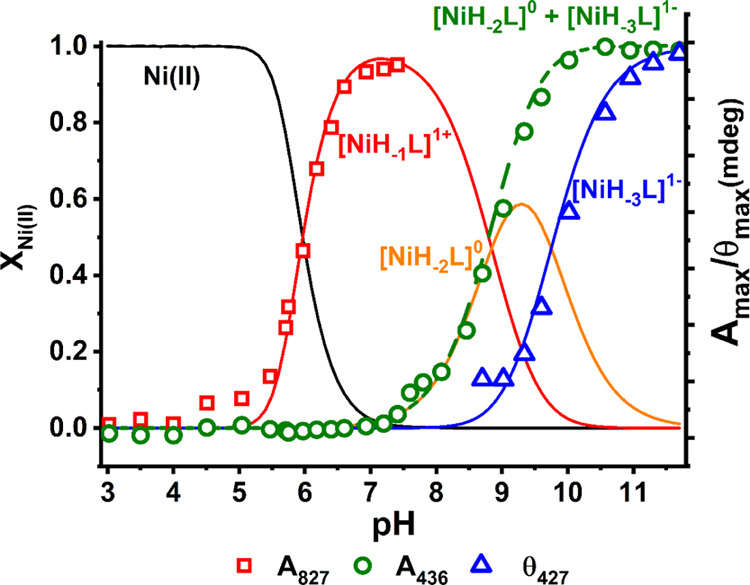
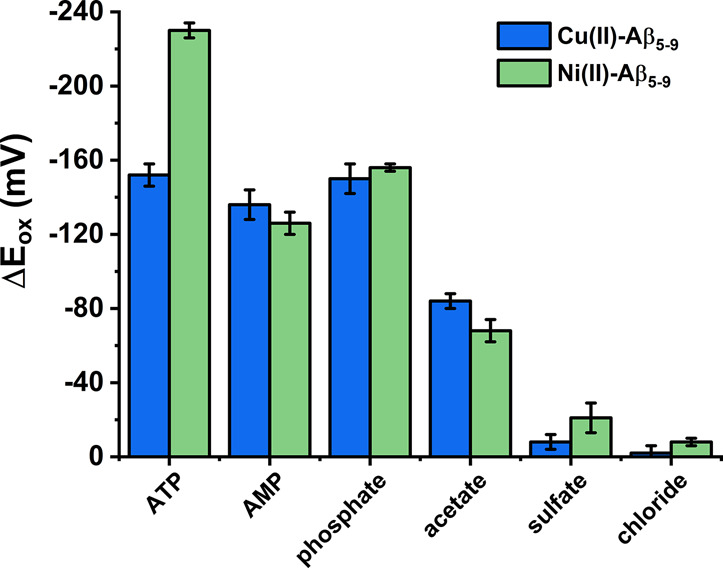
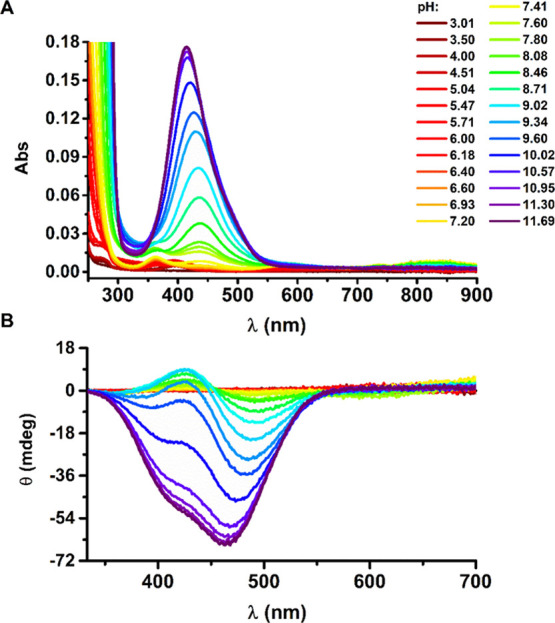
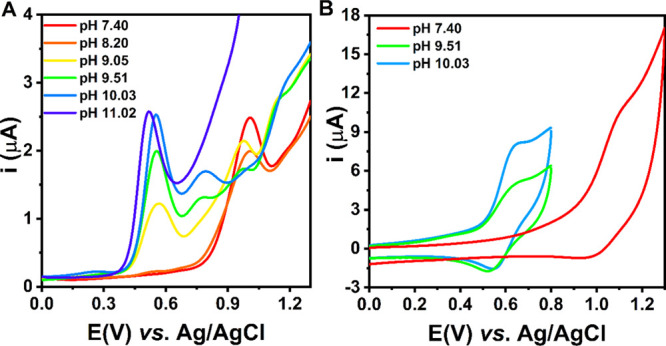
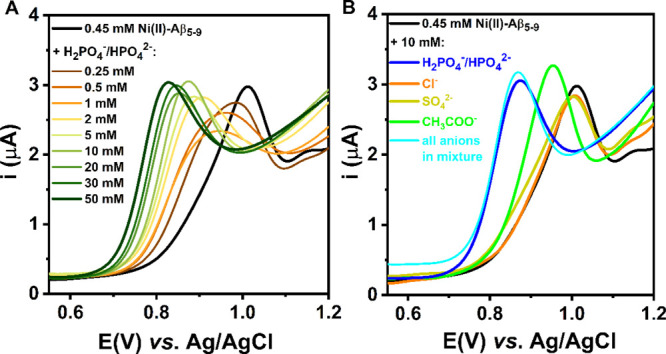
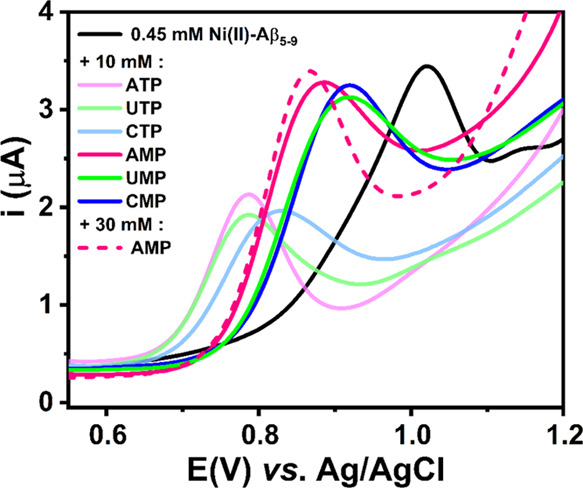
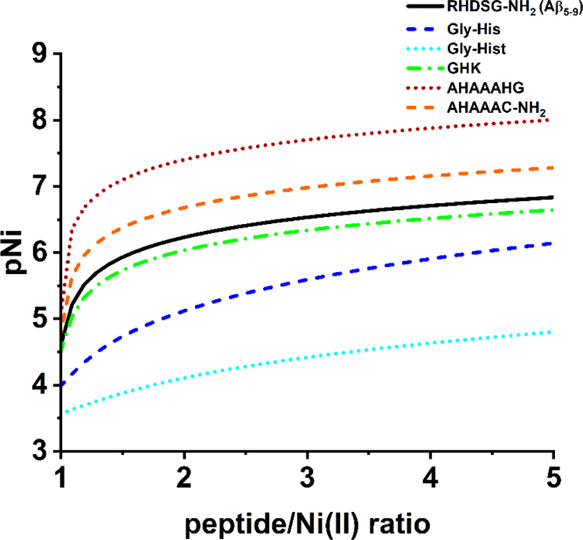
Amyloid-beta (Aβ) peptides, potentially relevant in the pathology of Alzheimer's disease, possess distinctive coordination properties, enabling an effective binding of transition-metal ions, with a preference for Cu(II). In this work, we found that a N-truncated Aβ analogue bearing a His-2 motif, Aβ, forms a stable Ni(II) high-spin octahedral complex at a physiological pH of 7.4 with labile coordination sites and facilitates ternary interactions with phosphates and nucleotides. As the pH increased above 9, a spin transition from a high-spin to a low-spin square-planar Ni(II) complex was observed. Employing electrochemical techniques, we showed that interactions between the binary Ni(II)-Aβ complex and phosphate species result in significant changes in the Ni(II) oxidation signal. Thus, the Ni(II)-Aβ complex could potentially serve as a receptor in electrochemical biosensors for phosphate species. The obtained results could also be important for nickel toxicology.
淀粉样蛋白-β(Aβ)肽在阿尔茨海默病的病理学中可能具有重要作用,其具有独特的配位性质,能够有效地与过渡金属离子结合,尤其是 Cu(II)。在这项工作中,我们发现一种带有 His-2 基序的 N 截断 Aβ类似物 Aβ,在生理 pH 值为 7.4 时形成稳定的 Ni(II)高自旋八面体配合物,具有不稳定的配位位点,并促进与磷酸盐和核苷酸的三元相互作用。当 pH 值升高到 9 以上时,观察到从高自旋到低自旋正方形平面 Ni(II)配合物的自旋转变。我们利用电化学技术表明,二元 Ni(II)-Aβ配合物与磷酸盐之间的相互作用导致 Ni(II)氧化信号发生显著变化。因此,Ni(II)-Aβ配合物可能在用于磷酸盐的电化学生物传感器中作为受体。所得结果对于镍毒理学也可能很重要。