Merck & Co., Inc., Kenilworth, NJ, USA.
School of Mathematical and Statistical Sciences, Arizona State University, Tempe, AZ, 85287, USA.
J Math Biol. 2021 Dec 8;83(6-7):73. doi: 10.1007/s00285-021-01686-z.
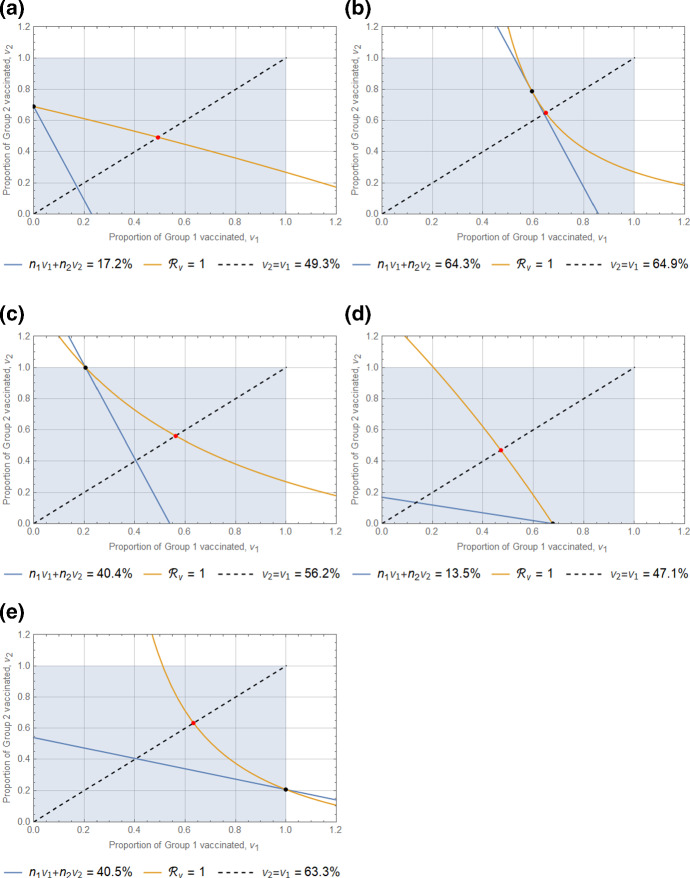
It has been suggested, without rigorous mathematical analysis, that the classical vaccine-induced herd immunity threshold (HIT) assuming a homogeneous population can be substantially higher than the minimum HIT obtained when considering population heterogeneities. We investigated this claim by developing, and rigorously analyzing, a vaccination model that incorporates various forms of heterogeneity and compared it with a model that considers a homogeneous population. By employing a two-group vaccination model in heterogeneous populations, we theoretically established conditions under which heterogeneity leads to different HIT values, depending on the relative values of the contact rates for each group, the type of mixing between the groups, the relative vaccine efficacy, and the relative population size of each group. For example, under biased random mixing assumption and when vaccinating a given group results in disproportionate prevention of higher transmission per capita, we show that it is optimal to vaccinate that group before vaccinating the other groups. We also found situations, under biased assortative mixing assumption, where it is optimal to vaccinate more than one group. We show that regardless of the form of mixing between the groups, the HIT values assuming a heterogeneous population are always lower than the HIT values obtained from a corresponding model with a homogeneous population. Using realistic numerical examples and parametrization (e.g., assuming assortative mixing together with vaccine efficacy of 95% and the value of the basic reproduction number, [Formula: see text], of the model set at [Formula: see text] 2.5), we demonstrate that the HIT value generated from a model that considers population heterogeneity (e.g., biased assortative mixing) is significantly lower (40%) compared with a HIT value of 63% obtained if the model uses homogeneous population.
有人提出,虽然没有经过严格的数学分析,但在假设人群同质的情况下,经典的疫苗诱导群体免疫阈值(HIT)可能远高于考虑人群异质性时获得的最小 HIT。我们通过开发并严格分析一个包含各种形式异质性的疫苗接种模型来研究这一说法,并将其与考虑同质人群的模型进行了比较。通过在异质人群中采用两组疫苗接种模型,我们从理论上建立了条件,根据每组接触率的相对值、组间混合的类型、相对疫苗效力以及每组的相对人口规模,异质性会导致不同的 HIT 值。例如,在存在偏向随机混合的假设下,当接种某一组疫苗会导致人均传播率不成比例地降低时,我们证明先给该组接种疫苗,然后再给其他组接种疫苗是最优的。我们还发现了在存在偏向聚集混合的假设下,接种多个组是最优的情况。我们发现,无论组间混合的形式如何,假设异质人群的 HIT 值总是低于对应同质人群模型的 HIT 值。我们使用现实的数值示例和参数化(例如,假设聚集混合以及 95%的疫苗效力和模型的基本繁殖数[Formula: see text]的值设置为[Formula: see text]2.5),证明了考虑人群异质性(例如,偏向聚集混合)的模型产生的 HIT 值(例如,40%)与使用同质人群模型获得的 HIT 值(例如,63%)相比显著降低。