Perisic Ana, Bauch Chris T
Department of Mathematics and Statistics, University of Guelph, Guelph, Ontario, Canada.
PLoS Comput Biol. 2009 Feb;5(2):e1000280. doi: 10.1371/journal.pcbi.1000280. Epub 2009 Feb 6.
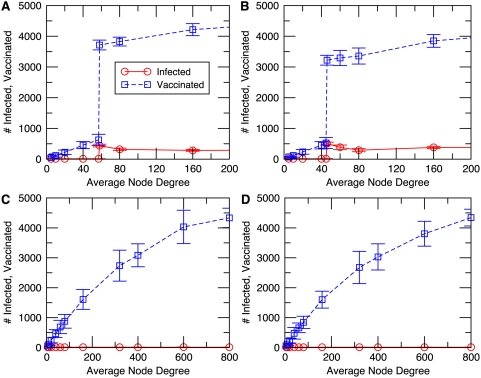
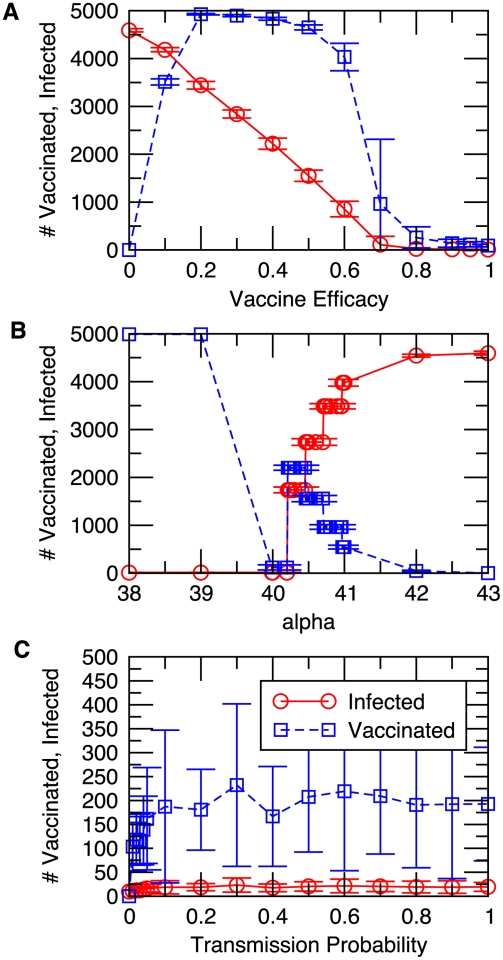
Certain theories suggest that it should be difficult or impossible to eradicate a vaccine-preventable disease under voluntary vaccination: Herd immunity implies that the individual incentive to vaccinate disappears at high coverage levels. Historically, there have been examples of declining coverage for vaccines, such as MMR vaccine and whole-cell pertussis vaccine, that are consistent with this theory. On the other hand, smallpox was globally eradicated by 1980 despite voluntary vaccination policies in many jurisdictions. Previous modeling studies of the interplay between disease dynamics and individual vaccinating behavior have assumed that infection is transmitted in a homogeneously mixing population. By comparison, here we simulate transmission of a vaccine-preventable SEIR infection through a random, static contact network. Individuals choose whether to vaccinate based on infection risks from neighbors, and based on vaccine risks. When neighborhood size is small, rational vaccinating behavior results in rapid containment of the infection through voluntary ring vaccination. As neighborhood size increases (while the average force of infection is held constant), a threshold is reached beyond which the infection can break through partially vaccinated rings, percolating through the whole population and resulting in considerable epidemic final sizes and a large number vaccinated. The former outcome represents convergence between individually and socially optimal outcomes, whereas the latter represents their divergence, as observed in most models of individual vaccinating behavior that assume homogeneous mixing. Similar effects are observed in an extended model using smallpox-specific natural history and transmissibility assumptions. This work illustrates the significant qualitative differences between behavior-infection dynamics in discrete contact-structured populations versus continuous unstructured populations. This work also shows how disease eradicability in populations where voluntary vaccination is the primary control mechanism may depend partly on whether the disease is transmissible only to a few close social contacts or to a larger subset of the population.
某些理论认为,在自愿接种疫苗的情况下,根除一种可通过疫苗预防的疾病应该是困难的或不可能的:群体免疫意味着在高接种率水平下,个人接种疫苗的动机就会消失。从历史上看,有一些疫苗接种率下降的例子,比如麻疹、腮腺炎和风疹(MMR)疫苗以及全细胞百日咳疫苗,这与该理论是一致的。另一方面,尽管许多司法管辖区实行自愿接种政策,但天花在1980年还是在全球范围内被根除了。以前关于疾病动态与个体接种行为之间相互作用的建模研究假设感染是在均匀混合的人群中传播的。相比之下,我们在此通过一个随机的静态接触网络模拟一种可通过疫苗预防的易感-暴露-感染-康复(SEIR)传染病的传播。个体根据来自邻居的感染风险以及疫苗风险来选择是否接种疫苗。当邻里规模较小时,理性的接种行为会通过自愿的环状接种迅速控制感染。随着邻里规模的增加(同时平均感染强度保持不变),会达到一个阈值,超过这个阈值,感染就会突破部分接种疫苗的环,在整个人口中蔓延,导致相当大的疫情最终规模以及大量的接种者。前一种结果代表个体最优结果与社会最优结果的趋同,而后者代表它们的分歧,正如在大多数假设均匀混合的个体接种行为模型中所观察到的那样。在一个使用天花特定自然史和传播性假设的扩展模型中也观察到了类似的效果。这项工作说明了离散接触结构人群与连续无结构人群中行为-感染动态之间存在显著的定性差异。这项工作还表明,在以自愿接种疫苗为主要控制机制的人群中,疾病的可根除性可能部分取决于该疾病是仅传播给少数密切的社会接触者还是传播给更大的人群子集。