Choi Jah Yeon, Kim Ji Bak, Lee Sunki, Lee Seo-Joon, Shin Seung Eon, Park Se Hyun, Park Eun Jin, Kim Woohyeun, Na Jin Oh, Choi Cheol Ung, Rha Seung-Woon, Park Chang Gyu, Seo Hong Seog, Ahn Jeonghoon, Jeong Hyun-Ghang, Kim Eung Ju
Cardiovascular Center, Korea University Guro Hospital, Korea University College of Medicine, Seoul, Republic of Korea.
Division of Cardiology, Department of Internal Medicine, Hallym University Dongtan Sacred Heart Hospital, Dongtan, Republic of Korea.
JMIR Med Inform. 2021 Dec 7;9(12):e23285. doi: 10.2196/23285.
Despite strong evidence of clinical benefit, cardiac rehabilitation (CR) programs are currently underutilized and smartphone-based CR strategies are thought to address this unmet need. However, data regarding the detailed process of development are scarce.
This study focused on the development of a smartphone-based, patient-specific, messaging app for patients who have undergone percutaneous coronary intervention (PCI).
The AnSim app was developed in collaboration with a multidisciplinary team that included cardiologists, psychiatrists, nurses, pharmacists, nutritionists, and rehabilitation doctors and therapists. First, a focus group interview was conducted, and the narratives of the patients were analyzed to identify their needs and preferences. Based on the results, health care experts and clinicians drafted messages into 5 categories: (1) general information regarding cardiovascular health and medications, (2) nutrition, (3) physical activity, (4) destressing, and (5) smoking cessation. In each category, 90 messages were developed according to 3 simplified steps of the transtheoretical model of behavioral change: (1) precontemplation, (2) contemplation and preparation, and (3) action and maintenance. After an internal review and feedback from potential users, a bank of 450 messages was developed.
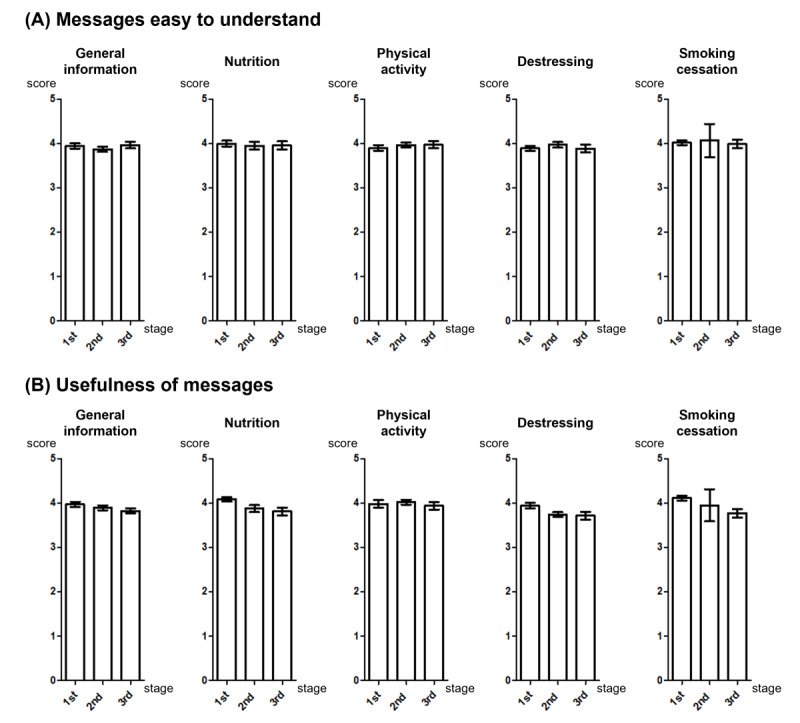
The focus interview was conducted with 8 patients with PCI within 1 year, and 450 messages, including various forms of multimedia, were developed based on the transtheoretical model of behavioral change in each category. Positive feedback was obtained from the potential users (n=458). The mean Likert scale score was 3.95 (SD 0.39) and 3.91 (SD 0.39) for readability and usefulness, respectively, and several messages were refined based on the feedback. Finally, the patient-specific message delivery system was developed according to the baseline characteristics and stages of behavioral change in each participant.
We developed an app (AnSim), which includes a bank of 450 patient-specific messages, that provides various medical information and CR programs regarding coronary heart disease. The detailed process of multidisciplinary collaboration over the course of the study provides a scientific basis for various medical professionals planning smartphone-based clinical research.
尽管有充分的临床益处证据,但心脏康复(CR)项目目前未得到充分利用,基于智能手机的CR策略被认为可以满足这一未满足的需求。然而,关于详细开发过程的数据却很稀少。
本研究聚焦于为接受经皮冠状动脉介入治疗(PCI)的患者开发一款基于智能手机的、针对患者个体的信息应用程序。
AnSim应用程序是与一个多学科团队合作开发的,该团队包括心脏病专家、精神科医生、护士、药剂师、营养师以及康复医生和治疗师。首先,进行了焦点小组访谈,并分析了患者的叙述以确定他们的需求和偏好。基于这些结果,医疗保健专家和临床医生将信息起草为5个类别:(1)心血管健康和药物的一般信息,(2)营养,(3)身体活动,(4)减压,(5)戒烟。在每个类别中,根据行为改变的跨理论模型的3个简化步骤开发了90条信息:(1)未考虑阶段,(2)考虑和准备阶段,(3)行动和维持阶段。经过内部审查以及潜在用户的反馈后,开发了一个包含450条信息的信息库。
对1年内接受PCI的8名患者进行了焦点访谈,并基于每个类别的行为改变跨理论模型开发了450条包括各种多媒体形式的信息。从潜在用户(n = 458)那里获得了积极反馈。可读性和有用性的平均李克特量表得分分别为3.95(标准差0.39)和3.91(标准差0.39),并根据反馈对几条信息进行了完善。最后,根据每个参与者的基线特征和行为改变阶段开发了针对患者个体的信息传递系统。
我们开发了一款应用程序(AnSim),其中包括一个包含450条针对患者个体的信息的信息库,该应用程序提供了有关冠心病的各种医疗信息和CR项目。研究过程中多学科合作的详细过程为各种医疗专业人员规划基于智能手机的临床研究提供了科学依据。